

Silibinin (Synonyms: Silibinin, Silibinin A, Silybin A) |
Catalog No.GN10292
 One-Click Copy Product Info
|

Silibinin is an orally active flavonoid with hepatoprotective and anticancer effects.
Products are for research use only. Not for human use. We do not sell to patients.
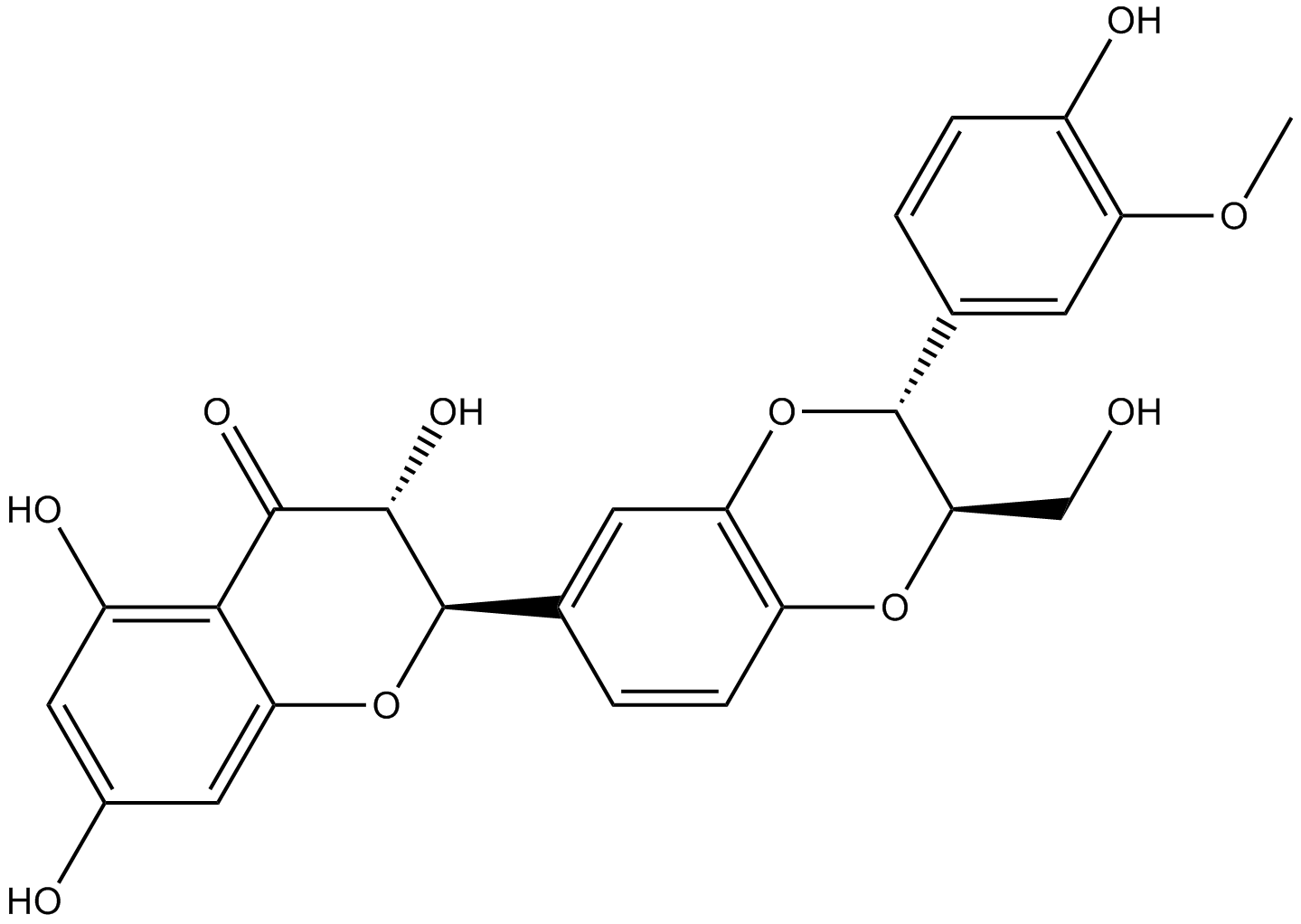
Cas No.: 22888-70-6
Sample solution is provided at 25 µL, 10mM.
_1-3.$$$39978408@51.jpg');)
_1-9.$$$38538795@65.jpg');)
_1-9.$$$39112701@51.jpg');)
_1-7.$$$37316672@70.jpg');)
_366-372.$$$36198801@70.jpg');)
.$$$38565142@65.jpg');)
_1867-1883.$$$33248023@67.jpg');)
_eads6055.$$$39977546@45.jpg');)
_eadm9805.$$$40080571@45.jpg');)
_eadj3020.$$$39666821@45.jpg');)
_1-20.$$$39757301@28.jpg');)
_1-24.$$$38898113@28.jpg');)
_273-287.$$$36806353@46.jpg');)
_1-16.$$$37156877@44.jpg');)
_1-19.$$$37460805@44.jpg');)
_1291-1307.$$$34518654@46.jpg');)
Silibinin is an orally active flavonoid with hepatoprotective and anticancer effects[1]. Silibinin can treat a variety of cancers by regulating cancer cell growth, proliferation, apoptosis, angiogenesis and many other mechanisms[2]. Silibinin can improve blood glucose homeostasis by improving the activity of pancreatic β cells, increasing insulin sensitivity in liver and muscle cells, and reducing lipid deposition in adipocytes[3].
In vitro, pretreatment of colorectal cancer SW480, LoVo and HT29 cells with Silibinin (50-200μM) for 2h significantly inhibited TNFα-induced NF-κB activation and decreased nuclear levels of p65 and p50 subunits, and significantly increased IκBα levels[4]. Silibinin (5-50μM) treatment of human breast cancer cell lines MCF7 and MDA-MB-231 cells for 24 and 48h reduced cell viability in both cell lines in a dose-dependent manner, induced apoptosis, and induced downregulation of extracellular signal-regulated kinase (ERK) and Akt expression[5]. Treatment of HT29 cells with Silibinin (0-100μM) for 24h caused cell shrinkage, blistering, and detachment from the culture dish, and induced the cleavage of the DNA repair enzyme PARP in a dose-dependent and time-dependent manner[6].
In vivo, oral treatment of streptozotocin (STZ)-induced diabetic rats with Silibinin (100, 200mg/kg) for 21 days prevented STZ-induced insulin reduction, reduced serum alanine aminotransferase (ALT), and improved anxiety-like behavior[7]. Oral treatment of chronic inflammatory rats with Silibinin (300mg/kg) significantly reduced the formation of exudate and granulation tissue[8].
References:
[1] Wing Ying Cheung C, Gibbons N, Wayne Johnson D, et al. Silibinin-a promising new treatment for cancer[J]. Anti-Cancer Agents in Medicinal Chemistry (Formerly Current Medicinal Chemistry-Anti-Cancer Agents), 2010, 10(3): 186-195.
[2] Zhu X X, Ding Y H, Wu Y, et al. Silibinin: a potential old drug for cancer therapy[J]. Expert review of clinical pharmacology, 2016, 9(10): 1323-1330.
[3] Chu C, Li D, Zhang S, et al. Role of silibinin in the management of diabetes mellitus and its complications[J]. Archives of pharmacal research, 2018, 41: 785-796.
[4] Raina K, Agarwal C, Agarwal R. Effect of silibinin in human colorectal cancer cells: targeting the activation of NF‐κB signaling[J]. Molecular carcinogenesis, 2013, 52(3): 195-206.
[5] Kim T H, Woo J S, Kim Y K, et al. Silibinin induces cell death through reactive oxygen species–dependent downregulation of notch-1/ERK/Akt signaling in human breast cancer cells[J]. Journal of Pharmacology and Experimental Therapeutics, 2014, 349(2): 268-278.
[6] Woo S M, Min K, Kim S, et al. Silibinin induces apoptosis of HT29 colon carcinoma cells through early growth response-1 (EGR-1)-mediated non-steroidal anti-inflammatory drug-activated gene-1 (NAG-1) up-regulation[J]. Chemico-biological interactions, 2014, 211: 36-43.
[7] Dagli Gul A S, Boyuk Ozcan G, Arihan O. Silibinin as a promising treatment for diabetes: Insights into behavioral and metabolic changes in an animal model[J]. Food Science & Nutrition, 2024, 12(5): 3336-3345.
[8] Aziz T A, Marouf B H, Ahmed Z A, et al. Anti-inflammatory activity of silibinin in animal models of chronic inflammation[J]. Am J Pharmacol Sci, 2014, 2(1): 7-11.
| Cell experiment [1]: | |
Cell lines | SW480、LoVo、HT29 cells |
Preparation Method | Cells were serum starved for 24h, pretreated with different doses of Silibinin (50-200μM) for 2h and then treated with TNFα for 10min. NF-kB activity in the respective nuclear lysates was measured using EMSA. |
Reaction Conditions | 50-200μM; 2h |
Applications | Silibinin treatment of human CRC SW480, LoVo, and HT29 cells strongly inhibits tumor necrosis factor α-induced NF-κB activation. |
| Animal experiment [2]: | |
Animal models | Wistar albino rats |
Preparation Method | Wistar albino rats were divided into 4 groups. Control: Saline solution, Diabetes: STZ 45mg/kg, S100: STZ 45mg/kg+Silibinin 100mg/kg, S200: STZ 45mg/kg+Silibinin 200mg/kg. Silibinin was administered to the S100 and S200 groups via oral gavage at the mentioned doses (100-200mg/kg) for a duration of 21 days, with a single dose per day. On the 21st day, open field and elevated plus maze as unconditional anxiety tests; Barnes maze for learning and memory; and rotarod test for locomotor activity were conducted. Following behavioral tests, blood samples were taken under anesthesia. Blood glucose levels and ALT values were measured. Insulin levels were measured with an ELISA plate reader. |
Dosage form | 100, 200mg/kg/day for 21 days; p.o. |
Applications | Silibinin shortened the time to find the correct hole. Silibinin prevented the decrease in insulin due to STZ, exhibited a hyperglycemia-reducing effect and decreased the elevation of ALT. |
References: | |
| Cas No. | 22888-70-6 | SDF | |
| Synonyms | Silibinin, Silibinin A, Silybin A | ||
| Chemical Name | (2R,3R)-3,5,7-trihydroxy-2-[(2R,3R)-3-(4-hydroxy-3-methoxyphenyl)-2-(hydroxymethyl)-2,3-dihydro-1,4-benzodioxin-6-yl]-2,3-dihydrochromen-4-one | ||
| Canonical SMILES | COC1=C(C=CC(=C1)C2C(OC3=C(O2)C=C(C=C3)C4C(C(=O)C5=C(C=C(C=C5O4)O)O)O)CO)O | ||
| Formula | C25H22O10 | M.Wt | 482.44 |
| Solubility | ≥ 19.95mg/mL in DMSO | Storage | Store at -20°C |
| General tips | Please select the appropriate solvent to prepare the stock solution according to the
solubility of the product in different solvents; once the solution is prepared, please store it in
separate packages to avoid product failure caused by repeated freezing and thawing.Storage method
and period of the stock solution: When stored at -80°C, please use it within 6 months; when stored
at -20°C, please use it within 1 month. To increase solubility, heat the tube to 37°C and then oscillate in an ultrasonic bath for some time. |
||
| Shipping Condition | Evaluation sample solution: shipped with blue ice. All other sizes available: with RT, or with Blue Ice upon request. | ||
| Prepare stock solution | |||

|
1 mg | 5 mg | 10 mg |
| 1 mM | 2.0728 mL | 10.364 mL | 20.728 mL |
| 5 mM | 414.6 μL | 2.0728 mL | 4.1456 mL |
| 10 mM | 207.3 μL | 1.0364 mL | 2.0728 mL |
Step 1: Enter information below (Recommended: An additional animal making an allowance for loss during the experiment)
 g
μL
g
μL
Step 2: Enter the in vivo formulation (This is only the calculator, not formulation. Please contact us first if there is no in vivo formulation at the solubility Section.)
Calculation results:
Working concentration: mg/ml;
Method for preparing DMSO master liquid: mg drug pre-dissolved in μL DMSO ( Master liquid concentration mg/mL, Please contact us first if the concentration exceeds the DMSO solubility of the batch of drug. )
Method for preparing in vivo formulation: Take μL DMSO master liquid, next addμL PEG300, mix and clarify, next addμL Tween 80, mix and clarify, next add μL saline, mix and clarify.
Method for preparing in vivo formulation: Take μL DMSO master liquid, next add μL Corn oil, mix and clarify.
Note: 1. Please make sure the liquid is clear before adding the next solvent.
2. Be sure to add the solvent(s) in order. You must ensure that the solution obtained, in the previous addition, is a clear solution before proceeding to add the next solvent. Physical methods such as vortex, ultrasound or hot water bath can be used to aid dissolving.
3. All of the above co-solvents are available for purchase on the GlpBio website.
Quality Control & SDS
- View current batch:
- Purity: >98.00% Appearance: A solid
- COA (Certificate of Analysis)
- SDS (Safety Data Sheet)
- Datasheet
Average Rating: 5 (Based on Reviews and 30 reference(s) in Google Scholar.)