

STK393606 |
Catalog No.GC12204
 One-Click Copy Product Info
|

competitive inhibitor of NAD+-dependent type-I 15-hydroxy PGDH
Products are for research use only. Not for human use. We do not sell to patients.
Cas No.: 355827-05-3
Sample solution is provided at 25 µL, 10mM.
_1-3.$$$39978408@51.jpg');)
_1-9.$$$38538795@65.jpg');)
_1-9.$$$39112701@51.jpg');)
_1-7.$$$37316672@70.jpg');)
_366-372.$$$36198801@70.jpg');)
.$$$38565142@65.jpg');)
_1867-1883.$$$33248023@67.jpg');)
_eads6055.$$$39977546@45.jpg');)
_eadm9805.$$$40080571@45.jpg');)
_eadj3020.$$$39666821@45.jpg');)
_1-20.$$$39757301@28.jpg');)
_1-24.$$$38898113@28.jpg');)
_273-287.$$$36806353@46.jpg');)
_1-16.$$$37156877@44.jpg');)
_1-19.$$$37460805@44.jpg');)
_1291-1307.$$$34518654@46.jpg');)
Target: NAD+-dependent type-I 15-hydroxy PGDH
IC50: 26.4 nM
Ki: 5 nM
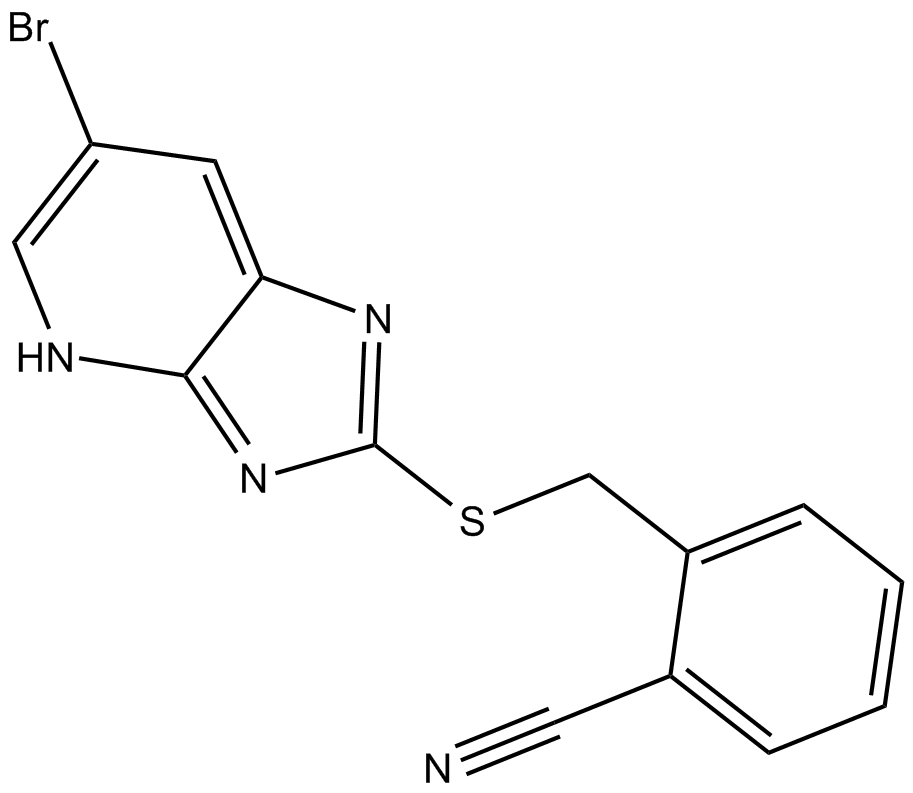
STK393606 is a competitive inhibitor of NAD+-dependent type-I 15-hydroxy PGDH, with the IC50 value of 26.4±2.4 nM, and the Ki value of 5 nM, which could cause a maximum of 100% inhibition [1].
Hydroxyprostaglandin dehydrogenase 15-(NAD), also called 15-hydroxy prostaglandin dehydrogenase (15-hydroxy PGDH), is a critical enzyme participated in the inactivation of prostaglandins (PGs) and related eiscosanoids. 15-hydroxy PGDH belongs to the family of oxidoreductases, specifically those acting on the CH-OH group of substrates with NAD+ or NADP+ as acceptor. 15-hydroxy PGDH could catalyze the oxidation of primary PGs to their 15-keto metabolites [2]. Radioimmunoassay for 15-hydroxy prostaglandin dehydrogenase had identified two types of enzyme activity, of which type-I used NAD+ as a cofactor, while type-II used NADP+ as a cofactor and bear wider substrate specificity [3].
In Vitro: no data available.
In Vivo: no data available.
Clinical trial: no data available.
References:
[1] Niesen F H, Schultz L, Jadhav A, et al. High-Affinity Inhibitors of Human NAD + -Dependent 15-Hydroxyprostaglandin Dehydrogenase: Mechanisms of Inhibition and Structure-Activity Relationships[J]. PLOS ONE, 2010, 5(11).
[2] Tai H, Ensor C M, Tong M, et al. Prostaglandin catabolizing enzymes.[J]. Prostaglandins & Other Lipid Mediators, 2002: 483-493.
[3] Lee S C, Levine L. Prostaglandin metabolism. II. Identification of two 15-hydroxyprostaglandin dehydrogenase types.[J]. Journal of Biological Chemistry, 1975, 250(2): 548-552.
| Cas No. | 355827-05-3 | SDF | |
| Chemical Name | 2-[[(6-bromo-3H-imidazo[4,5-b]pyridin-2-yl)thio]methyl]-benzonitrile | ||
| Canonical SMILES | BrC1=CNC2=NC(SCC3=CC=CC=C3C#N)=NC2=C1 | ||
| Formula | C14H9BrN4S | M.Wt | 345.2 |
| Solubility | ≤12mg/ml in DMSO;14mg/ml in dimethyl formamide | Storage | Store at -20°C |
| General tips | Please select the appropriate solvent to prepare the stock solution according to the
solubility of the product in different solvents; once the solution is prepared, please store it in
separate packages to avoid product failure caused by repeated freezing and thawing.Storage method
and period of the stock solution: When stored at -80°C, please use it within 6 months; when stored
at -20°C, please use it within 1 month. To increase solubility, heat the tube to 37°C and then oscillate in an ultrasonic bath for some time. |
||
| Shipping Condition | Evaluation sample solution: shipped with blue ice. All other sizes available: with RT, or with Blue Ice upon request. | ||
| Prepare stock solution | |||

|
1 mg | 5 mg | 10 mg |
| 1 mM | 2.8969 mL | 14.4844 mL | 28.9687 mL |
| 5 mM | 579.4 μL | 2.8969 mL | 5.7937 mL |
| 10 mM | 289.7 μL | 1.4484 mL | 2.8969 mL |
Step 1: Enter information below (Recommended: An additional animal making an allowance for loss during the experiment)
 g
μL
g
μL
Step 2: Enter the in vivo formulation (This is only the calculator, not formulation. Please contact us first if there is no in vivo formulation at the solubility Section.)
Calculation results:
Working concentration: mg/ml;
Method for preparing DMSO master liquid: mg drug pre-dissolved in μL DMSO ( Master liquid concentration mg/mL, Please contact us first if the concentration exceeds the DMSO solubility of the batch of drug. )
Method for preparing in vivo formulation: Take μL DMSO master liquid, next addμL PEG300, mix and clarify, next addμL Tween 80, mix and clarify, next add μL saline, mix and clarify.
Method for preparing in vivo formulation: Take μL DMSO master liquid, next add μL Corn oil, mix and clarify.
Note: 1. Please make sure the liquid is clear before adding the next solvent.
2. Be sure to add the solvent(s) in order. You must ensure that the solution obtained, in the previous addition, is a clear solution before proceeding to add the next solvent. Physical methods such as vortex, ultrasound or hot water bath can be used to aid dissolving.
3. All of the above co-solvents are available for purchase on the GlpBio website.
Quality Control & SDS
- View current batch:
- Purity: >98.00% Appearance: A solid
- COA (Certificate of Analysis)
- SDS (Safety Data Sheet)
- Datasheet
Average Rating: 5 (Based on Reviews and 1 reference(s) in Google Scholar.)