

Tetraethylammonium chloride |
Catalog No.GC10953
 One-Click Copy Product Info
|

Tetraethylammonium chloride is a non-specific potassium channel blocker whose main mechanism of action is to inhibit potassium ion efflux by binding to sites within the channel pores.
Products are for research use only. Not for human use. We do not sell to patients.
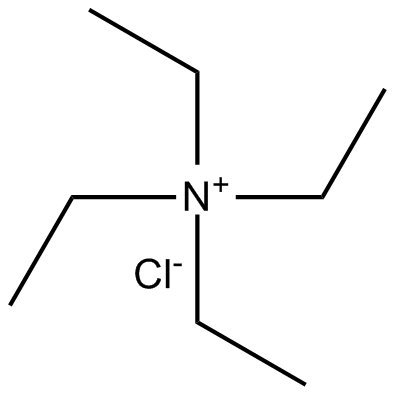
Cas No.: 56-34-8
Sample solution is provided at 25 µL, 10mM.
_1-3.$$$39978408@51.jpg');)
_1-9.$$$38538795@65.jpg');)
_1-9.$$$39112701@51.jpg');)
_1-7.$$$37316672@70.jpg');)
_366-372.$$$36198801@70.jpg');)
.$$$38565142@65.jpg');)
_1867-1883.$$$33248023@67.jpg');)
_eads6055.$$$39977546@45.jpg');)
_eadm9805.$$$40080571@45.jpg');)
_eadj3020.$$$39666821@45.jpg');)
_1-20.$$$39757301@28.jpg');)
_1-24.$$$38898113@28.jpg');)
_273-287.$$$36806353@46.jpg');)
_1-16.$$$37156877@44.jpg');)
_1-19.$$$37460805@44.jpg');)
_1291-1307.$$$34518654@46.jpg');)
Tetraethylammonium chloride is a non-specific potassium channel blocker whose main mechanism of action is to inhibit potassium ion efflux by binding to sites within the channel pores[1]. Due to its positively charged quaternary ammonium structure, it is difficult to penetrate cell membranes and the blood-brain barrier, and therefore it is mainly used in in vitro electrophysiological experiments and cardiovascular research [2-3].
In canine tracheal smooth muscle cell, Tetraethylammonium chloride (15-30mM; 180min) significantly increased the efflux rates of 42K and 86Rb in normal Krebs solution [4]. In smooth muscle cells of the rabbit main pulmonary artery, Tetraethylammonium chloride (10-30mM; 30min) induced membrane depolarization, increased membrane resistance, generated anomalous rectification and occasional spike potentials in response to applied depolarizing current pulses, and produced sustained contractions [5]. In vascular smooth muscle cells, Tetraethylammonium chloride (10mM; 1h) elicited oscillatory contractions and enhanced intercellular communication among cultured cells [6].
In the isoflurane exposure model, Tetraethylammonium chloride (5mg/kg; ip; single administration) significantly inhibited caspase activity in the mouse anterior cerebral cortex and reduced necrotic cell death in the hippocampal region [7]. In conscious mouse experiments, Tetraethylammonium chloride (40mg/kg; po; single administration) enhanced intestinal propulsion of a charcoal suspension and significantly increased duodenal maximum contractile force, minimum relaxation force, and contraction amplitude [8].
References:
[1] Chand N, Diamantis W, Sofia R D. Induction of non-specific airway hyperreactivity by potassium channel blockade in rat isolated trachea[J]. British journal of pharmacology, 1990, 101(3): 541.
[2] Xia M, Shahane S A, Huang R, et al. Identification of quaternary ammonium compounds as potent inhibitors of hERG potassium channels[J]. Toxicology and applied pharmacology, 2011, 252(3): 250-258.
[3] Nand V, Doggrell S A. Effects of tetraethylammonium, 4‐aminopyridine and bretylium on cardiovascular tissues from normo‐and hypertensive rats[J]. Journal of pharmacy and pharmacology, 1999, 51(5): 631-640.
[4] Imaizumi Y, Watanabe M. The effect of tetraethylammonium chloride on potassium permeability in the smooth muscle cell membrane of canine trachea[J]. The Journal of Physiology, 1981, 316(1): 33-46.
[5] Haeusler G, Thorens S. Effects of tetraethylammonium chloride on contractile, membrane and cable properties of rabbit artery muscle[J]. The Journal of Physiology, 1980, 303(1): 203-224.
[6] Watts S W, Tsai M L, Loch-Caruso R, et al. Gap junctional communication and vascular smooth muscle reactivity: use of tetraethylammonium chloride[J]. Journal of vascular research, 1994, 31(5): 307-313.
[7] Jung S, Kayser E B, Johnson S C, et al. Tetraethylammonium chloride reduces anaesthetic-induced neurotoxicity in Caenorhabditis elegans and mice[J]. British Journal of Anaesthesia, 2022, 128(1): 77-88.
[8] Dong D L, Wang Q H, Chen W, et al. Contrasting effects of tetraethylammonium and 4-aminopyridine on the gastrointestinal function of mice[J]. European journal of pharmacology, 2005, 509(2-3): 179-185.
| Cell experiment [1]: | |
|
Cell lines |
smooth muscle cells |
|
Preparation Method |
The effects of Tetraethylammonium chloride (TEA) on the voltage sensitivity of canine tracheal smooth muscle in normal Krebs solution were assessed using 42K/86Rb radioisotope efflux measurements, with TEA applied at concentrations ranging from 0.08 to 40mM by equimolar replacement of NaCl. |
|
Reaction Conditions |
0.08-40mM; 180min |
|
Applications |
In canine tracheal smooth muscle cell, Tetraethylammonium chloride (15-30mM; 180min) significantly increased the efflux rates of 42K and 86Rb in normal Krebs solution |
| Animal experiment [2]: | |
|
Animal models |
Isoflurane exposure model |
|
Preparation Method |
P7 mice received intraperitoneal injections of either trehalose (2mg/kg) or tetraethylammonium chloride (5mg/kg) dissolved in phosphate-buffered saline 30 minutes before isoflurane exposure. Control animals were administered an equivalent volume of vehicle solution. |
|
Dosage form |
5mg/kg; ip; single |
|
Applications |
Tetraethylammonium chloride (5mg/kg ; ip; single) significantly inhibited caspase activity in the mouse anterior cerebral cortex and reduced necrotic cell death in the hippocampal region. |
|
References: |
|
| Cas No. | 56-34-8 | SDF | |
| Chemical Name | tetraethylammonium chloride | ||
| Canonical SMILES | CC[N+](CC)(CC)CC.[Cl-] | ||
| Formula | C8H20ClN | M.Wt | 165.2 |
| Solubility | ≥ 16.5mg/mL in Ethanol | Storage | Store at 4°C, sealed storage, away from moisture |
| General tips | Please select the appropriate solvent to prepare the stock solution according to the
solubility of the product in different solvents; once the solution is prepared, please store it in
separate packages to avoid product failure caused by repeated freezing and thawing.Storage method
and period of the stock solution: When stored at -80°C, please use it within 6 months; when stored
at -20°C, please use it within 1 month. To increase solubility, heat the tube to 37°C and then oscillate in an ultrasonic bath for some time. |
||
| Shipping Condition | Evaluation sample solution: shipped with blue ice. All other sizes available: with RT, or with Blue Ice upon request. | ||
| Prepare stock solution | |||

|
1 mg | 5 mg | 10 mg |
| 1 mM | 6.0533 mL | 30.2663 mL | 60.5327 mL |
| 5 mM | 1.2107 mL | 6.0533 mL | 12.1065 mL |
| 10 mM | 605.3 μL | 3.0266 mL | 6.0533 mL |
Step 1: Enter information below (Recommended: An additional animal making an allowance for loss during the experiment)
 g
μL
g
μL
Step 2: Enter the in vivo formulation (This is only the calculator, not formulation. Please contact us first if there is no in vivo formulation at the solubility Section.)
Calculation results:
Working concentration: mg/ml;
Method for preparing DMSO master liquid: mg drug pre-dissolved in μL DMSO ( Master liquid concentration mg/mL, Please contact us first if the concentration exceeds the DMSO solubility of the batch of drug. )
Method for preparing in vivo formulation: Take μL DMSO master liquid, next addμL PEG300, mix and clarify, next addμL Tween 80, mix and clarify, next add μL saline, mix and clarify.
Method for preparing in vivo formulation: Take μL DMSO master liquid, next add μL Corn oil, mix and clarify.
Note: 1. Please make sure the liquid is clear before adding the next solvent.
2. Be sure to add the solvent(s) in order. You must ensure that the solution obtained, in the previous addition, is a clear solution before proceeding to add the next solvent. Physical methods such as vortex, ultrasound or hot water bath can be used to aid dissolving.
3. All of the above co-solvents are available for purchase on the GlpBio website.
Quality Control & SDS
- View current batch:
- Purity: >97.00% Appearance: A solid
- COA (Certificate of Analysis)
- SDS (Safety Data Sheet)
- Datasheet
Average Rating: 5 (Based on Reviews and 1 reference(s) in Google Scholar.)