

TPEN (Synonyms: TPEDA) |
Catalog No.GC12918
 One-Click Copy Product Info
|

TPEN is a cell-permeable, multidentate heavy metal chelator that binds zinc ions with high affinity, and has lower affinity for Mg2+ and Ca2+ .
Products are for research use only. Not for human use. We do not sell to patients.
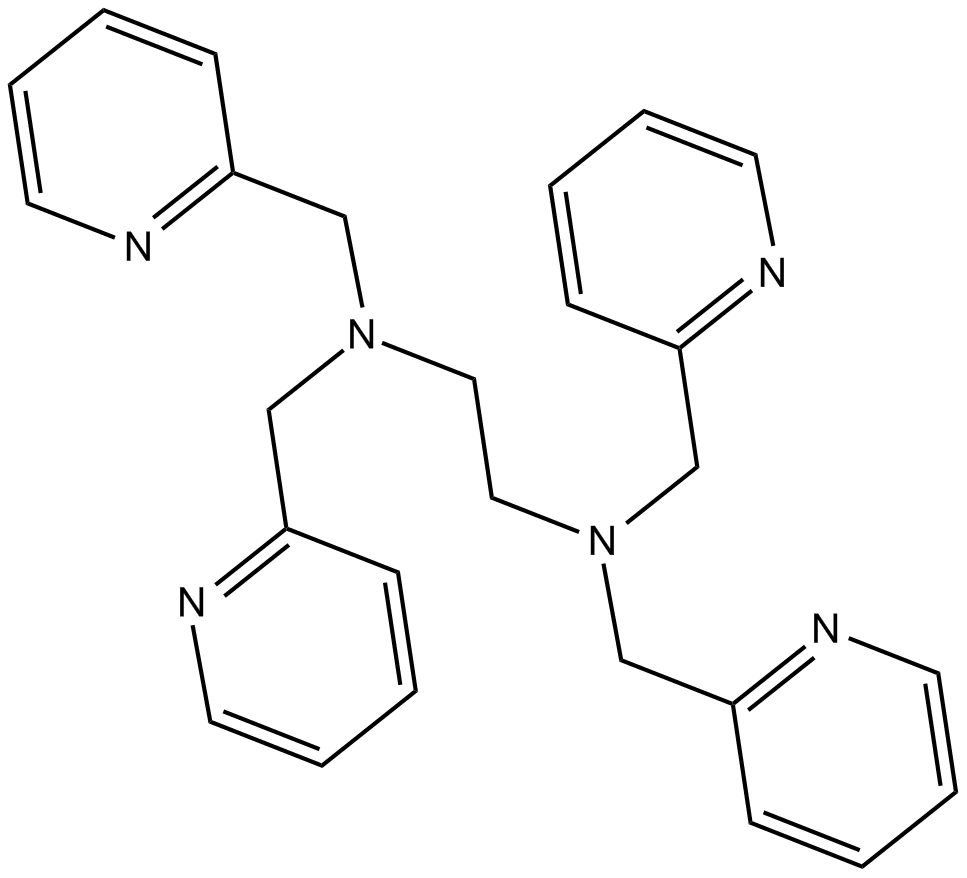
Cas No.: 16858-02-9
Sample solution is provided at 25 µL, 10mM.
TPEN is a cell-permeable, multidentate heavy metal chelator that binds zinc ions with high affinity, and has lower affinity for Mg2+ and Ca2+ [1]. TPEN depletes intracellular zinc, triggering increased ROS production, DNA damage, and caspase-dependent apoptosis, thereby inhibiting cell proliferation [2]. TPEN is primarily used in tumor therapy, hypoxia protection, and anti-infection research [3-4].
Retinal pigment epithelial cells, the cell morphology of cells exposed to TPEN (0.25-4μM; 24h) changed from a broad and flat shape to a fibrous one [5]. In Panc-1 cells, TPEN (0-6μM; 24h) significantly induced cell death by increasing reactive oxygen species (ROS) and inhibiting autophagy [6].
In mast cell-dependent mice model of allergic asthma, TPEN (10mg/kg; ip; 7d) significantly inhibited airway hyperresponsiveness and eosinophilia in bronchoalveolar lavage fluid [7]. In diabetic mice model, TPEN (5mg/kg; ip; 4 months) treatment further reduced diabetes-induced reduction in liver zinc levels [8].
References:
[1]. Taki M, Wolford J L, O'Halloran T V. Emission ratiometric imaging of intracellular zinc: design of a benzoxazole fluorescent sensor and its application in two-photon microscopy[J]. Journal of the American Chemical Society, 2004, 126(3): 712-713.
[2]. Mendivil-Perez M, Velez-Pardo C, Jimenez-Del-Rio M. TPEN induces apoptosis independently of zinc chelator activity in a model of acute lymphoblastic leukemia and ex vivo acute leukemia cells through oxidative stress and mitochondria caspase‐3‐and AIF‐dependent pathways[J]. Oxidative medicine and cellular longevity, 2012, 2012(1): 313275.
[3]. Schaefer-Ramadan S, Barlog M, Roach J, et al. Synthesis of TPEN variants to improve cancer cells selective killing capacity[J]. Bioorganic Chemistry, 2019, 87: 366-372.
[4]. Shmist Y A, Kamburg R, Ophir G, et al. N, N, N′, N′-Tetrakis (2-pyridylmethyl)-ethylenediamine improves myocardial protection against ischemia by modulation of intracellular Ca2+ homeostasis[J]. The Journal of pharmacology and experimental therapeutics, 2005, 313(3): 1046-1057.
[5]. Hyun H J, Sohn J H, Ha D W, et al. Depletion of intracellular zinc and copper with TPEN results in apoptosis of cultured human retinal pigment epithelial cells[J]. Investigative ophthalmology & visual science, 2001, 42(2): 460-465.
[6]. Yu Z, Yu Z, Chen Z B, et al. Zinc chelator TPEN induces pancreatic cancer cell death through causing oxidative stress and inhibiting cell autophagy[J]. Journal of cellular physiology, 2019, 234(11): 20648-20661.
[7]. Fukuyama S, Matsunaga Y, Zhanghui W, et al. A zinc chelator TPEN attenuates airway hyperresponsiveness and airway inflammation in mice in vivo[J]. Allergology International, 2011, 60(3): 259-266.
[8]. Zhang C, Lu X, Tan Y, et al. Diabetes-induced hepatic pathogenic damage, inflammation, oxidative stress, and insulin resistance was exacerbated in zinc deficient mouse model[J]. PloS one, 2012, 7(12): e49257.
| Cell experiment [1]: | |
|
Cell lines |
Retinal pigment epithelial cells |
|
Preparation Method |
Cells were exposed to 0.25 to 4μM TPEN and other drugs in serum-free medium. Prior to exposure, the pre-existing medium was rinsed several times and replaced with serum-free medium. TPEN and other drug exposures were accomplished by adding the required volume of stock solution to the serum-free exposure medium. Control cultures were exposed to TPEN with the same medium replacement procedure except for exposure. |
|
Reaction Conditions |
0.25-4μM; 24h |
|
Applications |
The cell morphology of cells exposed to TPEN changed from a broad and flat shape to a fibrous one. |
| Animal experiment [2]: | |
|
Animal models |
Mast cell-dependent mice model of allergic asthma |
|
Preparation Method |
C57BL6J mice were sensitized with intraperitoneal injections of 10μg ovalbumin (OVA) without aluminum hydroxide every other day for 14 days in a mast cell-dependent mice model of allergic asthma.20 On days 40, 43, and 46, mice received an aerosol challenge containing either saline or 1% OVA for 30min per day. Mice received an intraperitoneal injection of 10mg/kg TPEN or vehicle solution 30min before each OVA challenge. On day 47, 24h after the last aerosol challenge, measurements of the airway responsiveness and bronchoalveolar lavage (BAL) were performed. |
|
Dosage form |
10mg/kg; ip; 7d |
|
Applications |
TPEN significantly inhibited airway hyperresponsiveness and eosinophilia in BAL fluid. |
|
References: |
|
| Cas No. | 16858-02-9 | SDF | |
| Synonyms | TPEDA | ||
| Chemical Name | N1,N1,N2,N2-tetrakis(pyridin-2-ylmethyl)ethane-1,2-diamine | ||
| Canonical SMILES | N(CC1=NC=CC=C1)(CC2=NC=CC=C2)CCN(CC3=NC=CC=C3)CC4=NC=CC=C4 | ||
| Formula | C26H28N6 | M.Wt | 424.54 |
| Solubility | DMF: 1 mg/ml,DMSO: 0.15 mg/ml,Ethanol: 20 mg/ml,Ethanol:PBS (pH 7.2) (1:10): 0.1 mg/ml | Storage | Store at -20°C |
| General tips | Please select the appropriate solvent to prepare the stock solution according to the
solubility of the product in different solvents; once the solution is prepared, please store it in
separate packages to avoid product failure caused by repeated freezing and thawing.Storage method
and period of the stock solution: When stored at -80°C, please use it within 6 months; when stored
at -20°C, please use it within 1 month. To increase solubility, heat the tube to 37°C and then oscillate in an ultrasonic bath for some time. |
||
| Shipping Condition | Evaluation sample solution: shipped with blue ice. All other sizes available: with RT, or with Blue Ice upon request. | ||
| Prepare stock solution | |||

|
1 mg | 5 mg | 10 mg |
| 1 mM | 2.3555 mL | 11.7775 mL | 23.5549 mL |
| 5 mM | 471.1 μL | 2.3555 mL | 4.711 mL |
| 10 mM | 235.5 μL | 1.1777 mL | 2.3555 mL |
Step 1: Enter information below (Recommended: An additional animal making an allowance for loss during the experiment)
 g
μL
g
μL
Step 2: Enter the in vivo formulation (This is only the calculator, not formulation. Please contact us first if there is no in vivo formulation at the solubility Section.)
Calculation results:
Working concentration: mg/ml;
Method for preparing DMSO master liquid: mg drug pre-dissolved in μL DMSO ( Master liquid concentration mg/mL, Please contact us first if the concentration exceeds the DMSO solubility of the batch of drug. )
Method for preparing in vivo formulation: Take μL DMSO master liquid, next addμL PEG300, mix and clarify, next addμL Tween 80, mix and clarify, next add μL saline, mix and clarify.
Method for preparing in vivo formulation: Take μL DMSO master liquid, next add μL Corn oil, mix and clarify.
Note: 1. Please make sure the liquid is clear before adding the next solvent.
2. Be sure to add the solvent(s) in order. You must ensure that the solution obtained, in the previous addition, is a clear solution before proceeding to add the next solvent. Physical methods such as vortex, ultrasound or hot water bath can be used to aid dissolving.
3. All of the above co-solvents are available for purchase on the GlpBio website.
Quality Control & SDS
- View current batch:
- Purity: >97.00% Appearance: A solid
- COA (Certificate of Analysis)
- SDS (Safety Data Sheet)
- Datasheet
Average Rating: 5 (Based on Reviews and 1 reference(s) in Google Scholar.)