

Troxerutin (Synonyms: Trihydroxyethylrutin, Vitamin P4) |
Catalog No.GC15933
 One-Click Copy Product Info
|

flavonoid
Products are for research use only. Not for human use. We do not sell to patients.
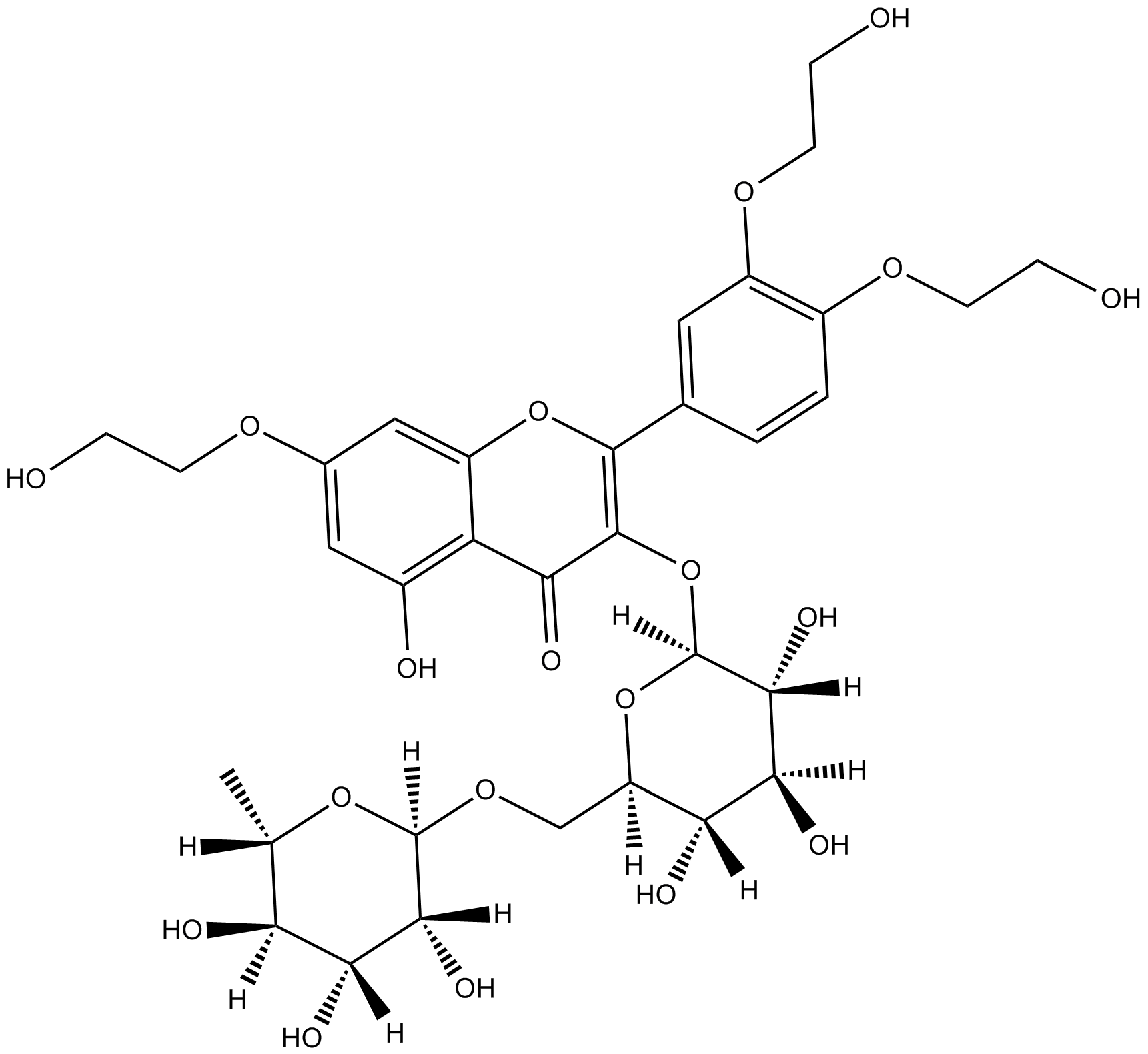
Cas No.: 7085-55-4
Sample solution is provided at 25 µL, 10mM.
_1-3.$$$39978408@51.jpg');)
_1-9.$$$38538795@65.jpg');)
_1-9.$$$39112701@51.jpg');)
_1-7.$$$37316672@70.jpg');)
_366-372.$$$36198801@70.jpg');)
.$$$38565142@65.jpg');)
_1867-1883.$$$33248023@67.jpg');)
_eads6055.$$$39977546@45.jpg');)
_eadm9805.$$$40080571@45.jpg');)
_eadj3020.$$$39666821@45.jpg');)
_1-20.$$$39757301@28.jpg');)
_1-24.$$$38898113@28.jpg');)
_273-287.$$$36806353@46.jpg');)
_1-16.$$$37156877@44.jpg');)
_1-19.$$$37460805@44.jpg');)
_1291-1307.$$$34518654@46.jpg');)
Troxerutin can also offer protection against DNA strand breaks and micronuclei formation induced by γ–radiation (GR), it enhances repair of DNA strand breaks induced by radiation. In lymphocytes, treatment with 1mM troxerutin significantly decreased the induction of micronuclei resulted from the exposure to 2 Gy γ-radiation by 41.26% [1].
GR can induce cellular damage and apoptosis. It can cause double-stranded and single-stranded breaks in the genomic DNA [2].
Under ex vivo condition of GR (2 Gy), DNA strand breaks were induced by the radiation. Treatment with troxerutin protected the human peripheral blood leucocytes from this GR effect. In the human lymphocytes, the micronuclei induction resulted from GR was significantly inhibited by troxerutin (1 mM) [1].
In mice, micronuclei formation in blood reticulocytes was significantly inhibited by the intraperitoneal administration of troxerutin (175 mg/kg) before and after whole body radiation exposure. 1 h prior to 4 Gy γ -radiation exposure, in bone marrow cells and blood leucocytes, the yield of DNA strand breaks was dose-dependently decreased by the administration of troxerutin at different doses (75, 125 and 175 mg/kg body weight). The dose-dependent protection was less pronounced in blood leucocytes than in bone marrow cells. In mice, 1 h prior or immediately after whole body irradiation, administration of troxerutin at 175 mg/kg body weight (i.p.) decrease the strand breaks depended on the post-irradiation interval [1].
References:
[1]. Maurya DK, Balakrishnan S, Salvi VP, et al. Protection of cellular DNA from gamma-radiation-induced damages and enhancement in DNA repair by troxerutin. Mol Cell Biochem, 2005, 280(1-2):57-68.
[2]. Chen YR, Meyer CF and Tan TH. Persistent Activation of c-Jun N-terminal Kinase 1 (JNK1) in γ Radiation-induced Apoptosis. J Biol Chem, 1996, 271(2): 631–634.
|
Cell experiment: |
The cells are plated at a density of 4×10³/well in a 96-well plate. At 70 to 80% confluence, the cells are treated with Troxerutin at concentrations ranging between 0 and 60 μM for 24 h at 37°C. Subsequently, 10 μL water soluble tetrazolium salt assay solution is added to each well and, following incubation for 30 min at 37°C, the optical density is measured at 490 nm using a reader. To examine Troxerutin mediated ROS protection, the cells are pretreated with Troxerutin at the following concentrations: 0, 5, 10 and 15 μM for 8 h. Subsequently, 750 μM H2O2 is added to each well. Following incubation for 24 h at 37°C, cell viability is evaluated using an Cell Viability Assay kit. The level of cell viability (%) is normalized to that of 0.1% dimethyl-sulfoxide (DMSO)-treated cells. Each experiment is repeated at least three times[1]. |
|
Animal experiment: |
Thirty two adult male Wistar rats weighing 250 to 300 grams are used in this study. The animals are randomly divided into four groups (n=8/each) as: group I: control (C), group II: control with Troxerutin (C+TXR), group III: diabetic (D), and group IV: diabetic with Troxerutin (D+TXR). The control rats are received the same amount of citrate buffer alone. Development of diabetes is confirmed by measuring blood glucose levels, 72 hours later. Animals with blood glucose levels higher than 16.65 mM (300 mg/dL) are considered diabetic and those with blood glucose levels lower than this value are excluded from the experiment. Troxerutin (150 mg/kg/day) is administered orally, once daily for four weeks. After 10 weeks of induction of diabetes, diabetic animals as well as the time-matched controls are killed and aortic samples are collected[3]. |
|
References: [1]. Lim KM, et al. Analysis of changes in microRNA expression profiles in response to the troxerutin-mediated antioxidant effect in human dermal papilla cells. Mol Med Rep. 2015 Aug;12(2):2650-60. |
|
| Cas No. | 7085-55-4 | SDF | |
| Synonyms | Trihydroxyethylrutin, Vitamin P4 | ||
| Chemical Name | 2-(3,4-bis(2-hydroxyethoxy)phenyl)-5-hydroxy-7-(2-hydroxyethoxy)-3-(((2S,3R,4S,5S,6R)-3,4,5-trihydroxy-6-((((2R,3R,4R,5R,6S)-3,4,5-trihydroxy-6-methyltetrahydro-2H-pyran-2-yl)oxy)methyl)tetrahydro-2H-pyran-2-yl)oxy)-4H-chromen-4-one | ||
| Canonical SMILES | C[C@@](O1)([H])[C@@](O)([H])[C@](O)([H])[C@](O)([H])[C@]1([H])OC[C@]2([H])[C@](O)([H])[C@@](O)([H])[C@](O)([H])[C@@](OC(C(C3=C(O)C=C(OCCO)C=C3O4)=O)=C4C5=CC(OCCO)=C(OCCO)C=C5)([H])O2 | ||
| Formula | C33H42O19 | M.Wt | 742.68 |
| Solubility | ≥ 74.3mg/mL in DMSO | Storage | Store at -20°C |
| General tips | Please select the appropriate solvent to prepare the stock solution according to the
solubility of the product in different solvents; once the solution is prepared, please store it in
separate packages to avoid product failure caused by repeated freezing and thawing.Storage method
and period of the stock solution: When stored at -80°C, please use it within 6 months; when stored
at -20°C, please use it within 1 month. To increase solubility, heat the tube to 37°C and then oscillate in an ultrasonic bath for some time. |
||
| Shipping Condition | Evaluation sample solution: shipped with blue ice. All other sizes available: with RT, or with Blue Ice upon request. | ||
| Prepare stock solution | |||

|
1 mg | 5 mg | 10 mg |
| 1 mM | 1.3465 mL | 6.7324 mL | 13.4647 mL |
| 5 mM | 269.3 μL | 1.3465 mL | 2.6929 mL |
| 10 mM | 134.6 μL | 673.2 μL | 1.3465 mL |
Step 1: Enter information below (Recommended: An additional animal making an allowance for loss during the experiment)
 g
μL
g
μL
Step 2: Enter the in vivo formulation (This is only the calculator, not formulation. Please contact us first if there is no in vivo formulation at the solubility Section.)
Calculation results:
Working concentration: mg/ml;
Method for preparing DMSO master liquid: mg drug pre-dissolved in μL DMSO ( Master liquid concentration mg/mL, Please contact us first if the concentration exceeds the DMSO solubility of the batch of drug. )
Method for preparing in vivo formulation: Take μL DMSO master liquid, next addμL PEG300, mix and clarify, next addμL Tween 80, mix and clarify, next add μL saline, mix and clarify.
Method for preparing in vivo formulation: Take μL DMSO master liquid, next add μL Corn oil, mix and clarify.
Note: 1. Please make sure the liquid is clear before adding the next solvent.
2. Be sure to add the solvent(s) in order. You must ensure that the solution obtained, in the previous addition, is a clear solution before proceeding to add the next solvent. Physical methods such as vortex, ultrasound or hot water bath can be used to aid dissolving.
3. All of the above co-solvents are available for purchase on the GlpBio website.
Quality Control & SDS
- View current batch:
- Purity: >98.00% Appearance: A solid
- COA (Certificate of Analysis)
- SDS (Safety Data Sheet)
- Datasheet
Average Rating: 5 (Based on Reviews and 20 reference(s) in Google Scholar.)