

UNC 0631 |
Catalog No.GC12548
 One-Click Copy Product Info
|

G9a inhibitor
Products are for research use only. Not for human use. We do not sell to patients.
Cas No.: 1320288-19-4
Sample solution is provided at 25 µL, 10mM.
_1-3.$$$39978408@51.jpg');)
_1-9.$$$38538795@65.jpg');)
_1-9.$$$39112701@51.jpg');)
_1-7.$$$37316672@70.jpg');)
_366-372.$$$36198801@70.jpg');)
.$$$38565142@65.jpg');)
_1867-1883.$$$33248023@67.jpg');)
_eads6055.$$$39977546@45.jpg');)
_eadm9805.$$$40080571@45.jpg');)
_eadj3020.$$$39666821@45.jpg');)
_1-20.$$$39757301@28.jpg');)
_1-24.$$$38898113@28.jpg');)
_273-287.$$$36806353@46.jpg');)
_1-16.$$$37156877@44.jpg');)
_1-19.$$$37460805@44.jpg');)
_1291-1307.$$$34518654@46.jpg');)
UNC 0631 is a potent inhibitor of Protein lysine methyltransferase G9a (also known as KMT1C or EHMT2) with the IC50 value of 4nM [1].
UNC 0631 has been revealed to inhibit the G9a in SAHH-coupled with the IC50 of 4nM. Besides, UNC 0631 has been found to be highly potent in reducing H3K9me2 levels in MDA-MB-231 cells with the ICW IC50 of 25nM. In addition, UNC 0631 has been shown the high in vitro potency against G9a and improved lipophilicity. Besides, UNC 0631 has also been reported to have low cell toxicity in MDA-MB-231 cells with the IC50 value of 2.8μM in MTT assay. In different cell lines, UNC 0631 has been demonstrated to potently reduce H3K9me2 levels with the ICW IC50 of 25nM, 18nM, 26nM, 24nM, 51nM, 72nM and 46nM in MDA-MB-231, MCF7, PC3, 22RV1, HCT116 wt, HCT 116 p53 and IMR90 cell lines, respectively [1].
References:
[1] Liu F1, Barsyte-Lovejoy D, Allali-Hassani A, He Y, Herold JM, Chen X, Yates CM, Frye SV, Brown PJ, Huang J, Vedadi M, Arrowsmith CH, Jin J.Optimization of cellular activity of G9a inhibitors 7-aminoalkoxy-quinazolines. J Med Chem. 2011 Sep 8;54( 17):6139-50.
| Cell experiment [1]: | |
|
Cell lines |
MDA-MB-231 cells |
|
Preparation method |
The solubility of this compound in DMSO is >18.35mg/mL. General tips for obtaining a higher concentration: Please warm the tube at 37℃ for 10 minutes and/or shake it in the ultrasonic bath for a while. Stock solution can be stored below -20℃ for several months. |
|
Reacting condition |
48 h |
|
Applications |
In MDA-MB-231 cells, UNC 0631 was highly potent in reducing H3K9me2 levels with IC50 value of 0.026 μM and had low cell toxicity with excellent tox/function ratios. UNC 0631 had high in vitro potency versus G9a and improved lipophilicity. UNC 0631 was valuable alternative tool compound that might be more suitable for investigating specific cellular systems. |
|
References: [1] Liu F1, Barsyte-Lovejoy D, Allali-Hassani A, He Y, Herold JM, Chen X, Yates CM, Frye SV, Brown PJ, Huang J, Vedadi M, Arrowsmith CH, Jin J.Optimization of cellular activity of G9a inhibitors 7-aminoalkoxy-quinazolines. J Med Chem. 2011 Sep 8;54( 17):6139-50. | |
| Cas No. | 1320288-19-4 | SDF | |
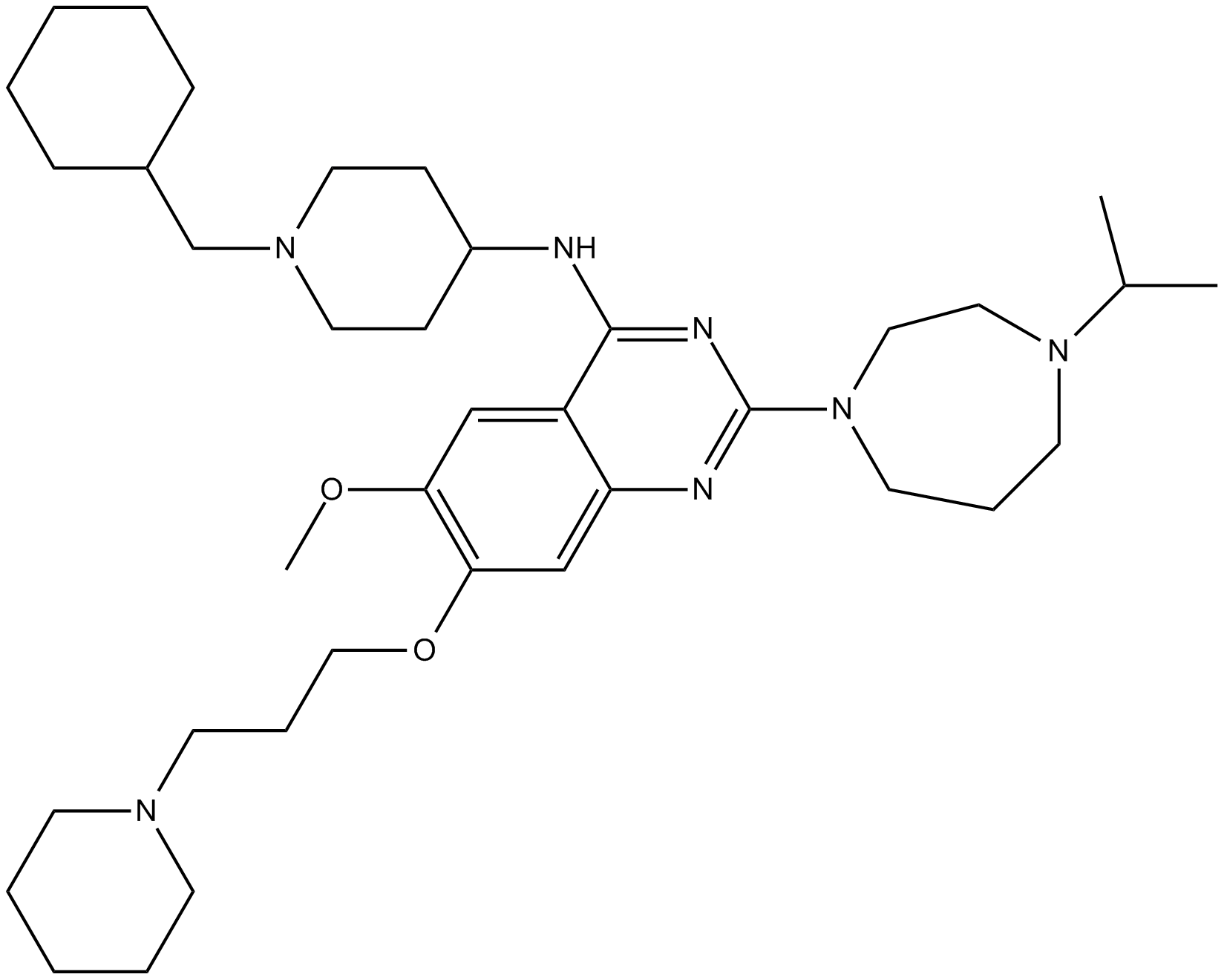
| Chemical Name | N-(1-(cyclohexylmethyl)piperidin-4-yl)-2-(4-isopropyl-1,4-diazepan-1-yl)-6-methoxy-7-(3-(piperidin-1-yl)propoxy)quinazolin-4-amine | ||
| Canonical SMILES | COC1=C(OCCCN2CCCCC2)C=C3C(C(NC4CCN(CC5CCCCC5)CC4)=NC(N6CCN(C(C)C)CCC6)=N3)=C1 | ||
| Formula | C37H61N7O2 | M.Wt | 635.93 |
| Solubility | ≥ 18.35mg/mL in DMSO with gentle warming | Storage | Store at -20°C |
| General tips | Please select the appropriate solvent to prepare the stock solution according to the
solubility of the product in different solvents; once the solution is prepared, please store it in
separate packages to avoid product failure caused by repeated freezing and thawing.Storage method
and period of the stock solution: When stored at -80°C, please use it within 6 months; when stored
at -20°C, please use it within 1 month. To increase solubility, heat the tube to 37°C and then oscillate in an ultrasonic bath for some time. |
||
| Shipping Condition | Evaluation sample solution: shipped with blue ice. All other sizes available: with RT, or with Blue Ice upon request. | ||
| Prepare stock solution | |||

|
1 mg | 5 mg | 10 mg |
| 1 mM | 1.5725 mL | 7.8625 mL | 15.725 mL |
| 5 mM | 314.5 μL | 1.5725 mL | 3.145 mL |
| 10 mM | 157.3 μL | 786.3 μL | 1.5725 mL |
Step 1: Enter information below (Recommended: An additional animal making an allowance for loss during the experiment)
 g
μL
g
μL
Step 2: Enter the in vivo formulation (This is only the calculator, not formulation. Please contact us first if there is no in vivo formulation at the solubility Section.)
Calculation results:
Working concentration: mg/ml;
Method for preparing DMSO master liquid: mg drug pre-dissolved in μL DMSO ( Master liquid concentration mg/mL, Please contact us first if the concentration exceeds the DMSO solubility of the batch of drug. )
Method for preparing in vivo formulation: Take μL DMSO master liquid, next addμL PEG300, mix and clarify, next addμL Tween 80, mix and clarify, next add μL saline, mix and clarify.
Method for preparing in vivo formulation: Take μL DMSO master liquid, next add μL Corn oil, mix and clarify.
Note: 1. Please make sure the liquid is clear before adding the next solvent.
2. Be sure to add the solvent(s) in order. You must ensure that the solution obtained, in the previous addition, is a clear solution before proceeding to add the next solvent. Physical methods such as vortex, ultrasound or hot water bath can be used to aid dissolving.
3. All of the above co-solvents are available for purchase on the GlpBio website.
Quality Control & SDS
- View current batch:
- Purity: >99.00% Appearance: A solid
- COA (Certificate of Analysis)
- SDS (Safety Data Sheet)
- Datasheet
Average Rating: 5 (Based on Reviews and 37 reference(s) in Google Scholar.)