

ZLN005 |
Catalog No.GC13437
 One-Click Copy Product Info
|

ZLN005 is a potent and cell-specific transcriptional activator of peroxisome proliferator-activated receptor-γ coactivator-1α (PGC-1α).
Products are for research use only. Not for human use. We do not sell to patients.
Cas No.: 49671-76-3
Sample solution is provided at 25 µL, 10mM.
ZLN005 is a potent and cell-specific transcriptional activator of peroxisome proliferator-activated receptor-γ coactivator-1α (PGC-1α)[1]. PGC-1α is a key transcriptional coactivator primarily regulating mitochondrial biogenesis and oxidative phosphorylation processes[2]. ZLN005 is commonly used in research related to diseases such as diabetes, mitochondrial aging, and sepsis[3,4].
In vitro, pretreatment of THP-1 cells with ZLN005 (1μM) for 48h, followed by stimulation with 1μg/mL lipopolysaccharide (LPS), significantly increased PGC-1α mRNA expression and restored the mitochondrial DNA copy number reduced by LPS stimulation[5]. Treatment of differentiated human retinal pigment epithelial ARPE-19 cells with ZLN005 (10μM) for 24h significantly reduced mitochondrial superoxide production[6].
In vivo, ZLN005 (12mg/kg/day; 3 days) administered via intraperitoneal injection to C57BL/6 mice with cecal ligation and puncture (CLP)-induced sepsis significantly improved the 6-day survival rate (from 0% to 30%)[5]. In a perioperative neurocognitive disorder (PND) mouse model, daily intraperitoneal injection of ZLN005 (7.5mg/kg/day) from 3 days before surgery until 1 day after surgery significantly reduced levels of the pro-inflammatory cytokines IL-6 and IL-1β in the hippocampus and cerebral cortex at 24h post-surgery, alleviating neuroinflammation[7]. Pretreatment of C57BL/6 mice with ZLN005 (12mg/kg/day) via intraperitoneal injection for 3 days prior to hepatic ischemia-reperfusion injury (IRI) surgery significantly decreased serum levels of ALT, AST, and LDH and reduced the area of liver tissue necrosis[8].
References:
[1] ZHANG W, XIONG H, PANG J, et al. PGC-1α overexpression promotes mitochondrial biogenesis to protect auditory cells against cisplatin-induced cytotoxicity[J]. Journal of Bio-X Research, 2019, 2(2): 81-86.
[2] LIU Y, BAI H, GUO F, et al. PGC-1α activator ZLN005 promotes maturation of cardiomyocytes derived from human embryonic stem cells[J]. Aging (Albany NY), 2020, 12(8): 7411.
[3] ZHAI M, HU H, ZHENG Y, et al. PGC1α: An emerging therapeutic target for chemotherapy-induced peripheral neuropathy[J]. Therapeutic Advances in Neurological Disorders, 2023, 16: 17562864231163361.
[4] QIAN L, ZHU Y, DENG C, et al. Peroxisome proliferator-activated receptor gamma coactivator-1 (PGC-1) family in physiological and pathophysiological process and diseases[J]. Signal Transduction and Targeted Therapy, 2024, 9(1): 50.
[5] SUZUKI Y, KAMI D, TAYA T, et al. ZLN005 improves the survival of polymicrobial sepsis by increasing the bacterial killing via inducing lysosomal acidification and biogenesis in phagocytes[J]. Frontiers in Immunology, 2023, 14: 1089905.
[6] SATISH S, PHILIPOSE H, ROSALES M A B, et al. Pharmaceutical induction of PGC-1α promotes retinal pigment epithelial cell metabolism and protects against oxidative damage[J]. Oxidative Medicine and Cellular Longevity, 2018, 2018(1): 9248640.
[7] WU X, DING S, WANG G, et al. ZLN005 reduces neuroinflammation and improves mitochondrial function in mice with perioperative neurocognitive disorders[J]. Journal of Inflammation Research, 2024, 17: 8135-8146.
[8] TOHME C, HAYKAL T, YANG R, et al. ZLN005, a PGC-1α Activator, Protects the Liver against Ischemia–Reperfusion Injury and the Progression of Hepatic Metastases[J]. Cells, 2024, 13(17): 1448.
| Cell experiment [1]: | |
Cell lines | THP-1 cells ( human monocytic leukemia cell line ) |
Preparation Method | Cells were seeded in 12-well cell culture plates at a density of 5 × 10⁵ cells per well in growth medium containing 10nM phorbol 12-myristate 13-acetat. After 48h, the supernatant of the medium was carefully removed to avoid detaching the cells attached to the bottom of the plate and replaced with new medium containing 1μM ZLN005. Forty-eight hours later, 1μg/ml LPS was added, and the cells were harvested at each time point and used for experiments. |
Reaction Conditions | 1μM; 48h |
Applications | Pretreatment of THP-1 cells with ZLN005 (1μM) for 48h, followed by stimulation with 1μg/mL LPS, significantly enhanced the mRNA expression of PGC-1α and restored the decreased mitochondrial DNA copy number induced by LPS stimulation. |
| Animal experiment [1]: | |
Animal models | CLP-induced sepsis C57BL/6 mice |
Preparation Method | ZLN005 stock solutions were prepared in DMSO adjusted to a 10mM concentration. Mice were injected with ZLN005 (12mg/kg) every day from Day 0 to Day 2. Mice were examined continuously for survival until 6 days post-CLP. |
Dosage form | 12mg/kg/day; 3 days; i.p. |
Applications | ZLN005 (12mg/kg/day; 3 days), administered via intraperitoneal injection, significantly improved the 6-day survival rate from 0% to 30% in C57BL/6 mice with sepsis induced by CLP. |
References: | |
| Cas No. | 49671-76-3 | SDF | |
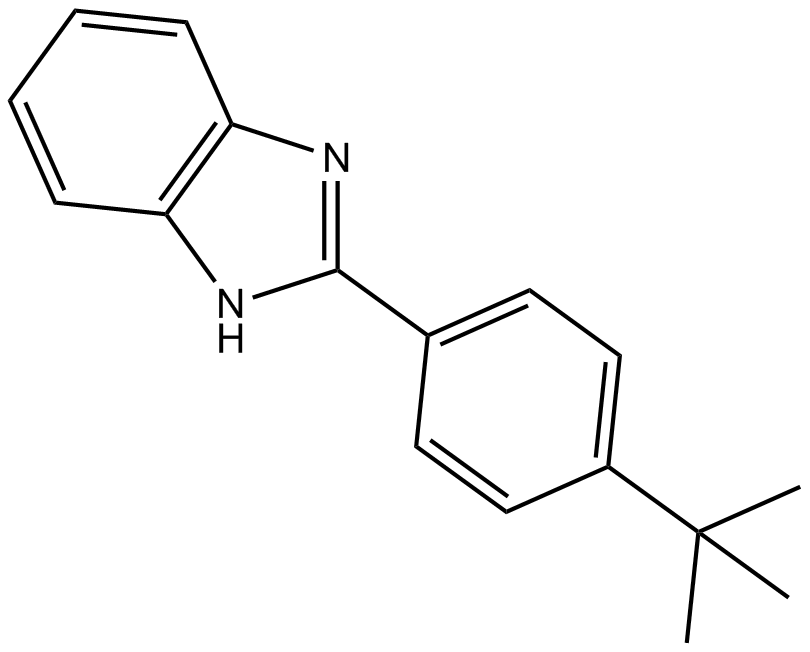
| Chemical Name | 2-(4-tert-butylphenyl)-1H-benzimidazole | ||
| Canonical SMILES | CC(C)(C)C1=CC=C(C=C1)C2=NC3=CC=CC=C3N2 | ||
| Formula | C17H18N2 | M.Wt | 250.34 |
| Solubility | ≥ 23.3mg/mL in DMSO | Storage | Store at -20°C |
| General tips | Please select the appropriate solvent to prepare the stock solution according to the
solubility of the product in different solvents; once the solution is prepared, please store it in
separate packages to avoid product failure caused by repeated freezing and thawing.Storage method
and period of the stock solution: When stored at -80°C, please use it within 6 months; when stored
at -20°C, please use it within 1 month. To increase solubility, heat the tube to 37°C and then oscillate in an ultrasonic bath for some time. |
||
| Shipping Condition | Evaluation sample solution: shipped with blue ice. All other sizes available: with RT, or with Blue Ice upon request. | ||
| Prepare stock solution | |||

|
1 mg | 5 mg | 10 mg |
| 1 mM | 3.9946 mL | 19.9728 mL | 39.9457 mL |
| 5 mM | 798.9 μL | 3.9946 mL | 7.9891 mL |
| 10 mM | 399.5 μL | 1.9973 mL | 3.9946 mL |
Step 1: Enter information below (Recommended: An additional animal making an allowance for loss during the experiment)
 g
μL
g
μL
Step 2: Enter the in vivo formulation (This is only the calculator, not formulation. Please contact us first if there is no in vivo formulation at the solubility Section.)
Calculation results:
Working concentration: mg/ml;
Method for preparing DMSO master liquid: mg drug pre-dissolved in μL DMSO ( Master liquid concentration mg/mL, Please contact us first if the concentration exceeds the DMSO solubility of the batch of drug. )
Method for preparing in vivo formulation: Take μL DMSO master liquid, next addμL PEG300, mix and clarify, next addμL Tween 80, mix and clarify, next add μL saline, mix and clarify.
Method for preparing in vivo formulation: Take μL DMSO master liquid, next add μL Corn oil, mix and clarify.
Note: 1. Please make sure the liquid is clear before adding the next solvent.
2. Be sure to add the solvent(s) in order. You must ensure that the solution obtained, in the previous addition, is a clear solution before proceeding to add the next solvent. Physical methods such as vortex, ultrasound or hot water bath can be used to aid dissolving.
3. All of the above co-solvents are available for purchase on the GlpBio website.
Quality Control & SDS
- View current batch:
- Purity: >99.50% Appearance: A solid
- COA (Certificate of Analysis)
- SDS (Safety Data Sheet)
- Datasheet
Average Rating: 5 (Based on Reviews and 1 reference(s) in Google Scholar.)