

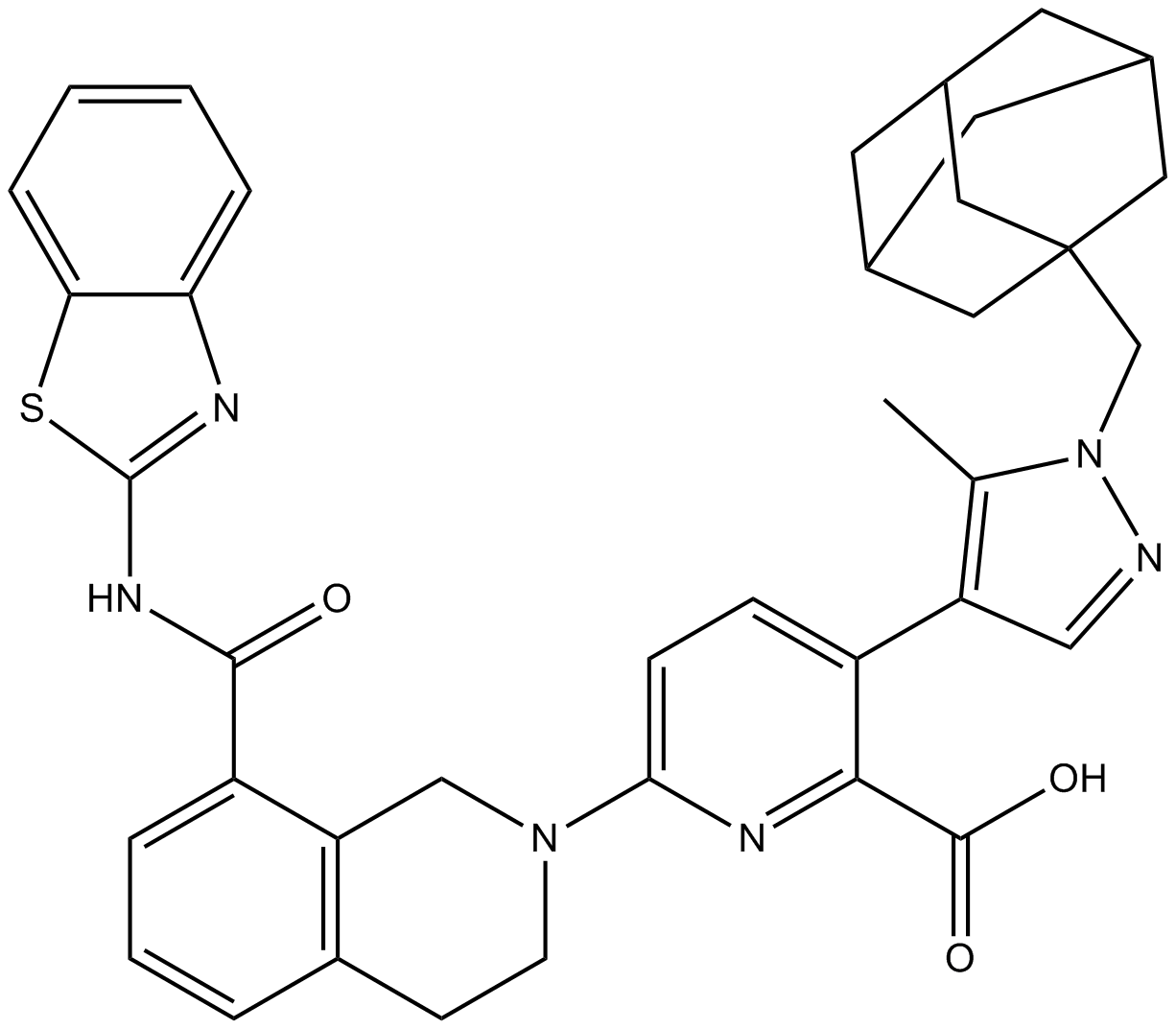
A-1331852 |
Catalog No.GC17513
 One-Click Copy Product Info
|

A-1331852 is an orally available BCL-XL selective inhibitor with a Ki value < 0.01nM.
Products are for research use only. Not for human use. We do not sell to patients.
Cas No.: 1430844-80-6
Sample solution is provided at 25 µL, 10mM.
_1-3.$$$39978408@51.jpg');)
_1-9.$$$38538795@65.jpg');)
_1-9.$$$39112701@51.jpg');)
_1-7.$$$37316672@70.jpg');)
_366-372.$$$36198801@70.jpg');)
.$$$38565142@65.jpg');)
_1867-1883.$$$33248023@67.jpg');)
_eads6055.$$$39977546@45.jpg');)
_eadm9805.$$$40080571@45.jpg');)
_eadj3020.$$$39666821@45.jpg');)
_1-20.$$$39757301@28.jpg');)
_1-24.$$$38898113@28.jpg');)
_273-287.$$$36806353@46.jpg');)
_1-16.$$$37156877@44.jpg');)
_1-19.$$$37460805@44.jpg');)
_1291-1307.$$$34518654@46.jpg');)
A-1331852 is an orally available BCL-XL selective inhibitor with a Ki value < 0.01nM [1]. A-1331852 can stimulate the exposure of phosphatidylserine (PS) in cells, induce the cleavage of caspase-3, and activate BAX and BAK, leading to rapid loss of mitochondrial membrane potential[2]. A-1331852 has been widely used to inhibit the proliferation of leukemia cells and the growth of xenograft tumors [3].
In vitro, A-1331852 treatment (1µM) for 24 hours significantly inhibited HL-60 cell viability, reduced the expression of MCL1, and induced phosphorylation of p38 MAPK[4]. Treatment with 10µM A-1331852 for 24 hours selectively eliminated senescent chondrocytes, accompanied by significant increases in nuclear condensation and cleavage of PARP protein[5]. Treatment with 10µM A-1331852 for 24 hours selectively killed senescent A549 cells and induced apoptosis of senescent A549 cells through the mitochondrial pathway[6].
In vivo, A-1331852 treatment via oral administration at a dose of 25mg/kg, twice daily for 18 days, significantly inhibited the growth of xenograft tumors in mice with fluorouracil (5-FU)-resistant HCT116 cells, without affecting body weight[7]. Oral administration of a 25mg/kg dose of A-1331852 daily for 3 weeks significantly delayed tumor growth in a lung adenocarcinoma mouse model and reduced the number of tumor-associated neutrophils (TAN)[8].
References:
[1] Leverson J D, Phillips D C, Mitten M J, et al. Exploiting selective BCL-2 family inhibitors to dissect cell survival dependencies and define improved strategies for cancer therapy[J]. Science translational medicine, 2015, 7(279): 279ra40-279ra40.
[2] Kehr S, Haydn T, Bierbrauer A, et al. Targeting BCL-2 proteins in pediatric cancer: Dual inhibition of BCL-XL and MCL-1 leads to rapid induction of intrinsic apoptosis[J]. Cancer letters, 2020, 482: 19-32.
[3] Enzenmüller S, Niedermayer A, Seyfried F, et al. Acquired venetoclax resistance in an in vivo model of B-cell precursor acute lymphoblastic leukemia is characterized by altered functions of apoptosis regulators[J]. Blood, 2023, 142: 1446.
[4] Chiou J T, Wu Y Y, Lee Y C, et al. BCL2L1 inhibitor A-1331852 inhibits MCL1 transcription and triggers apoptosis in acute myeloid leukemia cells[J]. Biochemical pharmacology, 2023, 215: 115738.
[5] Wu G, Zhang C, Xu L, et al. BAK plays a key role in A-1331852-induced apoptosis in senescent chondrocytes[J]. Biochemical and biophysical research communications, 2022, 609: 93-99.
[6] Wu G, Li X, Zhan Y, et al. BID-and BAX-mediated mitochondrial pathway dominates A-1331852-induced apoptosis in senescent A549 cells[J]. Biochemical and biophysical research communications, 2022, 627: 160-167.
[7] Kato A, Takahashi H, Asai H, et al. Bcl‑xL‑specific BH3 mimetic A‑1331852 suppresses proliferation of fluorouracil‑resistant colorectal cancer cells by inducing apoptosis[J]. Oncology Reports, 2024, 53(2): 26.
[8] Bodac A, Mayet A, Rana S, et al. Bcl-xL targeting eliminates ageing tumor-promoting neutrophils and inhibits lung tumor growth[J]. EMBO molecular medicine, 2023, 16(1): 158.
| Cell experiment [1]: | |
Cell lines | HL-60 cells |
Preparation Method | HL-60 cells were grown in RPMI-1640 medium supplemented with 2mM L-glutamine, and 1% sodium pyruvate, 1% penicillin/streptomycin, and 10% heat-inactivated fetal bovine serum (FBS) at 37°C in an incubator with 5% CO2. Cells were seeded into 96-well microplates at a density of 1×10³ cells/well for 24h. Various concentrations of A-1331852 (0, 1, 2, 5, 10, and 20µM) were added to each well. At the end of the incubation period (24h at 37°C), cell viability was analyzed. |
Reaction Conditions | 0, 1, 2, 5, 10, and 20µM; 24h |
Applications | A-1331852 treatment significantly reduced cell viability of HL-60 cells in a dose-dependent manner. |
| Animal experiment [2]: | |
Animal models | Male BALB/c nu-nu mice |
Preparation Method | Male BALB/c nu-nu mice (4 weeks old) were housed in standard cages at room temperature (20-26°C) and humidity (40-60%) under a 12/12h light/dark cycle with ad libitum access to autoclaved chow and water. 5-FU-resistant HCT116 cells were suspended at a density of 5×10⁶ cells in 200µl PBS and injected subcutaneously into the right flank of each mouse. When the average tumor volume surpassed 100mm3, mice were divided into A-1331852 and vehicle treatment groups and administered A-1331852 (25mg/kg) or vehicle (5% DMSO, 40% Polyethylene glycol 300, 5% Tween-80, and 50% ddH2O) twice daily through oral gavage, respectively. Tumor volume was calculated, and the treatment duration was set as 18 consecutive days. |
Dosage form | 25mg/kg; twice daily for 18 days; p.o. |
Applications | A-1331852 treatment significantly inhibited the growth of xenograft tumors in mice with fluorouracil (5-FU)-resistant HCT116 cells. |
References: | |
| Cas No. | 1430844-80-6 | SDF | |
| Chemical Name | 3-(1-(adamantan-1-ylmethyl)-5-methyl-1H-pyrazol-4-yl)-6-(8-(benzo[d]thiazol-2-ylcarbamoyl)-3,4-dihydroisoquinolin-2(1H)-yl)picolinic acid | ||
| Canonical SMILES | O=C(C1=NC(N2CC3=C(C=CC=C3C(NC4=NC5=CC=CC=C5S4)=O)CC2)=CC=C1C6=C(C)N(CC78CC9CC(C8)CC(C9)C7)N=C6)O | ||
| Formula | C38H38N6O3S | M.Wt | 658.81 |
| Solubility | DMF: 5 mg/ml,DMF:PBS (pH 7.2)(1:3): 0.25 mg/ml,DMSO: 2 mg/ml | Storage | Store at -20°C |
| General tips | Please select the appropriate solvent to prepare the stock solution according to the
solubility of the product in different solvents; once the solution is prepared, please store it in
separate packages to avoid product failure caused by repeated freezing and thawing.Storage method
and period of the stock solution: When stored at -80°C, please use it within 6 months; when stored
at -20°C, please use it within 1 month. To increase solubility, heat the tube to 37°C and then oscillate in an ultrasonic bath for some time. |
||
| Shipping Condition | Evaluation sample solution: shipped with blue ice. All other sizes available: with RT, or with Blue Ice upon request. | ||
| Prepare stock solution | |||

|
1 mg | 5 mg | 10 mg |
| 1 mM | 1.5179 mL | 7.5894 mL | 15.1789 mL |
| 5 mM | 303.6 μL | 1.5179 mL | 3.0358 mL |
| 10 mM | 151.8 μL | 758.9 μL | 1.5179 mL |
Step 1: Enter information below (Recommended: An additional animal making an allowance for loss during the experiment)
 g
μL
g
μL
Step 2: Enter the in vivo formulation (This is only the calculator, not formulation. Please contact us first if there is no in vivo formulation at the solubility Section.)
Calculation results:
Working concentration: mg/ml;
Method for preparing DMSO master liquid: mg drug pre-dissolved in μL DMSO ( Master liquid concentration mg/mL, Please contact us first if the concentration exceeds the DMSO solubility of the batch of drug. )
Method for preparing in vivo formulation: Take μL DMSO master liquid, next addμL PEG300, mix and clarify, next addμL Tween 80, mix and clarify, next add μL saline, mix and clarify.
Method for preparing in vivo formulation: Take μL DMSO master liquid, next add μL Corn oil, mix and clarify.
Note: 1. Please make sure the liquid is clear before adding the next solvent.
2. Be sure to add the solvent(s) in order. You must ensure that the solution obtained, in the previous addition, is a clear solution before proceeding to add the next solvent. Physical methods such as vortex, ultrasound or hot water bath can be used to aid dissolving.
3. All of the above co-solvents are available for purchase on the GlpBio website.
Quality Control & SDS
- View current batch:
- Purity: >98.00% Appearance: A solid
- COA (Certificate of Analysis)
- SDS (Safety Data Sheet)
- Datasheet
Average Rating: 5 (Based on Reviews and 4 reference(s) in Google Scholar.)