

Ac2-26 |
Catalog No.GC15598
 One-Click Copy Product Info
|

Ac2-26 is an N-terminal peptide of annexin 1 with the activities of anti-inflammation.
Products are for research use only. Not for human use. We do not sell to patients.
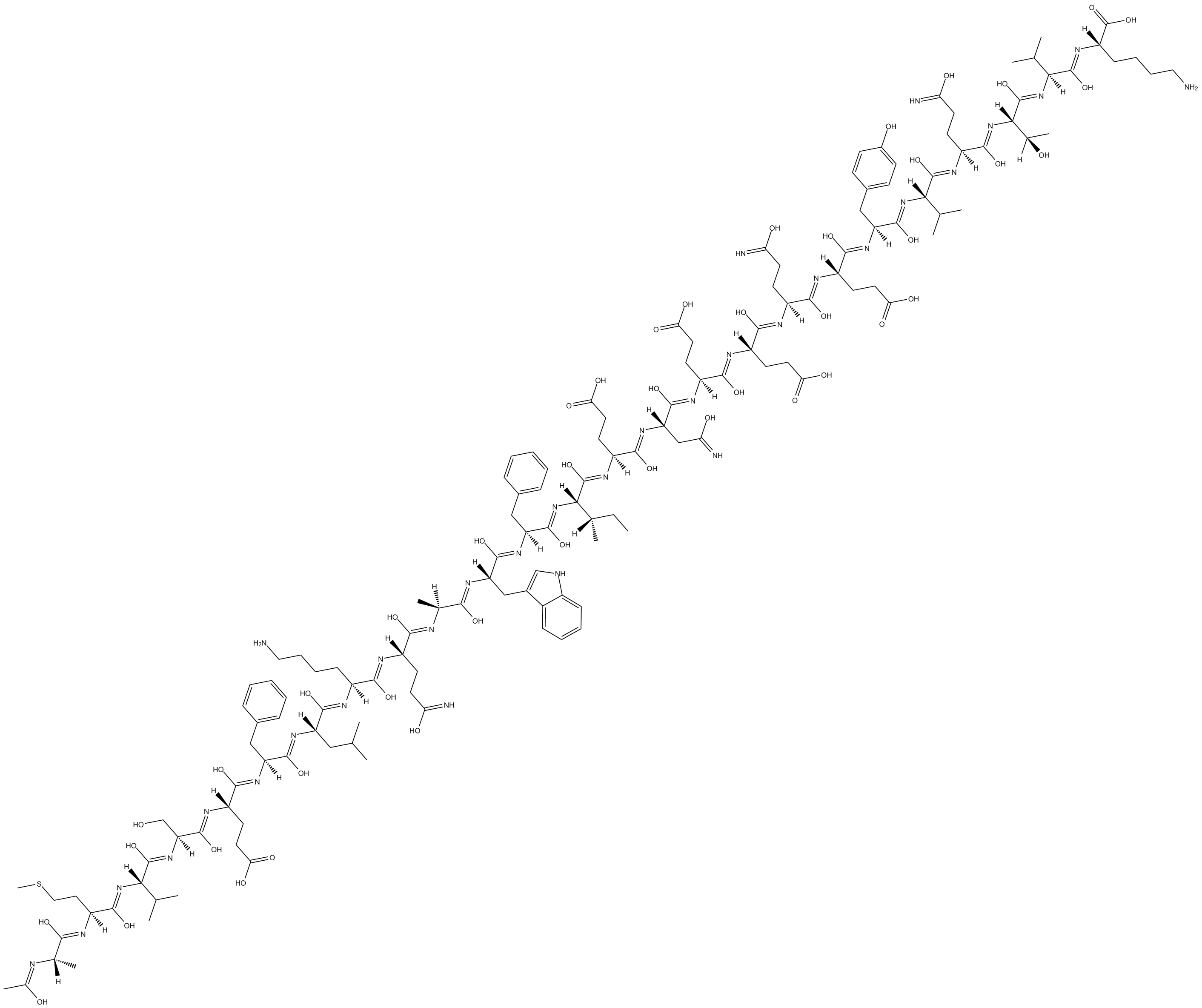
Cas No.: 151988-33-9
Sample solution is provided at 25 µL, 10mM.
Ac2-26 is an N-terminal peptide of annexin 1 with the activities of anti-inflammation [1]. Ac2-26 can inhibit mast cell degranulation, antigen-induced eotaxin release as well as the accumulation of both neutrophils and eosinophils in rat with pleurisy [2]. Ac2-26 has been widely used to inhibit the production of inflammatory mediators and to alleviate pain hypersensitivity in models of inflammatory pain in rats [3].
In vitro, Ac2-26 (1μM) treatment for 24 hours significantly promoted the migration of WS1 cells under high glucose conditions and increased the mobilization of intracellular Ca2+ [4]. 0.5μM of Ac2-26 pretreatment for 2 hours significantly inhibited the apoptosis of H9C2 cells induced by 10μg/ml Lipopolysaccharide (LPS), and enhanced the protein expression levels of LXA4 [5].
In vivo, Ac2-26 treatment via intraperitoneal injection at a dose of 250µg/kg 30 minutes before ischemia can rescue and alleviate liver ischemia-reperfusion (IR) injury in mice and relieve liver cell dysfunction[6]. In the rat model of IR lung injury, intraperitoneal injection of 1mg/kg dose of Ac2-26 for 30 minutes significantly reduced pulmonary edema and the production of pro-inflammatory cytokines in bronchoalveolar lavage fluid[7]. A single intraperitoneal injection of 1mg/kg dose of Ac2-26 can alleviate the neuroinflammation in a mouse model of bacterial meningitis within 6 hours[8].
References:
[1] Fredman G, Kamaly N, Spolitu S, et al. Targeted nanoparticles containing the proresolving peptide Ac2-26 protect against advanced atherosclerosis in hypercholesterolemic mice[J]. Science translational medicine, 2015, 7(275): 275ra20-275ra20.
[2] Wang L, Li W, Xu Y, et al. Annexin 1-derived peptide Ac2-26 inhibits eosinophil recruitment in vivo via decreasing prostaglandin D2[J]. International archives of allergy and immunology, 2011, 154(2): 137-148.
[3] Luo Z, Wang H, Fang S, et al. Annexin-1 mimetic peptide Ac2-26 suppresses inflammatory mediators in LPS-induced astrocytes and ameliorates pain hypersensitivity in a rat model of inflammatory pain[J]. Cellular and molecular neurobiology, 2020, 40(4): 569-585.
[4] Bizzarro V, Fontanella B, Carratu A, et al. Annexin A1 N-terminal derived peptide Ac2-26 stimulates fibroblast migration in high glucose conditions[J]. 2012.
[5] Zhang L, Zheng Y L, Hu R, et al. Annexin A1 mimetic peptide AC2-26 inhibits sepsis-induced cardiomyocyte apoptosis through LXA4/PI3K/AKT signaling pathway[J]. Current medical science, 2018, 38(6): 997-1004.
[6] Bai C, Jiang Z, Jiang H, et al. Ac2‑26 alleviates hepatic ischemia‑reperfusion injury based on inhibiting the positive feedback loop of HMGB1/TLR4/NF‑κB/neutrophils[J]. Experimental and Therapeutic Medicine, 2022, 24(5): 673.
[7] Liao W I, Wu S Y, Wu G C, et al. Ac2-26, an Annexin A1 peptide, attenuates ischemia-reperfusion-induced acute lung injury[J]. International journal of molecular sciences, 2017, 18(8): 1771.
[8] Rüger M, Kipp E, Schubert N, et al. The formyl peptide receptor agonist Ac2-26 alleviates neuroinflammation in a mouse model of pneumococcal meningitis[J]. Journal of neuroinflammation, 2020, 17(1): 325.
| Cell experiment [1]: | |
Cell lines | H9C2 cells |
Preparation Method | H9C2 cells were cultured in Dulbecco’s Modified Eagle’s Medium (DMEM) supplemented with 100μg/ml streptomycin, 100μg/ml penicillin and 10% fetal bovine serum at 37°C in an incubator with 5% CO2. The cells were divided into three groups as follows: control group, in which cells were only given the basic culture medium; LPS group, in which cells were treated with 10μg/ml LPS; and the Ac2-26 group, in which cells were treated with Ac2-26 (0.5μM) for 2h before 10μg/ml LPS was given. The cells in LPS group and Ac2-26 group were stimulated by LPS for 24h before experiments. The apoptosis of H9C2 cells was detected by flow cytometry. The protein levels of LXA4, PI3K, and AKT were determined by Western blotting. |
Reaction Conditions | 0.5μM; 2h |
Applications | Ac2-26 inhibited the apoptosis of H9C2 cells induced LPS, enhanced the protein expression levels of LXA4 and reduced levels of PI3K and AKT. |
| Animal experiment [2]: | |
Animal models | Male C57BL/6 mice |
Preparation Method | Male C57BL/6 mice, aged 8 weeks with weights of 22-25g, were housed in cages and maintained in air-conditioned animal quarters with a 12h light-dark cycle and free access to autoclaved tap water and a standard chow diet. A week later, before the operation, the animals were randomly allocated into sham, I/R, I/R + Ac2-26 and Ac2-26 groups (n=6). Mice in the I/R + Ac2-26 group were administered Ac2-26 at a dose of 250µg/kg via intraperitoneal injection 30min before ischemia, mice in the sham and Ac2-26 groups received the same anesthetic and laparotomy, with the exception of surgery. Briefly, mice were anesthetized via intraperitoneal injection of 1% pentobarbital sodium (40mg/kg) and the left and middle branches of the hepatic pedicle were occluded by clamping them with a noninvasive vascular clip for 45min, followed by 24h of reperfusion. The liver color change from red to dark purple, which indicated that the model was successfully established. Body temperature was maintained with an appropriative heating pad at 37±0.4˚C upon surgical procedures. Animals were provided food and water after fully awake. During the operation three mice succumbed due to intraoperative bleeding (mortality rate of 4.2%). Animal's health and behavior was monitored every half hour after surgery, including respiratory rate and depth, mucous membrane coloration and wounds. The serum levels of ALT and AST were detected. |
Dosage form | 250µg/kg for once; i.p. |
Applications | Ac2-26 treatment reduced serum levels of ALT and AST in mice with IR injury. |
References: | |
| Cas No. | 151988-33-9 | SDF | |
| Canonical SMILES | CC[C@]([C@@](/N=C(O)/[C@](/N=C(O)/[C@](/N=C(O)/[C@](/N=C(O)/[C@](/N=C(O)/[C@](/N=C(O)/[C@](/N=C(O)/[C@](/N=C(O)/[C@](/N=C(O)/[C@](/N=C(O)/[C@](/N=C(O)/[C@](/N=C(O)/[C@](/N=C(O)/C)([H])C)([H])CCSC)([H])C(C)C)([H])CO)([H])CCC(O)=O)([H])CC1=CC=CC=C1)([H])CC( | ||
| Formula | C141H210N32O44S | M.Wt | 3089.46 |
| Solubility | Soluble to 1 mg/ml in PBS | Storage | Store at -20°C,protect from light |
| General tips | Please select the appropriate solvent to prepare the stock solution according to the
solubility of the product in different solvents; once the solution is prepared, please store it in
separate packages to avoid product failure caused by repeated freezing and thawing.Storage method
and period of the stock solution: When stored at -80°C, please use it within 6 months; when stored
at -20°C, please use it within 1 month. To increase solubility, heat the tube to 37°C and then oscillate in an ultrasonic bath for some time. |
||
| Shipping Condition | Evaluation sample solution: shipped with blue ice. All other sizes available: with RT, or with Blue Ice upon request. | ||
| Prepare stock solution | |||

|
1 mg | 5 mg | 10 mg |
| 1 mM | 323.7 μL | 1.6184 mL | 3.2368 mL |
| 5 mM | 64.7 μL | 323.7 μL | 647.4 μL |
| 10 mM | 32.4 μL | 161.8 μL | 323.7 μL |
Step 1: Enter information below (Recommended: An additional animal making an allowance for loss during the experiment)
 g
μL
g
μL
Step 2: Enter the in vivo formulation (This is only the calculator, not formulation. Please contact us first if there is no in vivo formulation at the solubility Section.)
Calculation results:
Working concentration: mg/ml;
Method for preparing DMSO master liquid: mg drug pre-dissolved in μL DMSO ( Master liquid concentration mg/mL, Please contact us first if the concentration exceeds the DMSO solubility of the batch of drug. )
Method for preparing in vivo formulation: Take μL DMSO master liquid, next addμL PEG300, mix and clarify, next addμL Tween 80, mix and clarify, next add μL saline, mix and clarify.
Method for preparing in vivo formulation: Take μL DMSO master liquid, next add μL Corn oil, mix and clarify.
Note: 1. Please make sure the liquid is clear before adding the next solvent.
2. Be sure to add the solvent(s) in order. You must ensure that the solution obtained, in the previous addition, is a clear solution before proceeding to add the next solvent. Physical methods such as vortex, ultrasound or hot water bath can be used to aid dissolving.
3. All of the above co-solvents are available for purchase on the GlpBio website.
Quality Control & SDS
- View current batch:
- Purity: >98.50% Appearance: A solid
- COA (Certificate of Analysis)
- SDS (Safety Data Sheet)
- Datasheet
Average Rating: 5 (Based on Reviews and 27 reference(s) in Google Scholar.)