

Apocynin (Synonyms: Acetoguaiacone, Acetovanillone, NSC 2146, NSC 209524) |
Catalog No.GC16237
 One-Click Copy Product Info
|

Apocynin, a naturally occurring acetophenone, is a potent inhibitor of the complex NADPH-oxidase with an IC50 value of 10μM.
Products are for research use only. Not for human use. We do not sell to patients.
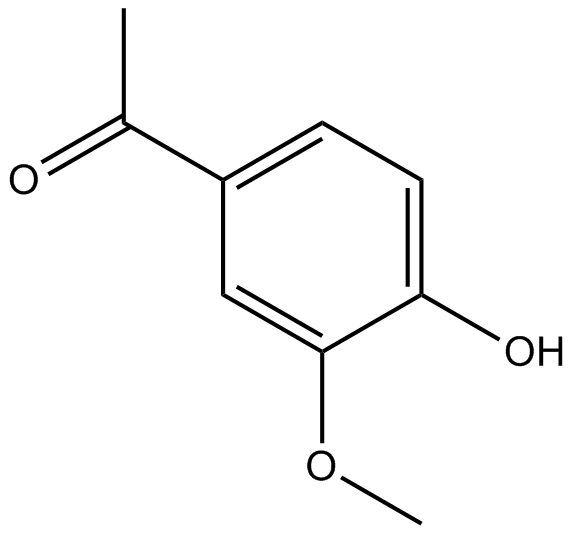
Cas No.: 498-02-2
Sample solution is provided at 25 µL, 10mM.
Apocynin, a naturally occurring acetophenone, is a potent inhibitor of the complex NADPH-oxidase with an IC50 value of 10μM[1]. Apocynin prevents translocation of p47phox subunit to the plasma membrane[2]. Apocynin can inhibit the generation of eNOS-dependent superoxide in diabetic cardiomyopathy, reduce the activation of NLRP3 and TGFβ/Smad signaling in diabetic nephropathy, and serve as a model compound for developing new therapeutic drugs for cardiovascular diseases[3].
In vitro, Apocynin treatment (300µM; 6h) increased the accumulation of nitrite in the extracellular culture medium of N11 mouse glial cells, and enhanced the activity of nitric oxide synthase (NOS) in the cell lysates[4]. Treatment of rat vascular smooth muscle cells with 100μM Apocynin for 15 minutes significantly inhibited the phosphorylation of Akt and extracellular signal-regulated kinase 1/2, and weakened the activation of p38 mitogen-activated protein kinase and Akt and extracellular signal-regulated kinase 1/2 induced by reactive oxygen species (ROS), as well as the production of superoxide anions[5].
In vivo, Apocynin treatment via intraperitoneal injection of 10mg/kg/day for 4 consecutive days can alleviate the morphological and histological changes in the lungs of rats induced by lipopolysaccharide (LPS), reduce pulmonary edema, lower pulmonary permeability, and decrease the MPO activity induced by LPS in the bronchoalveolar fluid and lung homogenate of rats, as well as TNF-α and IL-1β in the plasma[6]. Intravenous injection of 2.5mg/kg of Apocynin for 30 minutes before experimental stroke can improve neurological function, reduce infarct volume, and decrease the incidence of cerebral hemorrhage in the mouse model[7]. In SAMP6 mice, after 3 months of treatment with Apocynin via intraperitoneal injection (0.1mg/kg/day), both bone mineral density and total bone mass increased, and the activity of osteoblasts significantly enhanced in shin bones of mice[8].
References:
[1] Stefanska J, Pawliczak R. Apocynin: molecular aptitudes[J]. Mediators of inflammation, 2008, 2008(1): 106507.
[2] Savla S R, Laddha A P, Kulkarni Y A. Pharmacology of apocynin: a natural acetophenone[J]. Drug metabolism reviews, 2021, 53(4): 542-562.
[3] Bhatia A, Thakur S, Kohal R, et al. A comprehensive update on phytochemistry and medicinal developments of apocynin[J]. Fitoterapia, 2025: 106558.
[4] Riganti C, Costamagna C, Doublier S, et al. The NADPH oxidase inhibitor apocynin induces nitric oxide synthesis via oxidative stress[J]. Toxicology and applied pharmacology, 2008, 228(3): 277-285.
[5] Heumüller S, Wind S, Barbosa-Sicard E, et al. Apocynin is not an inhibitor of vascular NADPH oxidases but an antioxidant[J]. Hypertension, 2008, 51(2): 211-217.
[6] Kouki A, Ferjani W, Ghanem-Boughanmi N, et al. The NADPH oxidase inhibitors apocynin and diphenyleneiodonium protect rats from LPS-induced pulmonary inflammation[J]. Antioxidants, 2023, 12(3): 770.
[7] Tang X N, Cairns B, Cairns N, et al. Apocynin improves outcome in experimental stroke with a narrow dose range[J]. Neuroscience, 2008, 154(2): 556-562.
[8] Sun J, Ming L, Shang F, et al. Apocynin suppression of NADPH oxidase reverses the aging process in mesenchymal stem cells to promote osteogenesis and increase bone mass[J]. Scientific Reports, 2015, 5(1): 18572.
| Cell experiment [1]: | |
Cell lines | The N11 mouse glial cell |
Preparation Method | The N11 mouse glial cells were cultured in a 35-mm diameter (used for determining nitrite, hydrogen peroxide and enzyme activities) petri dish until confluence. The culture medium was Dulbecco modified Eagle medium supplemented with 10% fetal bovine serum. Then, the cells were incubated for 6 hours with Apocynin (10, 30, 60, 100, 300, 600, 1200µM). After incubation, 0.15ml of cell culture medium was added to 0.15ml of Griess reagent in a 96-well plate and incubated at 37°C in the dark for 10 minutes. The absorbance at 540nm was measured using a microplate reader. A blank was prepared without cells and the absorbance from the samples was subtracted from it. A calibration curve was established using nitrite as the standard. The nitrite concentration was expressed as nmol nitrite/h/mg cellular protein. The confluent cells grown in the 35-mm diameter petri dish were separated using trypsin/EDTA, washed with PBS, and resuspended in 0.3ml of Hepes/EDTA/DTT buffer (20mM Hepes, 0.5mM EDTA, 1mM DTT, pH 7.2). Two 10-second ultrasonic treatments were performed on the sample on ice. The NOS activity of 100µg of cell lysate was determined using a nitric oxide synthase ultrasensitive colorimetric assay kit. This method uses the NADPH cycling system to enable NOS to catalyze the production of NO at a constant level for several hours. The stable NO degradation product nitrite accumulated during this period was determined using Griess reagent. |
Reaction Conditions | 10, 30, 60, 100, 300, 600, 1200µM; 6h |
Applications | Apocynin significantly enhanced the accumulation of nitrite and promoted NOS activity in N11 mouse glial cells. |
| Animal experiment [2]: | |
Animal models | Male Wistar rat |
Preparation Method | Male Wistar rats, weighing 213 ± 15g, were randomly divided into four groups, with five rats in each group. All the rats were raised under controlled conditions throughout the experiment. The rats had free access to water. The environmental conditions included a temperature of (22 ± 1℃), humidity of (65-70%), and a 12:12 hour light-dark cycle. Two groups (the control group and the LPS group) were intraperitoneally injected with dimethyl sulfoxide (DMSO) every day for two consecutive days. The control group was instilled with PBS, while the LPS group was instilled with LPS (1.5mg/mL). The AP group and (AP + LPS) group were intraperitoneally injected with Apocynin dissolved in DMSO (10mg/kg) every day, followed by instillation with PBS. The (AP + LPS) group was treatment with Apocynin (10mg/kg; i.p) + LPS (1.5mg/mL). The entire experiment lasted for 4 days. At the end of the experiment, the rats were decapitated. The plasma and organs were carefully collected. The lung tissue was fixed in 10% formalin-PBS solution overnight, dehydrated in gradient ethanol solution, and embedded in paraffin. The tissue specimens were cut into 5µm thick sections, stained with hematoxylin-eosin (H&E), and examined under an optical microscope. |
Dosage form | 10mg/kg/day for 4 days; i.p. |
Applications | Apocynin treatment significantly alleviated the pulmonary morphological and histological changes induced by LPS, as well as reduced pulmonary edema in rats. |
References: | |
| Cas No. | 498-02-2 | SDF | |
| Synonyms | Acetoguaiacone, Acetovanillone, NSC 2146, NSC 209524 | ||
| Canonical SMILES | OC1=CC=C(C(C)=O)C=C1OC | ||
| Formula | C9H10O3 | M.Wt | 166.17 |
| Solubility | ≥ 8.25mg/mL in DMSO | Storage | Store at RT |
| General tips | Please select the appropriate solvent to prepare the stock solution according to the
solubility of the product in different solvents; once the solution is prepared, please store it in
separate packages to avoid product failure caused by repeated freezing and thawing.Storage method
and period of the stock solution: When stored at -80°C, please use it within 6 months; when stored
at -20°C, please use it within 1 month. To increase solubility, heat the tube to 37°C and then oscillate in an ultrasonic bath for some time. |
||
| Shipping Condition | Evaluation sample solution: shipped with blue ice. All other sizes available: with RT, or with Blue Ice upon request. | ||
| Prepare stock solution | |||

|
1 mg | 5 mg | 10 mg |
| 1 mM | 6.0179 mL | 30.0897 mL | 60.1793 mL |
| 5 mM | 1.2036 mL | 6.0179 mL | 12.0359 mL |
| 10 mM | 601.8 μL | 3.009 mL | 6.0179 mL |
Step 1: Enter information below (Recommended: An additional animal making an allowance for loss during the experiment)
 g
μL
g
μL
Step 2: Enter the in vivo formulation (This is only the calculator, not formulation. Please contact us first if there is no in vivo formulation at the solubility Section.)
Calculation results:
Working concentration: mg/ml;
Method for preparing DMSO master liquid: mg drug pre-dissolved in μL DMSO ( Master liquid concentration mg/mL, Please contact us first if the concentration exceeds the DMSO solubility of the batch of drug. )
Method for preparing in vivo formulation: Take μL DMSO master liquid, next addμL PEG300, mix and clarify, next addμL Tween 80, mix and clarify, next add μL saline, mix and clarify.
Method for preparing in vivo formulation: Take μL DMSO master liquid, next add μL Corn oil, mix and clarify.
Note: 1. Please make sure the liquid is clear before adding the next solvent.
2. Be sure to add the solvent(s) in order. You must ensure that the solution obtained, in the previous addition, is a clear solution before proceeding to add the next solvent. Physical methods such as vortex, ultrasound or hot water bath can be used to aid dissolving.
3. All of the above co-solvents are available for purchase on the GlpBio website.
Quality Control & SDS
- View current batch:
- Purity: >99.50% Appearance: A solid
- COA (Certificate of Analysis)
- SDS (Safety Data Sheet)
- Datasheet
Average Rating: 5 (Based on Reviews and 23 reference(s) in Google Scholar.)