

astragalin (Synonyms: Astragalin, Kaempferol 3-β-D-glucopyranoside) |
Catalog No.GN10561
 One-Click Copy Product Info
|

Astragalin is a natural flavonoid compound with strong antioxidant and anti-inflammatory activities and has shown potential therapeutic applications in various diseases, including cancer and cardiovascular diseases.
Products are for research use only. Not for human use. We do not sell to patients.
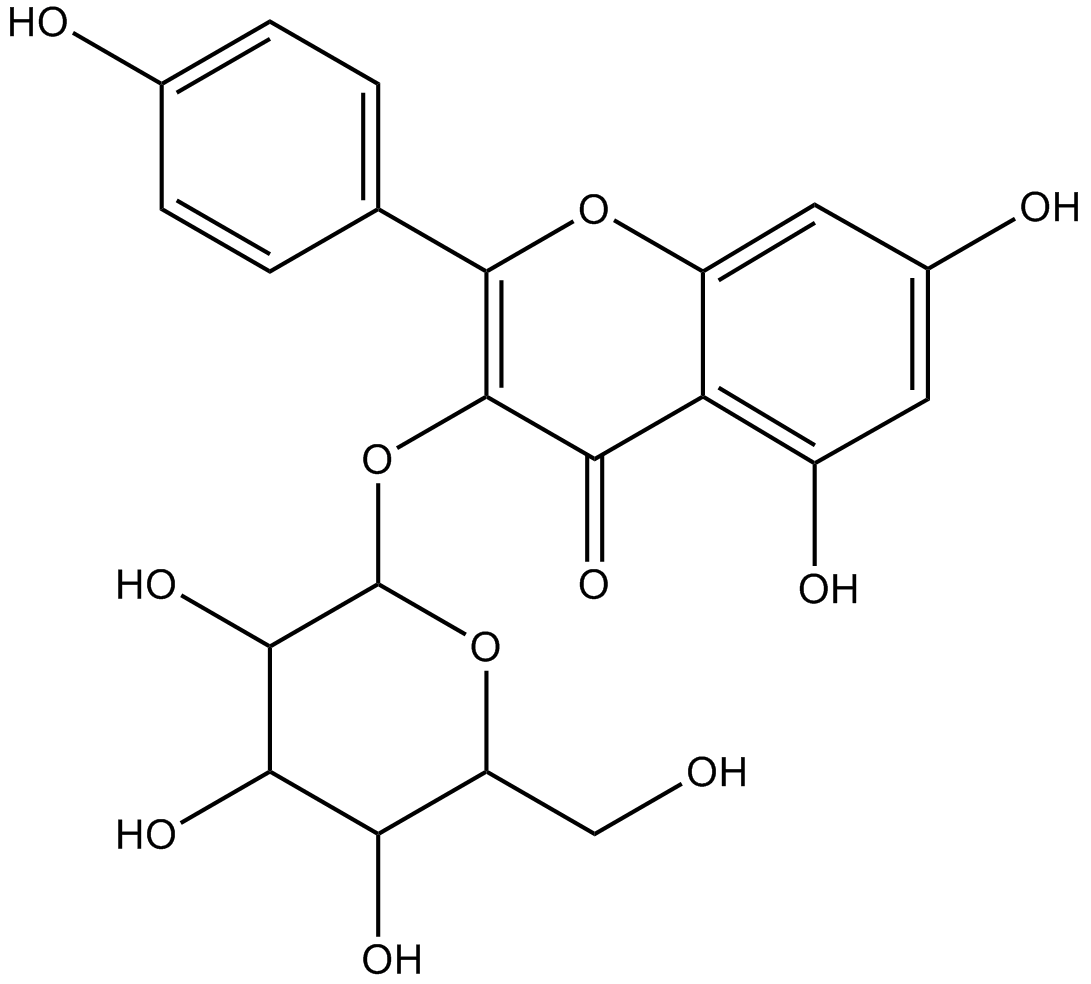
Cas No.: 480-10-4
Sample solution is provided at 25 µL, 10mM.
_1-3.$$$39978408@51.jpg');)
_1-9.$$$38538795@65.jpg');)
_1-9.$$$39112701@51.jpg');)
_1-7.$$$37316672@70.jpg');)
_366-372.$$$36198801@70.jpg');)
.$$$38565142@65.jpg');)
_1867-1883.$$$33248023@67.jpg');)
_eads6055.$$$39977546@45.jpg');)
_eadm9805.$$$40080571@45.jpg');)
_eadj3020.$$$39666821@45.jpg');)
_1-20.$$$39757301@28.jpg');)
_1-24.$$$38898113@28.jpg');)
_273-287.$$$36806353@46.jpg');)
_1-16.$$$37156877@44.jpg');)
_1-19.$$$37460805@44.jpg');)
_1291-1307.$$$34518654@46.jpg');)
Astragalin is a natural flavonoid compound with strong antioxidant and anti-inflammatory activities and has shown potential therapeutic applications in various diseases, including cancer and cardiovascular diseases[1]. Astragalin is extracted from plants such as Mongolian milkvetch (Astragalus membranaceus) and sumac (Rhus chinensis)[2]. In cancer research, Astragalin has been reported to inhibit the proliferation of cancer cells and induce apoptosis[3]. Astragalin also protects the cardiovascular system by reducing oxidative stress and inflammation[4].
In vitro, Astragalin (0–100µM) treatment of human colorectal epithelial cells (HCT-116 and HT-29) significantly inhibited cell proliferation. Pre-treatment with Astragalin significantly reduced the mRNA expression levels of tumor necrosis factor-α (TNF-α)-induced interleukin-6 (IL-6), IL-8, and TNF-α. Additionally, Astragalin inhibited the phosphorylation and degradation of IκBα induced by TNF-α and reduced the DNA-binding activity of NF-κB[5]. Astragalin (1–20µM) treatment of human bronchial epithelial cells (BEAS-2B) significantly inhibited the epithelial-mesenchymal transition (EMT) process induced by oxidative stress. Astragalin restored the reduced expression of E-cadherin induced by H₂O₂ and dose-dependently inhibited the expression of vimentin and the formation of autophagosomes[6].
In vivo, Astragalin (10, 20, 40mg/kg) was administered via intraperitoneal injection to APP/PS1 transgenic mice once daily for one month. Astragalin significantly improved cognitive dysfunction in APP/PS1 mice. Astragalin also alleviated neuronal damage in the hippocampus, reduced amyloid-β (Aβ) deposition and the number of senile plaques, and activated autophagy by promoting the expression of autophagy-related proteins (LC3B, Beclin-1, ATG5, ATG12, and LAMP-1). Furthermore, Astragalin inhibited the phosphorylation levels of PI3K/Akt-mTOR signaling pathway-related proteins, thereby exerting neuroprotective effects[7]. Astragalin (5, 10mg/kg/day) was administered orally to streptozotocin (STZ)-induced diabetic mice for 4 weeks. Astragalin significantly improved proteinuria and reduced serum creatinine levels in diabetic mice. Astragalin also alleviated renal pathological damage. Astragalin significantly inhibited the activity of aldose reductase (ALR2) in the kidneys, reduced oxidative stress, improved mitochondrial dysfunction, promoted mitochondrial biogenesis, maintained mitochondrial dynamic balance, and reduced renal cell apoptosis by activating the AMPK-dependent PGC1α pathway[8].
References:
[1] Chen J, Zhong K, Qin S, et al. Astragalin: a food-origin flavonoid with therapeutic effect for multiple diseases. Front Pharmacol. 2023 Oct 18;14:1265960.
[2] Riaz A, Rasul A, Hussain G, et al. Astragalin: A Bioactive Phytochemical with Potential Therapeutic Activities. Adv Pharmacol Sci. 2018 May 2;2018:9794625.
[3] Ruan J, Shi Z, Cao X, et al. Research Progress on Anti-Inflammatory Effects and Related Mechanisms of Astragalin. Int J Mol Sci. 2024 Apr 19;25(8):4476.
[4] Zhang Q, Yan Y. The role of natural flavonoids on neuroinflammation as a therapeutic target for Alzheimer's disease: a narrative review. Neural Regen Res. 2023 Dec;18(12):2582-2591.
[5] Han YM, Koh J, Kim JH, et al. Astragalin Inhibits Nuclear Factor-κB Signaling in Human Colonic Epithelial Cells and Attenuates Experimental Colitis in Mice. Gut Liver. 2021 Jan 15;15(1):100-108.
[6] Cho IH, Choi YJ, Gong JH, et al. Astragalin inhibits autophagy-associated airway epithelial fibrosis. Respir Res. 2015 Apr 21;16(1):51.
[7] Yang CZ, Wang SH, Zhang RH, et al. Neuroprotective effect of astragalin via activating PI3K/Akt-mTOR-mediated autophagy on APP/PS1 mice. Cell Death Discov. 2023 Jan 21;9(1):15.
[8] Sun MY, Ye HJ, Zheng C, et al. Astragalin ameliorates renal injury in diabetic mice by modulating mitochondrial quality control via AMPK-dependent PGC1α pathway. Acta Pharmacol Sin. 2023 Aug;44(8):1676-1686.
| Cell experiment [1]: | |
Cell lines | BEAS-2B cells |
Preparation Method | BEAS-2B cells were seeded into 6-well plates at a density of 5 × 10⁴ cells per well and cultured in HEPES-buffered M199 medium containing 10% FBS and other supplements for 24 hours. The cells were then pretreated with different concentrations (1, 5, 10, and 20μM) of Astragalin for 1 hour before being stimulated with 20μM H₂O₂ for up to 72 hours. |
Reaction Conditions | 1, 5, 10, and 20μM Astragalin; 20μM H₂O₂; 72 hours |
Applications | Astragalin significantly restored the expression of E-cadherin and inhibited the induction of vimentin in H₂O₂-treated BEAS-2B cells, indicating its ability to attenuate EMT. Astragalin blocked the induction of autophagy-related proteins beclin-1 and LC3A/B and reduced autophagosome formation. |
| Animal experiment [2]: | |
Animal models | C57BL/6J mice |
Preparation Method | Six-week-old male C57BL/6J mice were used. Diabetes was induced by intraperitoneal injection of streptozotocin (STZ, 100mg/kg/day) for two consecutive days. Seven days after injection, mice with random blood glucose ≥16.7mmol/L were randomly divided into groups and treated with Astragalin (5 and 10mg/kg/day) by oral gavage for 4 weeks. At the end of the experiment, blood and kidney tissues were collected for analysis. |
Dosage form | 5 and 10mg/kg/day for 4 weeks; p.o. |
Applications | Astragalin significantly improved renal function by reducing proteinuria, lowering serum creatinine levels, and improving kidney pathological damage in diabetic mice. It also inhibited aldose reductase activity, reduced oxidative stress, improved mitochondrial dysfunction, and regulated mitochondrial dynamics by activating the AMPK/PGC1α pathway. |
References: | |
| Cas No. | 480-10-4 | SDF | |
| Synonyms | Astragalin, Kaempferol 3-β-D-glucopyranoside | ||
| Chemical Name | 5,7-dihydroxy-2-(4-hydroxyphenyl)-3-[(2S,3R,4S,5S,6R)-3,4,5-trihydroxy-6-(hydroxymethyl)oxan-2-yl]oxychromen-4-one | ||
| Canonical SMILES | C1=CC(=CC=C1C2=C(C(=O)C3=C(C=C(C=C3O2)O)O)OC4C(C(C(C(O4)CO)O)O)O)O | ||
| Formula | C21H20O11 | M.Wt | 448.38 |
| Solubility | ≥ 44.8mg/mL in DMSO | Storage | Store at 2-8°C,protect from light |
| General tips | Please select the appropriate solvent to prepare the stock solution according to the
solubility of the product in different solvents; once the solution is prepared, please store it in
separate packages to avoid product failure caused by repeated freezing and thawing.Storage method
and period of the stock solution: When stored at -80°C, please use it within 6 months; when stored
at -20°C, please use it within 1 month. To increase solubility, heat the tube to 37°C and then oscillate in an ultrasonic bath for some time. |
||
| Shipping Condition | Evaluation sample solution: shipped with blue ice. All other sizes available: with RT, or with Blue Ice upon request. | ||
| Prepare stock solution | |||

|
1 mg | 5 mg | 10 mg |
| 1 mM | 2.2303 mL | 11.1513 mL | 22.3025 mL |
| 5 mM | 446.1 μL | 2.2303 mL | 4.4605 mL |
| 10 mM | 223 μL | 1.1151 mL | 2.2303 mL |
Step 1: Enter information below (Recommended: An additional animal making an allowance for loss during the experiment)
 g
μL
g
μL
Step 2: Enter the in vivo formulation (This is only the calculator, not formulation. Please contact us first if there is no in vivo formulation at the solubility Section.)
Calculation results:
Working concentration: mg/ml;
Method for preparing DMSO master liquid: mg drug pre-dissolved in μL DMSO ( Master liquid concentration mg/mL, Please contact us first if the concentration exceeds the DMSO solubility of the batch of drug. )
Method for preparing in vivo formulation: Take μL DMSO master liquid, next addμL PEG300, mix and clarify, next addμL Tween 80, mix and clarify, next add μL saline, mix and clarify.
Method for preparing in vivo formulation: Take μL DMSO master liquid, next add μL Corn oil, mix and clarify.
Note: 1. Please make sure the liquid is clear before adding the next solvent.
2. Be sure to add the solvent(s) in order. You must ensure that the solution obtained, in the previous addition, is a clear solution before proceeding to add the next solvent. Physical methods such as vortex, ultrasound or hot water bath can be used to aid dissolving.
3. All of the above co-solvents are available for purchase on the GlpBio website.
Quality Control & SDS
- View current batch:
- Purity: >98.00% Appearance: A solid
- COA (Certificate of Analysis)
- SDS (Safety Data Sheet)
- Datasheet
Average Rating: 5 (Based on Reviews and 30 reference(s) in Google Scholar.)