

BMS 309403 (Synonyms: Adipocyte FABP Inhibitor, AFABP Inhibitor, ALBP Inhibitor, aP2 Inhibitor, FABP4 Inhibitor, Fatty Acid Binding Protein 4 Inhibitor) |
Catalog No.GC11894
 One-Click Copy Product Info
|

BMS 309403 is a potent, orally active and selective inhibitor of adipocyte fatty acid binding protein (FABP4), with an IC50 value of 0.71μM.
Products are for research use only. Not for human use. We do not sell to patients.
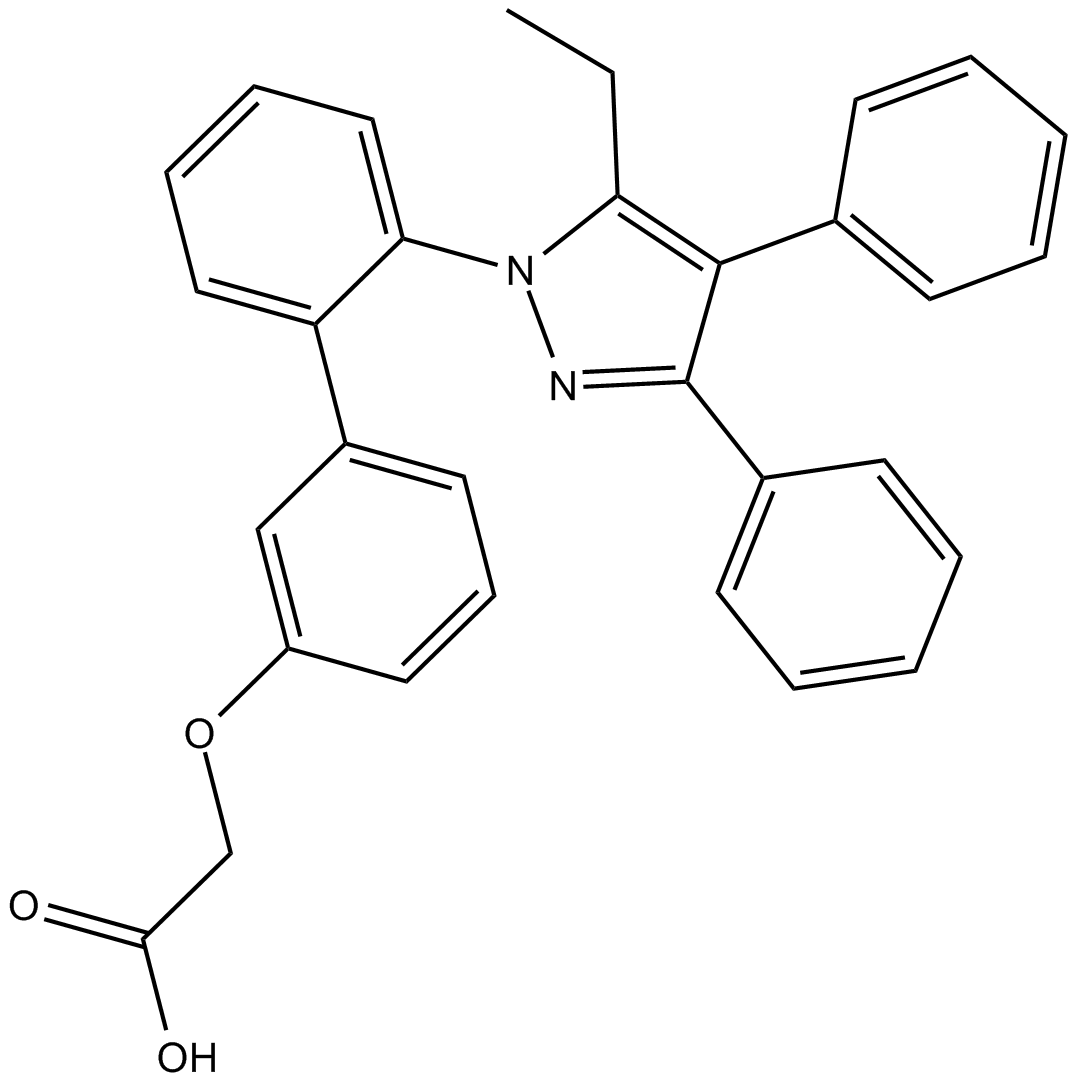
Cas No.: 300657-03-8
Sample solution is provided at 25 µL, 10mM.
BMS 309403 is a potent, orally active and selective inhibitor of adipocyte fatty acid binding protein (FABP4), with an IC50 value of 0.71μM [1]. The pyrazole core and the 4-position aromatic ring of BMS 309403 can respectively be inserted into two different hydrophobic pockets of the lipid transporter domain of FABP4 to exhibit inhibitory effect and reduce lipid accumulation[2]. BMS 309403 has been widely used to attenuate a systemic inflammatory damage in mice [3].
In vitro, BMS 309403 treatment for 72 hours significantly inhibited the proliferation of A2780 cells, SKOV3 cells and OVCAR3 cells, with IC50 values of 48.1µM, 71.2µM and 60.5µM, respectively[4]. 5μM dose of BMS 309403 pretreatment for 2 hours significantly inhibited the DNA synthesis and cell migration of rat vascular smooth muscle cells (VSMCs) induced by PDGF-BB (10ng/ml; 24 hours)[5]. Treatment with 50µM BMS 309403 for 24 hours can alleviate endoplasmic reticulum stress in H9c2 cardiomyocytes under hypoxic conditions and reduce cell apoptosis[6].
In vivo, BMS 309403 treatment via oral administration at a dose of 40mg/kg/day for 6 consecutive weeks could lead to a reduction in liver fat infiltration in ob/ob mice, a significant decrease in total liver triglyceride content, and alleviation of atherosclerosis[7]. For three consecutive weeks, intragastric administration of 40mg/kg/day dose of BMS 309403 significantly inhibited renal inflammation and fibrosis in mice with hyperuricemia, improved renal dysfunction, suppressed the mRNA levels of KIM-1 and NGAL, and reduced the expression of pro-inflammatory cytokines and fibrotic proteins in the damaged kidneys[8].
References:
[1] Okada T, Hiromura M, Otsuka M, et al. Synthesis of BMS-309403-related compounds, including [14C] BMS-309403, a radioligand for adipocyte fatty acid binding protein[J]. Chemical and Pharmaceutical Bulletin, 2012, 60(1): 164-168.
[2] Chen S, Pan Z, Liu M, et al. Recent Advances on Small-Molecule Inhibitors of Lipocalin-like Proteins[J]. Journal of Medicinal Chemistry, 2024, 67(7): 5144-5167.
[3] Su H, Zou Y, Chen G, et al. Exploration of fragment binding poses leading to efficient discovery of highly potent and orally effective inhibitors of FABP4 for anti-inflammation[J]. Journal of Medicinal Chemistry, 2020, 63(8): 4090-4106.
[4] Lemberger L, Wagner R, Heller G, et al. Pharmacological inhibition of lipid import and transport proteins in ovarian cancer[J]. Cancers, 2022, 14(23): 6004.
[5] Okamura Y, Otani K, Sekiguchi A, et al. Vasculo-protective effect of BMS-309403 is independent of its specific inhibition of fatty acid-binding protein 4[J]. Pflügers Archiv-European Journal of Physiology, 2017, 469(9): 1177-1188.
[6] Sun F, Du J, Li H, et al. FABP4 inhibitor BMS309403 protects against hypoxia‐induced H9c2 cardiomyocyte apoptosis through attenuating endoplasmic reticulum stress[J]. Journal of Cellular and Molecular Medicine, 2020, 24(19): 11188-11197.
[7] Furuhashi M, Tuncman G, Görgün C Z, et al. Treatment of diabetes and atherosclerosis by inhibiting fatty-acid-binding protein aP2[J]. Nature, 2007, 447(7147): 959-965.
[8] Shi M, Guo F, Liao D, et al. Pharmacological inhibition of fatty acid-binding protein 4 alleviated kidney inflammation and fibrosis in hyperuricemic nephropathy[J]. European journal of pharmacology, 2020, 887: 173570.
| Cell experiment [1]: | |
|
Cell lines |
A2780 cells |
|
Preparation Method |
The A2780 cells were cultured in a medium containing 10% fetal bovine serum (FBS), 100IU/ml penicillin-streptomycin and 2mM glutamine, with the culture conditions set at 37°C, 5% CO2 and 95% humidity. A2780 cells were seeded at a density of 2.35×10⁴ cells/ml in 96-well plates and cultured in a medium containing 5% FBS overnight. Then, different concentrations of BMS 309403 (0, 20, 40, 60, 80, and 100μM) were added and the cells were treated for 72 hours. Finally, the number of viable cells was determined. |
|
Reaction Conditions |
0, 20, 40, 60, 80, and 100μM; 72h |
|
Applications |
BMS 309403 treatment reduced cell viability of A2780 cells in a dose-dependent manner. |
| Animal experiment [2]: | |
|
Animal models |
Male C57BL/6J mice |
|
Preparation Method |
Male C57BL/6J mice (9-10 weeks old, weighing 25-27g) were housed in an environment with a temperature controlled at 23±2°C and a 12-hour light/12-hour dark cycle. Mice had free access to food and water. After an adaptation period of 1 week, the mice were randomly divided into 4 groups (n ≥ 6 in each group): control group, hyperuricemic nephropathy (HN) group, allopurinol group, and FABP4i group. The HN mouse model was established by intragastric administration. A 200μl solution of adenine (160mg/kg/day) and potassium oxonate (2400mg/kg/day) dissolved in double-distilled water was administered intragastrically daily for 3 weeks. The control group was given the same volume of double-distilled water. 3 hours after intragastric administration, the mice were given allopurinol (10mg/kg/day) or BMS 309403 (40mg/kg/day) daily. After 3 weeks, the mice were sacrificed and kidney samples were collected for subsequent analysis. |
|
Dosage form |
40mg/kg/day for 3 weeks; p.o. |
|
Applications |
BMS 309403 treatment suppressed kidney inflammation and fibrosis in hyperuricemic mice. |
|
References: |
|
| Cas No. | 300657-03-8 | SDF | |
| Synonyms | Adipocyte FABP Inhibitor, AFABP Inhibitor, ALBP Inhibitor, aP2 Inhibitor, FABP4 Inhibitor, Fatty Acid Binding Protein 4 Inhibitor | ||
| Chemical Name | 2-((2'-(5-ethyl-3,4-diphenyl-1H-pyrazol-1-yl)-[1,1'-biphenyl]-3-yl)oxy)acetic acid | ||
| Canonical SMILES | OC(COC1=CC(C2=CC=CC=C2N3N=C(C4=CC=CC=C4)C(C5=CC=CC=C5)=C3CC)=CC=C1)=O | ||
| Formula | C31H26N2O3 | M.Wt | 474.55 |
| Solubility | ≥ 18.15mg/mL in DMSO | Storage | Store at -20°C |
| General tips | Please select the appropriate solvent to prepare the stock solution according to the
solubility of the product in different solvents; once the solution is prepared, please store it in
separate packages to avoid product failure caused by repeated freezing and thawing.Storage method
and period of the stock solution: When stored at -80°C, please use it within 6 months; when stored
at -20°C, please use it within 1 month. To increase solubility, heat the tube to 37°C and then oscillate in an ultrasonic bath for some time. |
||
| Shipping Condition | Evaluation sample solution: shipped with blue ice. All other sizes available: with RT, or with Blue Ice upon request. | ||
| Prepare stock solution | |||

|
1 mg | 5 mg | 10 mg |
| 1 mM | 2.1073 mL | 10.5363 mL | 21.0726 mL |
| 5 mM | 421.5 μL | 2.1073 mL | 4.2145 mL |
| 10 mM | 210.7 μL | 1.0536 mL | 2.1073 mL |
Step 1: Enter information below (Recommended: An additional animal making an allowance for loss during the experiment)
 g
μL
g
μL
Step 2: Enter the in vivo formulation (This is only the calculator, not formulation. Please contact us first if there is no in vivo formulation at the solubility Section.)
Calculation results:
Working concentration: mg/ml;
Method for preparing DMSO master liquid: mg drug pre-dissolved in μL DMSO ( Master liquid concentration mg/mL, Please contact us first if the concentration exceeds the DMSO solubility of the batch of drug. )
Method for preparing in vivo formulation: Take μL DMSO master liquid, next addμL PEG300, mix and clarify, next addμL Tween 80, mix and clarify, next add μL saline, mix and clarify.
Method for preparing in vivo formulation: Take μL DMSO master liquid, next add μL Corn oil, mix and clarify.
Note: 1. Please make sure the liquid is clear before adding the next solvent.
2. Be sure to add the solvent(s) in order. You must ensure that the solution obtained, in the previous addition, is a clear solution before proceeding to add the next solvent. Physical methods such as vortex, ultrasound or hot water bath can be used to aid dissolving.
3. All of the above co-solvents are available for purchase on the GlpBio website.
Quality Control & SDS
- View current batch:
- Purity: >98.00% Appearance: A solid
- COA (Certificate of Analysis)
- SDS (Safety Data Sheet)
- Datasheet
Average Rating: 5 (Based on Reviews and 14 reference(s) in Google Scholar.)