

Broflanilide |
Catalog No.GC30521
 One-Click Copy Product Info
|

Broflanilide is a meta‑diamide broad‑spectrum insecticide and acts as a pro‑insecticide that is metabolically converted to its active form, des‑methyl broflanilide, a potent non‑competitive antagonist at the insect resistant‑to‑dieldrin (RDL) γ‑aminobutyric acid (GABA) receptor (IC₅₀=1.3nM against Spodoptera litura RDL GABAR).
Products are for research use only. Not for human use. We do not sell to patients.
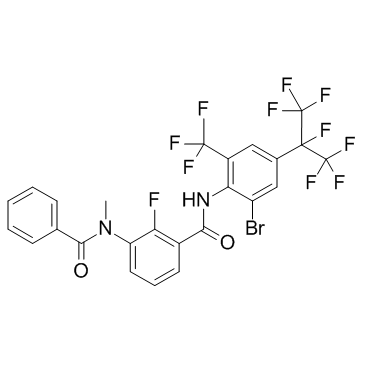
Cas No.: 1207727-04-5
Sample solution is provided at 25 µL, 10mM.
_1-3.$$$39978408@51.jpg');)
_1-9.$$$38538795@65.jpg');)
_1-9.$$$39112701@51.jpg');)
_1-7.$$$37316672@70.jpg');)
_366-372.$$$36198801@70.jpg');)
.$$$38565142@65.jpg');)
_1867-1883.$$$33248023@67.jpg');)
_eads6055.$$$39977546@45.jpg');)
_eadm9805.$$$40080571@45.jpg');)
_eadj3020.$$$39666821@45.jpg');)
_1-20.$$$39757301@28.jpg');)
_1-24.$$$38898113@28.jpg');)
_273-287.$$$36806353@46.jpg');)
_1-16.$$$37156877@44.jpg');)
_1-19.$$$37460805@44.jpg');)
_1291-1307.$$$34518654@46.jpg');)
Broflanilide is a meta‑diamide broad‑spectrum insecticide and acts as a pro‑insecticide that is metabolically converted to its active form, des‑methyl broflanilide, a potent non‑competitive antagonist at the insect resistant‑to‑dieldrin (RDL) γ‑aminobutyric acid (GABA) receptor (IC₅₀=1.3nM against Spodoptera litura RDL GABAR). Broflanilide is used for the control of lepidopteran and coleopteran pests on agricultural crops such as rice, vegetables, soybean, and cotton, as well as for the management of sanitary/urban pests including termites, cockroaches, mosquitoes, and flies[1-4].
In vitro, Broflanilide (50–125μg/mL) was applied to treat human neuroblastoma SH‑SY5Y cells for 8–24h. Broflanilide caused mitochondrial damage in the cells, induced DNA single‑strand breaks and double‑strand breaks as well as reactive‑oxygen‑species‑mediated oxidative DNA damage, and triggered mitochondrial‑mediated apoptosis while inhibiting cell viability[5]. Broflanilide (1–10nM) was applied to treat mouse mammary epithelial cells for 72h. Broflanilide reduced cell proliferation, upregulated cleaved caspase‑3 expression and elevated the BAX/Bcl‑2 ratio, thereby inducing apoptosis[6].
In vivo, Broflanilide (0.1–0.8mg/L) was administered to AB line zebrafish (Danio rerio) via waterborne exposure for 24–96h. Broflanilide induced excessive generation of reactive oxygen species (ROS) and accumulation of the lipid peroxidation product malondialdehyde (MDA) in zebrafish gill tissue, suppressed the antioxidant enzyme activities of superoxide dismutase (SOD), catalase (CAT), and glutathione peroxidase (GPx), upregulated tumor protein p53 (p53) and Bax, downregulated Bcl‑2, and simultaneously upregulated apaf‑1, caspase‑9, and caspase‑3expression, leading to gill cell apoptosis[7]. Broflanilide (5μg/L and 25μg/L; with daily medium renewal; continuous exposure) was administered to AB line zebrafish (Danio rerio) via waterborne exposure for 30 days. Broflanilide (25μg/L) induced abnormal locomotor behavior and cognitive deficits in zebrafish, accompanied by disruption of brain synaptic homeostasis, increased neural cell apoptosis, and neuronal loss; Broflanilide significantly altered metabolite levels including GABA, glutamate, and glutathione in the zebrafish brain and disturbed glutathione metabolism and GABAergic synaptic pathways; Broflanilide altered the cellular composition of brain neural cells[8].
References:
[1] van Herk WG, Vernon RS, Goudis L, et al. Broflanilide, a Meta-Diamide Insecticide Seed Treatment for Protection of Wheat and Mortality of Wireworms (Agriotes obscurus) in the Field. J Econ Entomol. 2021 Feb 9;114(1):161-173.
[2] Katsuta H, Nomura M, Wakita T, et al. Discovery of broflanilide, a novel insecticide. J Pestic Sci. 2019 May 20;44(2):120-128.
[3] Nakao T, Banba S. Broflanilide: A meta-diamide insecticide with a novel mode of action. Bioorg Med Chem. 2016 Feb 1;24(3):372-7.
[4] Lin H, Yang Y, Li N, et al. Risk assessment of broflanilide for human and non-target terrestrial organisms in cauliflower production. Environ Res. 2024 May 1;248:118327.
[5] Xu Y, Wang X, Yang X, et al. The toxicity of insecticide broflanilide on human SH-SY5Y cells. Environ Toxicol Chem. 2025 Dec 1;44(12):3603-3613.
[6] Han L, Yasui Y, Uehara T,et al. Broflanilide impairs cell viability and milk protein secretion in mammary epithelial cells by regulating Akt/mTOR and STAT5 signaling. Food Chem Toxicol. 2026 Feb;208:115857.
[7] Wang K, Che W, Duan M, et al. Effects of Broflanilide on Oxidative Stress and Expression of Apoptotic Genes in Zebrafish (Danio rerio) Gill. Bull Environ Contam Toxicol. 2023 May 8;110(5):91.
[8] Wang K, Mu X, Liu X, et al. Broflanilide induces zebrafish neurobehavioral defects by interfering with synaptic homeostasis. Aquat Toxicol. 2025 Jun;283:107355.
| Cell experiment [1]: | |
Cell lines | SH-SY5Y cells (human neuroblastoma cell line) |
Preparation Method | SH-SY5Y cells were cultured in Dulbecco's modified Eagle medium (DMEM) supplemented with 1% antibiotics (streptomycin and penicillin) and 10% fetal bovine serum, and maintained in an incubator at 37°C, 5% CO₂. SH-SY5Y cells were treated with the Broflanilide at 50-125μg/mL for 8 hours or 24 hours. |
Reaction Conditions | 50-125μg/mL; 8-24h |
Applications | Broflanilide inhibited SH-SY5Y cell viability in a dose-dependent manner and induced mitochondria-mediated apoptosis. Broflanilide reduced ATP levels and mitochondrial mass, promoted mitochondrial permeability transition pore (mPTP) opening and mitochondrial membrane potential collapse, upregulated the proapoptotic Bax/Bcl-2 ratio, led to cytochrome c release into the cytoplasm, and activated caspase-9 and caspase-3 cleavage. Broflanilide also induced DNA damage, including DNA single-strand breaks, DNA double-strand breaks, and ROS-mediated oxidative DNA damage, accompanied by caspase-3-mediated PARP cleavage. |
| Animal experiment [2]: | |
Animal models | Healthy adult AB line zebrafish (Danio rerio) |
Preparation Method | Zebrafish were maintained in a recirculating culture system at 26 ± 0.5 °C under a 14h:10h light:dark cycle and fed brine shrimp nauplii twice daily. Broflanilide treatments were 0.1, 0.2, 0.4, and 0.8mg/L. The exposure medium was renewed by 80% daily, and water‑quality parameters were monitored daily. Zebrafish were sampled after 24h and 96h of exposure, and gill tissues were collected. |
Dosage form | 0.1, 0.2, 0.4, and 0.8mg/L; waterborne exposure; sampling at 24h and 96h |
Applications | Broflanilide significantly elevated SOD and CA activities without significant changes in ROS or MDA, indicating a compensatory antioxidant response with no detectable gill apoptosis at that time point. Broflanilide altered apoptosis‑related gene expression—upregulating p53, Bax, apaf‑1, caspase‑9, and caspase‑3and downregulating Bcl‑2—and produced TUNEL‑positive signals indicative of gill cell apoptosis. |
References: | |
| Cas No. | 1207727-04-5 | SDF | |
| Canonical SMILES | FC(F)(F)C(F)(C1=CC(C(F)(F)F)=C(NC(C2=C(C(N(C)C(C3=CC=CC=C3)=O)=CC=C2)F)=O)C(Br)=C1)C(F)(F)F | ||
| Formula | C25H14BrF11N2O2 | M.Wt | 663.28 |
| Solubility | DMSO : 250 mg/mL (376.91 mM; Need ultrasonic) | Storage | Store at -20°C |
| General tips | Please select the appropriate solvent to prepare the stock solution according to the
solubility of the product in different solvents; once the solution is prepared, please store it in
separate packages to avoid product failure caused by repeated freezing and thawing.Storage method
and period of the stock solution: When stored at -80°C, please use it within 6 months; when stored
at -20°C, please use it within 1 month. To increase solubility, heat the tube to 37°C and then oscillate in an ultrasonic bath for some time. |
||
| Shipping Condition | Evaluation sample solution: shipped with blue ice. All other sizes available: with RT, or with Blue Ice upon request. | ||
| Prepare stock solution | |||

|
1 mg | 5 mg | 10 mg |
| 1 mM | 1.5077 mL | 7.5383 mL | 15.0766 mL |
| 5 mM | 301.5 μL | 1.5077 mL | 3.0153 mL |
| 10 mM | 150.8 μL | 753.8 μL | 1.5077 mL |
Step 1: Enter information below (Recommended: An additional animal making an allowance for loss during the experiment)
 g
μL
g
μL
Step 2: Enter the in vivo formulation (This is only the calculator, not formulation. Please contact us first if there is no in vivo formulation at the solubility Section.)
Calculation results:
Working concentration: mg/ml;
Method for preparing DMSO master liquid: mg drug pre-dissolved in μL DMSO ( Master liquid concentration mg/mL, Please contact us first if the concentration exceeds the DMSO solubility of the batch of drug. )
Method for preparing in vivo formulation: Take μL DMSO master liquid, next addμL PEG300, mix and clarify, next addμL Tween 80, mix and clarify, next add μL saline, mix and clarify.
Method for preparing in vivo formulation: Take μL DMSO master liquid, next add μL Corn oil, mix and clarify.
Note: 1. Please make sure the liquid is clear before adding the next solvent.
2. Be sure to add the solvent(s) in order. You must ensure that the solution obtained, in the previous addition, is a clear solution before proceeding to add the next solvent. Physical methods such as vortex, ultrasound or hot water bath can be used to aid dissolving.
3. All of the above co-solvents are available for purchase on the GlpBio website.
Quality Control & SDS
- View current batch:
- Purity: >98.00% Appearance: A solid
- COA (Certificate of Analysis)
- SDS (Safety Data Sheet)
- Datasheet
Average Rating: 5 (Based on Reviews and 17 reference(s) in Google Scholar.)