

Budesonide |
Catalog No.GC11897
 One-Click Copy Product Info
|

Budesonide is a glucocorticoid with potent local anti-inflammatory effects.
Products are for research use only. Not for human use. We do not sell to patients.
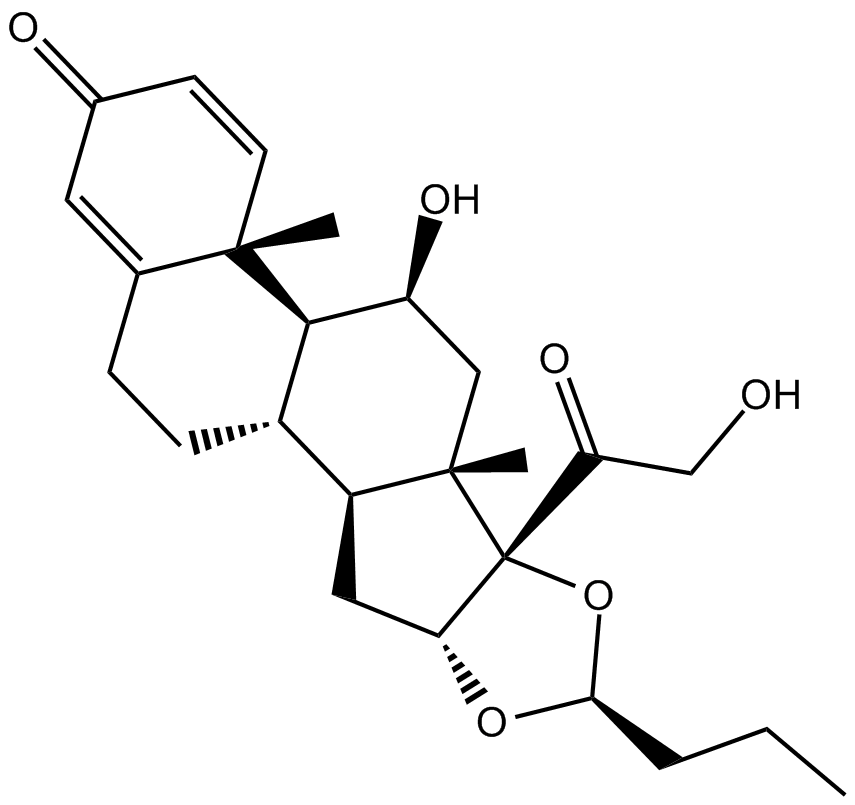
Cas No.: 51333-22-3
Sample solution is provided at 25 µL, 10mM.
_1-3.$$$39978408@51.jpg');)
_1-9.$$$38538795@65.jpg');)
_1-9.$$$39112701@51.jpg');)
_1-7.$$$37316672@70.jpg');)
_366-372.$$$36198801@70.jpg');)
.$$$38565142@65.jpg');)
_1867-1883.$$$33248023@67.jpg');)
_eads6055.$$$39977546@45.jpg');)
_eadm9805.$$$40080571@45.jpg');)
_eadj3020.$$$39666821@45.jpg');)
_1-20.$$$39757301@28.jpg');)
_1-24.$$$38898113@28.jpg');)
_273-287.$$$36806353@46.jpg');)
_1-16.$$$37156877@44.jpg');)
_1-19.$$$37460805@44.jpg');)
_1291-1307.$$$34518654@46.jpg');)
Budesonide is a glucocorticoid with potent local anti-inflammatory effects. Budesonide enhances the stability of endothelial cells, smooth muscle cells, and lysosomal membranes, inhibits immune responses, and reduces antibody synthesis, thereby decreasing the release and activity of allergic mediators such as histamine. Budesonide is used in the treatment of bronchial asthma, asthmatic chronic bronchitis, allergic rhinitis, nasal polyps, Crohn's disease, and ulcerative colitis[1-4].
In vitro, Budesonide (1μM–25μM) was used to treat LS180 and Caco-2 intestinal cell lines for 48h–72h. Budesonide induced the expression of MDR1/P-gp in LS180 cells and down-regulated the expression of MDR1/P-gp in Caco-2 cells[5]. Budesonide (0.1–25μM) was co-treated with SARS-CoV-2 (MOI=0.1) in Vero E6 cells for 24 hours. Budesonide significantly reduced the viral titer in Vero E6 cells without affecting cell viability[6].
In vivo, Budesonide (10mg/kg/day) was administered daily via oral gavage to female C57BL/6 mice for 5 days. Budesonide significantly increased the mortality rate in Clostridium difficile-infected mice[7]. Budesonide (1mg) combined with Calcitriol (100ng) was administered daily via nebulized inhalation and intraperitoneal injection to asthmatic model BALB/c mice for 8 weeks. Budesonide and Calcitriol synergistically inhibited airway remodeling in asthmatic mice[8].
References:
[1] Olivas I, Cobreros M, Londoño MC, et al. Budesonide in the first line treatment of patients with autoimmune hepatitis. Gastroenterol Hepatol. 2022 Aug-Sep;45(7):561-570.
[2] Grossmann C, Scholz T, Rochel M, et al. Transactivation via the human glucocorticoid and mineralocorticoid receptor by therapeutically used steroids in CV-1 cells: a comparison of their glucocorticoid and mineralocorticoid properties. Eur J Endocrinol. 2004 Sep;151(3):397-406.
[3] Dong L, Zhu YH, Liu DX, et al. Intranasal Application of Budesonide Attenuates Lipopolysaccharide-Induced Acute Lung Injury by Suppressing Nucleotide-Binding Oligomerization Domain-Like Receptor Family, Pyrin Domain-Containing 3 Inflammasome Activation in Mice. J Immunol Res. 2019 Feb 27;2019:7264383.
[4] Pereira MA, Tao L, Liu Y, et al. Modulation by budesonide of DNA methylation and mRNA expression in mouse lung tumors. Int J Cancer. 2007 Mar 1;120(5):1150-3.
[5] Maier A, Zimmermann C, Beglinger C, et al. Effects of budesonide on P-glycoprotein expression in intestinal cell lines. Br J Pharmacol. 2007 Feb;150(3):361-8.
[6] Heinen N, Meister TL, Klöhn M, et al. Antiviral Effect of Budesonide against SARS-CoV-2. Viruses. 2021 Jul 20;13(7):1411.
[7] Lin Q, Li Z, Lu L, et al. Budesonide, an anti-inflammatory drug, exacerbate clostridioides difficile colitis in mice. Biomed Pharmacother. 2023 Nov;167:115489.
[8] Qian J, Xu Y, Yu Z. Budesonide and Calcitriol Synergistically Inhibit Airway Remodeling in Asthmatic Mice. Can Respir J. 2018 May 2;2018:5259240.
| Cell experiment [1]: | |
Cell lines | LS180 and Caco-2 cells (human intestinal cell lines) |
Preparation Method | LS180 and Caco-2 cells were cultured in Dulbecco's modified Eagle's medium with Glutamax-I, supplemented with 10% fetal bovine serum, 1% non-essential amino acids, 1% sodium pyruvate, 50μg/ml gentamycin. Cells were seeded into 12-well plastic culture dishes and maintained in a humidified 37°C incubator with 5% CO2. Cells were treated with Budesonide (1μM–25μM). |
Reaction Conditions | 1μM–25μM; 48h |
Applications | Budesonide induced MDR1/P-glycoprotein expression in LS180 cells and down-regulated MDR1/P-glycoprotein expression in Caco-2 cells. These changes were confirmed at mRNA, protein, and functional levels. |
| Animal experiment [2]: | |
Animal models | Female BALB/c mice (6-8 weeks old) |
Preparation Method | Mice were sensitized by intraperitoneal injection of 50μg ovalbumin (Ova) with 1mg aluminum hydroxide on days 1 and 14. From day 21, mice were challenged by inhalation of 1% Ova solution for 30min once daily for eight weeks to establish an asthma model. In the Budesonide treatment group, 0.5h before each Ova challenge, mice inhaled 5mL PBS containing 1mg Budesonide via a nebulizer over 30min. |
Dosage form | 1mg; inhalation; daily administration before each Ova challenge; 8 weeks |
Applications | Budesonide monotherapy alleviated pathological changes including airway eosinophil infiltration, mucus secretion, and collagen proliferation in asthmatic mice. Budesonide inhibited the high expression of collagen type I (COL I), collagen type III (COL III), and α-smooth muscle actin (α-SMA), downregulated the expression of TGFβ type I receptor (TGFβRI), phosphorylated Smad2 (pSmad2), and phosphorylated Smad3 (pSmad3), and upregulated the expression of Smad7 in lung tissue. Budesonide decreased the expression of microRNA-21 (miR-21) in lung tissue. |
References: | |
| Cas No. | 51333-22-3 | SDF | |
| Chemical Name | (6aR,6bS,7S,8aS,8bS,11aR,12aS,12bS)-7-hydroxy-8b-(2-hydroxyacetyl)-6a,8a-dimethyl-10-propyl-6a,6b,7,8,8a,8b,11a,12,12a,12b-decahydro-1H-naphtho[2',1':4,5]indeno[1,2-d][1,3]dioxol-4(2H)-one | ||
| Canonical SMILES | O=C(C([H])([H])O[H])[C@@]12OC(C([H])([H])C([H])([H])C([H])([H])[H])([H])O[C@]1([H])C([H])([H])[C@]([C@@](C([H])([H])C3([H])[H])([H])[C@@]4([H])[C@@](C([H])([H])[H])(C([H])=C5[H])C3=C([H])C5=O)([H])[C@]2(C([H])([H])[H])C([H])([H])[C@]4([H])O[H] | ||
| Formula | C25H34O6 | M.Wt | 430.53 |
| Solubility | ≥ 20.2mg/mL in DMSO | Storage | Store at -20°C |
| General tips | Please select the appropriate solvent to prepare the stock solution according to the
solubility of the product in different solvents; once the solution is prepared, please store it in
separate packages to avoid product failure caused by repeated freezing and thawing.Storage method
and period of the stock solution: When stored at -80°C, please use it within 6 months; when stored
at -20°C, please use it within 1 month. To increase solubility, heat the tube to 37°C and then oscillate in an ultrasonic bath for some time. |
||
| Shipping Condition | Evaluation sample solution: shipped with blue ice. All other sizes available: with RT, or with Blue Ice upon request. | ||
| Prepare stock solution | |||

|
1 mg | 5 mg | 10 mg |
| 1 mM | 2.3227 mL | 11.6136 mL | 23.2272 mL |
| 5 mM | 464.5 μL | 2.3227 mL | 4.6454 mL |
| 10 mM | 232.3 μL | 1.1614 mL | 2.3227 mL |
Step 1: Enter information below (Recommended: An additional animal making an allowance for loss during the experiment)
 g
μL
g
μL
Step 2: Enter the in vivo formulation (This is only the calculator, not formulation. Please contact us first if there is no in vivo formulation at the solubility Section.)
Calculation results:
Working concentration: mg/ml;
Method for preparing DMSO master liquid: mg drug pre-dissolved in μL DMSO ( Master liquid concentration mg/mL, Please contact us first if the concentration exceeds the DMSO solubility of the batch of drug. )
Method for preparing in vivo formulation: Take μL DMSO master liquid, next addμL PEG300, mix and clarify, next addμL Tween 80, mix and clarify, next add μL saline, mix and clarify.
Method for preparing in vivo formulation: Take μL DMSO master liquid, next add μL Corn oil, mix and clarify.
Note: 1. Please make sure the liquid is clear before adding the next solvent.
2. Be sure to add the solvent(s) in order. You must ensure that the solution obtained, in the previous addition, is a clear solution before proceeding to add the next solvent. Physical methods such as vortex, ultrasound or hot water bath can be used to aid dissolving.
3. All of the above co-solvents are available for purchase on the GlpBio website.
Quality Control & SDS
- View current batch:
- Purity: >99.50% Appearance: A solid
- COA (Certificate of Analysis)
- SDS (Safety Data Sheet)
- Datasheet
Average Rating: 5 (Based on Reviews and 37 reference(s) in Google Scholar.)