

Captopril (Synonyms: SA 333, SQ 14,225) |
Catalog No.GC16223
 One-Click Copy Product Info
|

Captopril is an orally active angiotensin-converting enzyme (ACE) inhibitor with an IC50 value of 0.025μM.
Products are for research use only. Not for human use. We do not sell to patients.
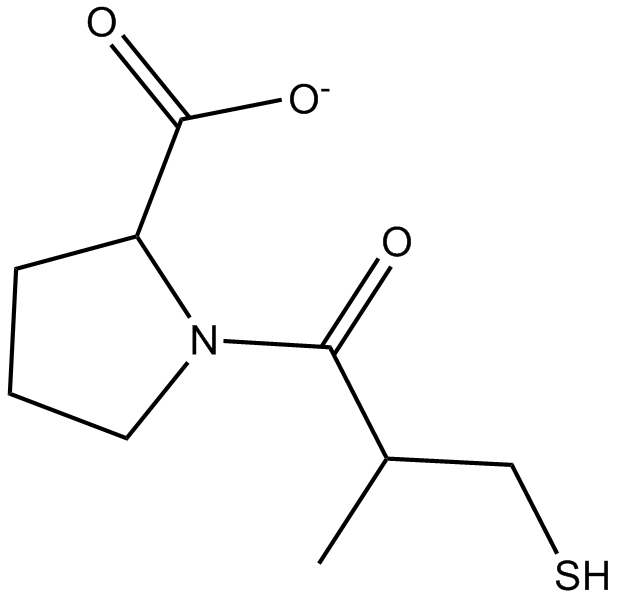
Cas No.: 62571-86-2
Sample solution is provided at 25 µL, 10mM.
_1-3.$$$39978408@51.jpg');)
_1-9.$$$38538795@65.jpg');)
_1-9.$$$39112701@51.jpg');)
_1-7.$$$37316672@70.jpg');)
_366-372.$$$36198801@70.jpg');)
.$$$38565142@65.jpg');)
_1867-1883.$$$33248023@67.jpg');)
_eads6055.$$$39977546@45.jpg');)
_eadm9805.$$$40080571@45.jpg');)
_eadj3020.$$$39666821@45.jpg');)
_1-20.$$$39757301@28.jpg');)
_1-24.$$$38898113@28.jpg');)
_273-287.$$$36806353@46.jpg');)
_1-16.$$$37156877@44.jpg');)
_1-19.$$$37460805@44.jpg');)
_1291-1307.$$$34518654@46.jpg');)
Captopril is an orally active angiotensin-converting enzyme (ACE) inhibitor with an IC50 value of 0.025μM[1]. Captopril exerts its effects by blocking the conversion of angiotensin I to angiotensin II, thereby achieving vasodilation, lowering blood pressure, and reducing cardiac workload[2]. Captopril is commonly used in the treatment and research of hypertension, heart failure, and diabetic nephropathy[3,4].
In vitro, BV2 microglial cells were incubated with Captopril (0.1, 0.3, 1, and 3mM) and lipopolysaccharide (LPS, 7ng/mL) for 24h. Low concentrations of Captopril (0.3, 1mM) enhanced LPS-induced NO production, whereas a high concentration of Captopril (3mM) inhibited LPS-induced NO production[5].
In vivo, normal ICR mice were treated with Captopril (10mg/kg) by gavage for 8 weeks, resulting in decreased mean arterial pressure and serum calcium levels, as well as increased urinary calcium excretion[6]. BALB-c mice were pretreated with Captopril (25, 50mg/kg) via intraperitoneal injection for 7 days. On day 7, 30min after the last dose, pentylenetetrazole (PTZ, 60mg/kg) was injected to induce epileptic seizures. Captopril treatment significantly reduced the formation of dark neurons in the hippocampal CA1, CA2, CA3 regions and the dentate gyrus (DG)[7].
References:
[1] Afrin S, Rakib M A, Kim B H, et al. Eritadenine from edible mushrooms inhibits activity of angiotensin converting enzyme in vitro[J]. Journal of Agricultural and Food Chemistry, 2016, 64(11): 2263-2268.
[2] Bolterman R J, Manriquez M C, Ruiz M C O, et al. Effects of captopril on the renin angiotensin system, oxidative stress, and endothelin in normal and hypertensive rats[J]. Hypertension, 2005, 46(4): 943-947.
[3] Atkinson A B, Robertson J I S. Captopril in the treatment of clinical hypertension and cardiac failure[J]. The Lancet, 1979, 314(8147): 836-839.
[4] Heel R C, Brogden R N, Speight T M, et al. Captopril: a preliminary review of its pharmacological properties and therapeutic efficacy[J]. Drugs, 1980, 20(6): 409-452.
[5] Asraf K, Torika N, Apte R N, et al. Microglial activation is modulated by captopril: in vitro and in vivo studies[J]. Frontiers in Cellular Neuroscience, 2018, 12: 116.
[6] Yang M, Xia C, Song Y, et al. Impairing effects of angiotensin-converting enzyme inhibitor captopril on bone of normal mice[J]. European Journal of Pharmacology, 2016, 771: 40-47.
[7] Tastemur Y, Gumus E, Ergul M, et al. Positive effects of angiotensin-converting enzyme (ACE) inhibitor, captopril, on pentylenetetrazole-induced epileptic seizures in mice[J]. Tropical Journal of Pharmaceutical Research, 2020, 19(3): 637-643.
| Cell experiment [1]: | |
Cell lines | BV2 microglia |
Preparation Method | BV2 microglia were incubated in 24-well plates in the presence of 7ng/ml LPS with Captopril (0.1, 0.3, 1 or 3mM) for 24h. Thereafter, supernatants were analyzed for nitrite levels using the Griess reaction. Nitrite levels were normalized to cell counts. |
Reaction Conditions | 0.1, 0.3, 1, and 3mM; 24h |
Applications | Treatment of BV2 cells with 7ng/ml LPS and low doses of Captopril (0.3 and 1mM) resulted in 50% and 45% increased NO production, respectively, as compared to cells induced with LPS alone. Higher dose of Captopril (3mM) reduced LPS-induced NO levels in the BV2 microglial cell line by more than 40%. |
| Animal experiment [2]: | |
Animal models | BALB/c mice |
Preparation Method | Mice were pretreated with Captopril (25 or 50mg/kg; i.p.) for 7 days, then received PTZ (60mg/kg, i.p.) 30min after the last dose. The animals were sacrificed 4h later, and brain sections were stained with Toluidine blue to assess dark neurons in hippocampal regions. |
Dosage form | 25, 50mg/kg; 7 days; i.p. |
Applications | Both the 25 mg/kg and 50 mg/kg doses of Captopril significantly prevented dark neuron formation in CA1, CA2, and CA3 regions of the hippocampus and DG after PTZ induced seizures. |
References: | |
| Cas No. | 62571-86-2 | SDF | |
| Synonyms | SA 333, SQ 14,225 | ||
| Chemical Name | (2S)-1-[(2S)-2-methyl-3-sulfanylpropanoyl]pyrrolidine-2-carboxylic acid | ||
| Canonical SMILES | CC(CS)C(=O)N1CCCC1C(=O)[O-] | ||
| Formula | C9H15NO3S | M.Wt | 217.3 |
| Solubility | ≥ 21.7 mg/mL in DMSO, ≥ 105.2 mg/mL in EtOH with ultrasonic, ≥ 48.6 mg/mL in Water with ultrasonic | Storage | Store at -20°C |
| General tips | Please select the appropriate solvent to prepare the stock solution according to the
solubility of the product in different solvents; once the solution is prepared, please store it in
separate packages to avoid product failure caused by repeated freezing and thawing.Storage method
and period of the stock solution: When stored at -80°C, please use it within 6 months; when stored
at -20°C, please use it within 1 month. To increase solubility, heat the tube to 37°C and then oscillate in an ultrasonic bath for some time. |
||
| Shipping Condition | Evaluation sample solution: shipped with blue ice. All other sizes available: with RT, or with Blue Ice upon request. | ||
| Prepare stock solution | |||

|
1 mg | 5 mg | 10 mg |
| 1 mM | 4.6019 mL | 23.0097 mL | 46.0193 mL |
| 5 mM | 920.4 μL | 4.6019 mL | 9.2039 mL |
| 10 mM | 460.2 μL | 2.301 mL | 4.6019 mL |
Step 1: Enter information below (Recommended: An additional animal making an allowance for loss during the experiment)
 g
μL
g
μL
Step 2: Enter the in vivo formulation (This is only the calculator, not formulation. Please contact us first if there is no in vivo formulation at the solubility Section.)
Calculation results:
Working concentration: mg/ml;
Method for preparing DMSO master liquid: mg drug pre-dissolved in μL DMSO ( Master liquid concentration mg/mL, Please contact us first if the concentration exceeds the DMSO solubility of the batch of drug. )
Method for preparing in vivo formulation: Take μL DMSO master liquid, next addμL PEG300, mix and clarify, next addμL Tween 80, mix and clarify, next add μL saline, mix and clarify.
Method for preparing in vivo formulation: Take μL DMSO master liquid, next add μL Corn oil, mix and clarify.
Note: 1. Please make sure the liquid is clear before adding the next solvent.
2. Be sure to add the solvent(s) in order. You must ensure that the solution obtained, in the previous addition, is a clear solution before proceeding to add the next solvent. Physical methods such as vortex, ultrasound or hot water bath can be used to aid dissolving.
3. All of the above co-solvents are available for purchase on the GlpBio website.
Quality Control & SDS
- View current batch:
- Purity: >99.00% Appearance: A solid
- COA (Certificate of Analysis)
- SDS (Safety Data Sheet)
- Datasheet
Average Rating: 5 (Based on Reviews and 30 reference(s) in Google Scholar.)