

Chlorotoxin |
Catalog No.GC33024
 One-Click Copy Product Info
|

Chlorotoxin is a polypeptide toxin isolated from the venom of the Israeli deathstalker scorpion.
Products are for research use only. Not for human use. We do not sell to patients.
Cas No.: 163515-35-3
Sample solution is provided at 25 µL, 10mM.
_1-3.$$$39978408@51.jpg');)
_1-9.$$$38538795@65.jpg');)
_1-9.$$$39112701@51.jpg');)
_1-7.$$$37316672@70.jpg');)
_366-372.$$$36198801@70.jpg');)
.$$$38565142@65.jpg');)
_1867-1883.$$$33248023@67.jpg');)
_eads6055.$$$39977546@45.jpg');)
_eadm9805.$$$40080571@45.jpg');)
_eadj3020.$$$39666821@45.jpg');)
_1-20.$$$39757301@28.jpg');)
_1-24.$$$38898113@28.jpg');)
_273-287.$$$36806353@46.jpg');)
_1-16.$$$37156877@44.jpg');)
_1-19.$$$37460805@44.jpg');)
_1291-1307.$$$34518654@46.jpg');)
Chlorotoxin is a polypeptide toxin isolated from the venom of the Israeli deathstalker scorpion[1-2]. Chlorotoxin selectively binds to the MMP-2 protein and chloride ion channels on the surface of glioma cells to inhibit tumor cell migration and invasion, while simultaneously blocking chloride ion currents to affect cellular volume changes. Chlorotoxin is applicable in the diagnosis, imaging, and therapeutic research of glioblastoma[3-4].
In vitro, Chlorotoxin (10nM-100μM) bound to superparamagnetic nanoparticles (NPC) and was applied to rat C6 glioma cells for 2 hours. Chlorotoxin significantly inhibited cell invasion and induced the internalization of lipid rafts containing MMP-2 and ion channels[5]. Chlorotoxin (0.05–5μM) was applied to human ER-positive breast cancer cells MCF-7, T47D, and ER-negative cells MDA-MB-231 for 12–72 hours. Chlorotoxin significantly inhibited cell proliferation, migration, and invasion in a concentration- and time-dependent manner, and downregulated the mRNA and protein expression levels of ERα, VASP, and MMP2 in the cells[6].
In vivo, Chlorotoxin (60μg/kg) was administered via intraperitoneal injection to tumor-bearing (SiHa cells) BALB/c nude mice, beginning when the tumor volume reached 50-100mm³ and repeated every 4 days. Chlorotoxin significantly enhanced the tumor-suppressive effect of cisplatin and downregulated the expression level of P-glycoprotein in tumor tissue[7]. Chlorotoxin (2μM; 10μL; single injection) was administered intrathecally to adult rats. Chlorotoxin significantly increased sciatic nerve injury and pain vulnerability in the rats[8].
References:
[1] Dardevet L, Rani D, Aziz TA, et al. Chlorotoxin: a helpful natural scorpion peptide to diagnose glioma and fight tumor invasion. Toxins (Basel). 2015 Mar 27;7(4):1079-101.
[2] Fu Y, An N, Li K, et al. Chlorotoxin-conjugated nanoparticles as potential glioma-targeted drugs. J Neurooncol. 2012 May;107(3):457-62.
[3] Cohen G, Burks SR, Frank JA. Chlorotoxin-A Multimodal Imaging Platform for Targeting Glioma Tumors. Toxins (Basel). 2018 Nov 26;10(12):496.
[4] Veiseh O, Gunn JW, Kievit FM, et al. Inhibition of tumor-cell invasion with chlorotoxin-bound superparamagnetic nanoparticles. Small. 2009 Feb;5(2):256-64.
[5] Tang J, Chen S, Deng Y, et al. MA104 cell line is permissive for human bocavirus 1 infection. J Virol. 2025 Feb 25;99(2):e0153924.
[6] Wang Y, Li K, Han S, et al. Chlorotoxin targets ERα/VASP signaling pathway to combat breast cancer. Cancer Med. 2019 Apr;8(4):1679-1693.
[7] Shen J, Zhang D, Zheng Q, et al. ClC-3 inhibition induces autophagy to reverse cisplatin resistance in cervical cancer via the Akt/mTOR pathway. Biochim Biophys Acta Mol Basis Dis. 2026 Jan;1872(1):168030.
[8] Zhang XL, Zhang JJ, Chen ZH, et al. Difference of pain vulnerability in adult and juvenile rodents: the role of SIRT1-mediated ClC-3 trafficking in sensory neurons. Pain. 2021 Jun 1;162(6):1882-1896.
| Cell experiment [1]: | |
Cell lines | MCF-7, MDA-MB-231, T47D cells (human breast cancer cell lines) |
Preparation Method | Cells were maintained in DMEM (MCF-7, MDA-MB-231) or RPMI-1640 medium (T47D) supplemented with 10% fetal bovine serum (FBS) at 37°C, 5% CO2. Cells were treated with Chlorotoxin at concentrations of 0, 0.05, 0.5, and 5μM for 12, 24, 48, or 72 hours. |
Reaction Conditions | 0.05–5μM; 12–72h. |
Applications | Chlorotoxin significantly inhibited the proliferation, migration, and invasion of breast cancer cells in a concentration- and time-dependent manner. Chlorotoxin also downregulated the mRNA and protein expression levels of ERα, VASP, and MMP2, and inhibited the activity of the ERα promoter reporter gene. Immunofluorescence showed that Chlorotoxin treatment reduced nuclear ERα expression, decreased VASP and actin protein levels, disrupted actin morphology, and decreased MMP2 expression. |
| Animal experiment [2]: | |
Animal models | Adult and juvenile Sprague-Dawley rats |
Preparation Method | Chlorotoxin (2µM; 10µL) was administered intrathecally into the subarachnoid space of the L4-L6 spinal cord once every 2 days. The treatment was applied in the context of established pain models (e.g., spared nerve injury). |
Dosage form | 2µM; 10µL; Intrathecal injection; Once every 2 days. |
Applications | Chlorotoxin significantly increased the pain vulnerability of juvenile rats in neuropathic, chemotherapeutic, and inflammatory pain models, abolishing the inherent lower pain vulnerability typically observed in juvenile compared to adult rats. |
References: | |
| Cas No. | 163515-35-3 | SDF | |
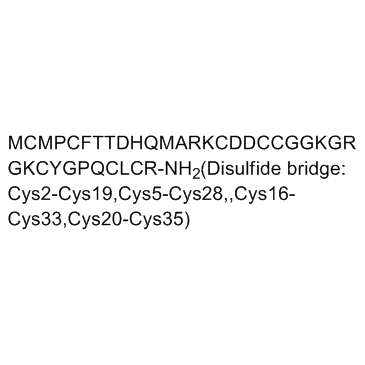
| Canonical SMILES | Met-Cys-Met-Pro-Cys-Phe-Thr-Thr-Asp-His-Gln-Met-Ala-Arg-Lys-Cys-Asp-Asp-Cys-Cys-Gly-Gly-Lys-Gly-Arg-Gly-Lys-Cys-Tyr-Gly-Pro-Gln-Cys-Leu-Cys-Arg-NH2 (Disulfide bridge: Cys2-Cys19,Cys5-Cys28,Cys16-Cys33,Cys20-Cys35) | ||
| Formula | C158H249N53O47S11 | M.Wt | 3995.71 |
| Solubility | Soluble in DMSO | Storage | Store at -20°C |
| General tips | Please select the appropriate solvent to prepare the stock solution according to the
solubility of the product in different solvents; once the solution is prepared, please store it in
separate packages to avoid product failure caused by repeated freezing and thawing.Storage method
and period of the stock solution: When stored at -80°C, please use it within 6 months; when stored
at -20°C, please use it within 1 month. To increase solubility, heat the tube to 37°C and then oscillate in an ultrasonic bath for some time. |
||
| Shipping Condition | Evaluation sample solution: shipped with blue ice. All other sizes available: with RT, or with Blue Ice upon request. | ||
| Prepare stock solution | |||

|
1 mg | 5 mg | 10 mg |
| 1 mM | 250.3 μL | 1.2513 mL | 2.5027 mL |
| 5 mM | 50.1 μL | 250.3 μL | 500.5 μL |
| 10 mM | 25 μL | 125.1 μL | 250.3 μL |
Step 1: Enter information below (Recommended: An additional animal making an allowance for loss during the experiment)
 g
μL
g
μL
Step 2: Enter the in vivo formulation (This is only the calculator, not formulation. Please contact us first if there is no in vivo formulation at the solubility Section.)
Calculation results:
Working concentration: mg/ml;
Method for preparing DMSO master liquid: mg drug pre-dissolved in μL DMSO ( Master liquid concentration mg/mL, Please contact us first if the concentration exceeds the DMSO solubility of the batch of drug. )
Method for preparing in vivo formulation: Take μL DMSO master liquid, next addμL PEG300, mix and clarify, next addμL Tween 80, mix and clarify, next add μL saline, mix and clarify.
Method for preparing in vivo formulation: Take μL DMSO master liquid, next add μL Corn oil, mix and clarify.
Note: 1. Please make sure the liquid is clear before adding the next solvent.
2. Be sure to add the solvent(s) in order. You must ensure that the solution obtained, in the previous addition, is a clear solution before proceeding to add the next solvent. Physical methods such as vortex, ultrasound or hot water bath can be used to aid dissolving.
3. All of the above co-solvents are available for purchase on the GlpBio website.
Quality Control & SDS
- View current batch:
- Purity: >98.00% Appearance: A solid
- COA (Certificate of Analysis)
- SDS (Safety Data Sheet)
- Datasheet
Average Rating: 5 (Based on Reviews and 25 reference(s) in Google Scholar.)