

TMPA |
Catalog No.GC30015
 One-Click Copy Product Info
|

TMPA, a Nur77 antagonist, prevents the binding of Nur77 and LKB1 as well as stimulates LKB1 transport to the cytosol and phosphorylation.
Products are for research use only. Not for human use. We do not sell to patients.
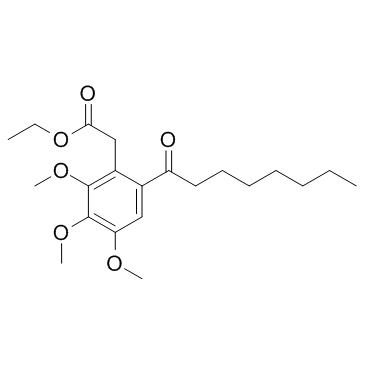
Cas No.: 1258275-73-8
Sample solution is provided at 25 µL, 10mM.
_1-3.$$$39978408@51.jpg');)
_1-9.$$$38538795@65.jpg');)
_1-9.$$$39112701@51.jpg');)
_1-7.$$$37316672@70.jpg');)
_366-372.$$$36198801@70.jpg');)
.$$$38565142@65.jpg');)
_1867-1883.$$$33248023@67.jpg');)
_eads6055.$$$39977546@45.jpg');)
_eadm9805.$$$40080571@45.jpg');)
_eadj3020.$$$39666821@45.jpg');)
_1-20.$$$39757301@28.jpg');)
_1-24.$$$38898113@28.jpg');)
_273-287.$$$36806353@46.jpg');)
_1-16.$$$37156877@44.jpg');)
_1-19.$$$37460805@44.jpg');)
_1291-1307.$$$34518654@46.jpg');)
TMPA, a Nur77 antagonist, prevents the binding of Nur77 and LKB1 as well as stimulates LKB1 transport to the cytosol and phosphorylation [1]. The binding of TMPA to Nur77 decreases the stability of Nur77-LKB1 complex by inducing an open-close motion of Nur77 and thereby facilitates the solvation of the interface region[2]. TMPA has been widely used in diabetic mouse models to regulate blood glucose levels[3].
In vitro, TMPA treatment at 10μM for 1 hour increased the phosphorylation of AMPK in hepatic L02 cells [4]. Treatment of mouse bone marrow-derived mast cells (BMMCs) with 10μM TMPA for 6 hours increased phosphorylation of LKB1 and AMPK and concomitantly reduced IgE/Ag-induced degranulation and eicosanoid production, which inhibited FcεRI-mediated mast cell signaling[5]. Treatment with 10μM TMPA for 18h significantly increased TNFα-induced IL-6 production in HeLa cells[6]. Pretreatment of HepG2 cells with 10μM TMPA for 6 hours reduced lipid accumulation after free fatty acid (FFA) stimulation[7].
In vivo, Intraperitoneal injection of TMPA (50mg/kg/day) once daily for 19 days significantly reduced insulin levels, lowered blood glucose, and improved glucose tolerance in diabetic mice[8].
References:
[1] Wu L, Chen L. Characteristics of Nur77 and its ligands as potential anticancer compounds[J]. Molecular medicine reports, 2018, 18(6): 4793-4801.
[2] Rungsung I, Rajagopalan M, Ramaswamy A. Molecular dynamics study of TMPA mediated dissociation of Nur77-LKB1 complex[J]. Computational Biology and Chemistry, 2018, 76: 67-78.
[3] Safe S. Natural products and synthetic analogs as selective orphan nuclear receptor 4A (NR4A) modulators[J]. Histology and histopathology, 2023, 39(5): 543.
[4] Li L, Liu Y, Chen H, et al. Impeding the interaction between Nur77 and p38 reduces LPS-induced inflammation[J]. Nature chemical biology, 2015, 11(5): 339-346.
[5] Jin F, Li X, Deng Y, et al. The orphan nuclear receptor NR4A1 promotes FcεRI‐stimulated mast cell activation and anaphylaxis by counteracting the inhibitory LKB1/AMPK axis[J]. Allergy, 2019, 74(6): 1145-1156.
[6] Huang B, Pei H Z, Chang H W, et al. The E3 ubiquitin ligase Trim13 regulates Nur77 stability via casein kinase 2α[J]. Scientific reports, 2018, 8(1): 13895.
[7] Wang X, Li G, Guo C, et al. Ethyl 2-[2, 3, 4-Trimethoxy-6-(1-Octanoyl) Phenyl] acetate (Tmpa) ameliorates lipid accumulation by disturbing the combination of Lkb1 with Nur77 and activating the ampk pathway in Hepg2 cells and mice primary hepatocytes[J]. Diabetes, Metabolic Syndrome and Obesity, 2021: 4165-4177.
[8] Zhan Y, Chen Y, Zhang Q, et al. The orphan nuclear receptor Nur77 regulates LKB1 localization and activates AMPK[J]. Nature chemical biology, 2012, 8(11): 897-904.
| Cell experiment [1]: | |
Cell lines | L02 cells |
Preparation Method | The human liver cell line (L02) was cultured in RPMI-1640 medium supplemented with 10% fetal bovine serum (FBS), 100 units of penicillin, and 100μg/ml streptomycin. Cells were treated with 10μM TMPA for 1h, and the amount of AMPKα phosphorylation was determined by western blot. |
Reaction Conditions | 10μM; 1h |
Applications | TMPA increased the phosphorylation of AMPK in hepatic L02 cells. |
| Animal experiment [2]: | |
Animal models | Male C57BL/KsJ-Leprdb/Leprdb (db/db) mice |
Preparation Method | Male C57BL/KsJ-Leprdb/Leprdb (db/db) mice were randomly divided into three groups. One group of mice was injected intraperitoneally with TMPA once daily at a dose of 50mg/kg for 19 days. The remaining groups were injected with metformin (250mg/kg) or vehicle (DMSO) as positive and negative controls. Mice were fasted for 18h prior to measurement of blood glucose. Mouse blood glucose was measured every 4 days. After 19 days of treatment, mice were intraperitoneally injected with D-glucose (1g/kg) for a glucose tolerance test. |
Dosage form | 50mg/kg/day for 19 days; tail vein injection |
Applications | TMPA treatment reduced blood glucose and improved glucose tolerance in diabetic mice. |
References: | |
| Cas No. | 1258275-73-8 | SDF | |
| Canonical SMILES | COC1=C(CC(OCC)=O)C(C(CCCCCCC)=O)=CC(OC)=C1OC | ||
| Formula | C21H32O6 | M.Wt | 380.48 |
| Solubility | DMSO : ≥ 100 mg/mL (262.83 mM);Water : < 0.1 mg/mL (insoluble) | Storage | Store at -20°C |
| General tips | Please select the appropriate solvent to prepare the stock solution according to the
solubility of the product in different solvents; once the solution is prepared, please store it in
separate packages to avoid product failure caused by repeated freezing and thawing.Storage method
and period of the stock solution: When stored at -80°C, please use it within 6 months; when stored
at -20°C, please use it within 1 month. To increase solubility, heat the tube to 37°C and then oscillate in an ultrasonic bath for some time. |
||
| Shipping Condition | Evaluation sample solution: shipped with blue ice. All other sizes available: with RT, or with Blue Ice upon request. | ||
| Prepare stock solution | |||

|
1 mg | 5 mg | 10 mg |
| 1 mM | 2.6283 mL | 13.1413 mL | 26.2826 mL |
| 5 mM | 525.7 μL | 2.6283 mL | 5.2565 mL |
| 10 mM | 262.8 μL | 1.3141 mL | 2.6283 mL |
Step 1: Enter information below (Recommended: An additional animal making an allowance for loss during the experiment)
 g
μL
g
μL
Step 2: Enter the in vivo formulation (This is only the calculator, not formulation. Please contact us first if there is no in vivo formulation at the solubility Section.)
Calculation results:
Working concentration: mg/ml;
Method for preparing DMSO master liquid: mg drug pre-dissolved in μL DMSO ( Master liquid concentration mg/mL, Please contact us first if the concentration exceeds the DMSO solubility of the batch of drug. )
Method for preparing in vivo formulation: Take μL DMSO master liquid, next addμL PEG300, mix and clarify, next addμL Tween 80, mix and clarify, next add μL saline, mix and clarify.
Method for preparing in vivo formulation: Take μL DMSO master liquid, next add μL Corn oil, mix and clarify.
Note: 1. Please make sure the liquid is clear before adding the next solvent.
2. Be sure to add the solvent(s) in order. You must ensure that the solution obtained, in the previous addition, is a clear solution before proceeding to add the next solvent. Physical methods such as vortex, ultrasound or hot water bath can be used to aid dissolving.
3. All of the above co-solvents are available for purchase on the GlpBio website.
Quality Control & SDS
- View current batch:
- Purity: >98.50% Appearance: A solid
- COA (Certificate of Analysis)
- SDS (Safety Data Sheet)
- Datasheet
Average Rating: 5 (Based on Reviews and 28 reference(s) in Google Scholar.)