

Eleclazine hydrochloride (GS 6615 hydrochloride) (Synonyms: GS 6615 hydrochloride) |
Catalog No.GC30063
 One-Click Copy Product Info
|

Eleclazine (GS 6615) hydrochloride is a selective cardiac late sodium current inhibitor and a weak inhibitor of potassium current with IC50 value of <1 μM and approximately 14.2 μM, respectively.
Products are for research use only. Not for human use. We do not sell to patients.
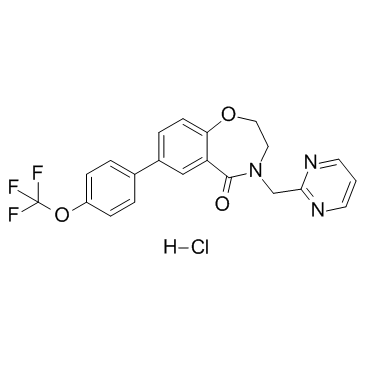
Cas No.: 1448754-43-5
Sample solution is provided at 25 µL, 10mM.
_1-3.$$$39978408@51.jpg');)
_1-9.$$$38538795@65.jpg');)
_1-9.$$$39112701@51.jpg');)
_1-7.$$$37316672@70.jpg');)
_366-372.$$$36198801@70.jpg');)
.$$$38565142@65.jpg');)
_1867-1883.$$$33248023@67.jpg');)
_eads6055.$$$39977546@45.jpg');)
_eadm9805.$$$40080571@45.jpg');)
_eadj3020.$$$39666821@45.jpg');)
_1-20.$$$39757301@28.jpg');)
_1-24.$$$38898113@28.jpg');)
_273-287.$$$36806353@46.jpg');)
_1-16.$$$37156877@44.jpg');)
_1-19.$$$37460805@44.jpg');)
_1291-1307.$$$34518654@46.jpg');)
Eleclazine hydrochloride (GS 6615 hydrochloride) is a novel, highly selective inhibitor of the cardiac late sodium current, with an IC50 value of <1μM[1]. By reducing intracellular sodium and calcium overload, Eleclazine hydrochloride (GS 6615 hydrochloride) stabilizes the cardiac membrane potential and suppresses arrhythmias, and is commonly used in the treatment and research of arrhythmic conditions such as long QT syndrome and ventricular tachycardia[2,3,4].
In vitro, Eleclazine hydrochloride (GS 6615 hydrochloride) (1μM) pretreatment of isolated rabbit hearts for 20min significantly accelerated intracellular Ca2+ decay and suppressed the induction of spatially discordant alternans (SDA) under normothermic conditions[5]. Eleclazine hydrochloride (GS 6615 hydrochloride) (10μM) treatment of isolated rabbit atrial myocytes for 5min reduced the late sodium current density induced by isoproterenol (ISO, 15nM) by 41% (p < 0.05)[6].
In vivo, Yorkshire pigs pretreated with Eleclazine hydrochloride (GS 6615 hydrochloride) (0.9mg/kg; intravenous infusion over 15min) showed an 83% reduction in the incidence of 1-2 beat atrial premature beats (APBs) and a 75% reduction in ≥3 APBs induced by epinephrine (2.0μg/kg, intravenous bolus over 1min) at 120min after Eleclazine hydrochloride (GS 6615 hydrochloride) administration[7].
References:
[1] BACIC D, CARNEIRO J S, BENTO A A, et al. Eleclazine hydrochloride (GS 6615 hydrochloride), an inhibitor of the cardiac late sodium current, is superior to flecainide in suppressing catecholamine-induced ventricular tachycardia and T-wave alternans in an intact porcine model[J]. Heart Rhythm, 2017, 14(3): 448-454.
[2] RAJAMANI S, LIU G, EL-BIZRI N, et al. The novel late Na+ current inhibitor, GS-6615 (Eleclazine hydrochloride (GS 6615 hydrochloride)) and its anti-arrhythmic effects in rabbit isolated heart preparations[J]. British Journal of Pharmacology, 2016, 173(21): 3088-3098.
[3] POTET F, EGECIOGLU D E, BURRIDGE P W, et al. GS-967 and Eleclazine hydrochloride (GS 6615 hydrochloride) block sodium channels in human induced pluripotent stem cell-derived cardiomyocytes[J]. Molecular Pharmacology, 2020, 98(5): 540-547.
[4] ZHANG Y, WANG H M, WANG Y Z, et al. Increment of late sodium currents in the left atrial myocytes and its potential contribution to increased susceptibility of atrial fibrillation in castrated male mice[J]. Heart Rhythm, 2017, 14(7): 1073-1080.
[5] LEE H L, CHANG P C, WO H T, et al. Eleclazine hydrochloride (GS 6615 hydrochloride) suppresses ventricular fibrillation in failing rabbit hearts with ischemia-reperfusion injury undergoing therapeutic hypothermia[J]. Pharmacology, 2025, 110(3): 151-164.
[6] LIU X, REN L, YU S, et al. Late sodium current in synergism with Ca2+/calmodulin-dependent protein kinase II contributes to β-adrenergic activation-induced atrial fibrillation[J]. Philosophical Transactions of the Royal Society B: Biological Sciences, 2023, 378(1879).
[7] FULLER H, JUSTO F, NEARING B D, et al. Eleclazine hydrochloride (GS 6615 hydrochloride), a new selective cardiac late sodium current inhibitor, confers concurrent protection against autonomically induced atrial premature beats, repolarization alternans and heterogeneity, and atrial fibrillation in an intact porcine model[J]. Heart Rhythm, 2016, 13(8): 1679-1686.
| Cell experiment [1]: | |
Cell lines | Atrial myocytes |
Preparation Method | Atrial myocytes isolated from rabbit hearts were treated with 15nM ISO in the absence or presence of 10μM Eleclazine hydrochloride (GS 6615 hydrochloride) for 5min, and late sodium current (late INa) was recorded using the whole-cell patch-clamp technique. |
Reaction Conditions | 10μM; 5min |
Applications | Treatment with Eleclazine hydrochloride (GS 6615 hydrochloride) reduced ISO-induced late sodium current density by 41% (p < 0.05). |
| Animal experiment [2]: | |
Animal models | Yorkshire pigs |
Preparation Method | Yorkshire pigs were treated with 0.9mg/kg Eleclazine hydrochloride (GS 6615 hydrochloride) (intravenous infusion over 15min), and the incidence of epinephrine-induced APBs was analyzed at multiple time points thereafter (60, 90, 120, 150min). |
Dosage form | 0.9mg/kg; 120min; i.v. |
Applications | Treatment with Eleclazine hydrochloride (GS 6615 hydrochloride) reduced the incidence of 1-2 APBs induced by epinephrine by 83% and the incidence of ≥3 APBs by 75%. |
References: | |
| Cas No. | 1448754-43-5 | SDF | |
| Synonyms | GS 6615 hydrochloride | ||
| Canonical SMILES | O=C1N(CC2=NC=CC=N2)CCOC3=CC=C(C4=CC=C(OC(F)(F)F)C=C4)C=C13.[H]Cl | ||
| Formula | C21H17ClF3N3O3 | M.Wt | 451.83 |
| Solubility | DMSO : ≥ 100 mg/mL (221.32 mM) | Storage | Store at -20°C |
| General tips | Please select the appropriate solvent to prepare the stock solution according to the
solubility of the product in different solvents; once the solution is prepared, please store it in
separate packages to avoid product failure caused by repeated freezing and thawing.Storage method
and period of the stock solution: When stored at -80°C, please use it within 6 months; when stored
at -20°C, please use it within 1 month. To increase solubility, heat the tube to 37°C and then oscillate in an ultrasonic bath for some time. |
||
| Shipping Condition | Evaluation sample solution: shipped with blue ice. All other sizes available: with RT, or with Blue Ice upon request. | ||
| Prepare stock solution | |||

|
1 mg | 5 mg | 10 mg |
| 1 mM | 2.2132 mL | 11.0661 mL | 22.1322 mL |
| 5 mM | 442.6 μL | 2.2132 mL | 4.4264 mL |
| 10 mM | 221.3 μL | 1.1066 mL | 2.2132 mL |
Step 1: Enter information below (Recommended: An additional animal making an allowance for loss during the experiment)
 g
μL
g
μL
Step 2: Enter the in vivo formulation (This is only the calculator, not formulation. Please contact us first if there is no in vivo formulation at the solubility Section.)
Calculation results:
Working concentration: mg/ml;
Method for preparing DMSO master liquid: mg drug pre-dissolved in μL DMSO ( Master liquid concentration mg/mL, Please contact us first if the concentration exceeds the DMSO solubility of the batch of drug. )
Method for preparing in vivo formulation: Take μL DMSO master liquid, next addμL PEG300, mix and clarify, next addμL Tween 80, mix and clarify, next add μL saline, mix and clarify.
Method for preparing in vivo formulation: Take μL DMSO master liquid, next add μL Corn oil, mix and clarify.
Note: 1. Please make sure the liquid is clear before adding the next solvent.
2. Be sure to add the solvent(s) in order. You must ensure that the solution obtained, in the previous addition, is a clear solution before proceeding to add the next solvent. Physical methods such as vortex, ultrasound or hot water bath can be used to aid dissolving.
3. All of the above co-solvents are available for purchase on the GlpBio website.
Quality Control & SDS
- View current batch:
- Purity: >99.50% Appearance: A solid
- COA (Certificate of Analysis)
- SDS (Safety Data Sheet)
- Datasheet
Average Rating: 5 (Based on Reviews and 33 reference(s) in Google Scholar.)