

α-Mangostin |
Catalog No.GC35306
 One-Click Copy Product Info
|

α-Mangostin is a natural xanthone compound extracted from the peel of Garcinia mangostana and exhibits a wide range of biological activities.
Products are for research use only. Not for human use. We do not sell to patients.
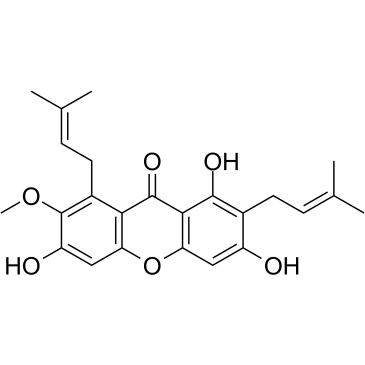
Cas No.: 6147-11-1
Sample solution is provided at 25 µL, 10mM.
α-Mangostin is a natural xanthone compound extracted from the peel of Garcinia mangostana and exhibits a wide range of biological activities[1-2]. α-Mangostin exerts anti-inflammatory effects by downregulating the NF-κB pathway, while also displaying antioxidant activity through scavenging free radicals and inhibiting ROS generation. α-Mangostin can be used in research related to cancer, antibacterial, and antiviral studies[3-4].
In vitro, treatment of MCF-7 human breast cancer cells with α-Mangostin (10–30μM) for 12–48 hours, α-Mangostin significantly upregulates MOAP-1 protein expression and promotes its interaction with activated BAX, inducing BAX oligomerization, mitochondrial cytochrome C release, and caspase activation, while downregulating BCL-XL protein levels, ultimately leading to apoptosis[5]. In HUAEC vascular endothelial cells treated with α-Mangostin (10μM) for 24 hours, α-Mangostin inhibits KDR tyrosine kinase and its phosphorylation at the Y1175 site, and suppresses cell proliferation, migration, and tube formation[6].
In vivo, in an angiotensin II-induced hypertensive C57BL/6 mouse model treated with α-Mangostin (4-8mg/kg; administered twice daily via oral gavage for 2 weeks), α-Mangostin significantly reduced systolic blood pressure, improved endothelium-dependent vasodilation, reversed aortic wall thickening and collagen deposition, downregulated aortic ACE/AT1R expression, and upregulated the ACE2/Ang-(1-7)/MasR axis activity [7]. In A375 and B16F10 cell-transplanted nude and C57BL/6 mouse melanoma models treated with α-Mangostin (10mg/kg; intraperitoneal injection every 2 days starting from day 7 after implantation), α-Mangostin significantly inhibited tumor growth and enhanced the chemotherapeutic efficacy of Cisplatin (3mg/kg)[8].
References:
[1] Majdalawieh AF, Khatib BK, Terro TM. α-Mangostin Is a Xanthone Derivative from Mangosteen with Potent Immunomodulatory and Anti-Inflammatory Properties. Biomolecules. 2025 May 7;15(5):681.
[2] Chavan T, Muth A. The diverse bioactivity of α-mangostin and its therapeutic implications. Future Med Chem. 2021 Oct;13(19):1679-1694.
[3] Liu X, Song M, Liu Y, et al. Rational Design of Natural Xanthones Against Gram-negative Bacteria. Adv Sci (Weinh). 2025 Apr;12(14):e2411923.
[4] Majdalawieh AF, Terro TM, Ahari SH, et al. α-Mangostin: A Xanthone Derivative in Mangosteen with Potent Anti-Cancer Properties. Biomolecules. 2024 Oct 30;14(11):1382.
[5] Simon SE, Lim HS, Jayakumar FA, et al. Alpha-Mangostin Activates MOAP-1 Tumor Suppressor and Mitochondrial Signaling in MCF-7 Human Breast Cancer Cells. Evid Based Complement Alternat Med. 2022 Jan 17;2022:7548191.
[6] Shiozaki T, Fukai M, Hermawati E, et al. Anti-angiogenic effect of α-mangostin. J Nat Med. 2013 Jan;67(1):202-6.
[7] Xue QQ, Liu CH, Zhang DY, et al. α-Mangostin Attenuates Blood Pressure and Reverses Vascular Remodeling by Balancing ACE/AT1R and ACE2/Ang-(1-7)/MasR Axes in Ang II-Infused Hypertensive Mice. Phytother Res. 2024 Dec;38(12):5918-5929.
[8] Xie Y, Gong C, Xia Y, et al. α-Mangostin Suppresses Melanoma Growth, Migration, and Invasion and Potentiates the Anti-tumor Effect of Chemotherapy. Int J Med Sci. 2023 Aug 6;20(9):1220-1234.
| Cell experiment [1]: | |
|
Cell lines |
MCF-7 and MCF-7-CR human breast cancer cells, and HaCaT human keratinocyte cells |
|
Preparation Method |
Cells were maintained in Dulbecco's Modified Eagle Medium (DMEM) supplemented with 10% fetal bovine serum (FBS) at 37°C, 5% CO₂. Cells were treated with α-Mangostin at various concentrations (10-30μM) for 12-48 hours. |
|
Reaction Conditions |
10-30μM; 12-48 hours. |
|
Applications |
α-Mangostin significantly induced dose-dependent apoptotic cell death in MCF-7 cells. α-Mangostin treatment led to the upregulation of endogenous MOAP-1 protein expression and downregulation of BCL-XL, while promoting the interaction between MOAP-1 and activated BAX (act-BAX). |
| Animal experiment [2]: | |
|
Animal models |
Nude mice (A375 xenograft) and C57BL/6 mice (B16F10 allograft) |
|
Preparation Method |
Mice were subcutaneously inoculated with A375 or B16F10 melanoma cells. Seven days post-implantation, mice were intraperitoneally administered α-Mangostin (10mg/kg) every two days. Mice were sacrificed, and tumors were dissected for analysis. |
|
Dosage form |
10mg/kg; i.p.; Administered every two days. |
|
Applications |
α-Mangostin significantly inhibited melanoma tumor growth in both nude mouse and C57BL/6 mouse models. α-Mangostin potentiated the anti-tumor effect of cisplatin, leading to a significantly greater reduction in tumor volume compared to monotherapy in immunocompetent C57BL/6 mice. |
|
References: |
|
| Cas No. | 6147-11-1 | SDF | |
| Canonical SMILES | O=C1C2=C(OC3=C1C(C/C=C(C)\C)=C(OC)C(O)=C3)C=C(O)C(C/C=C(C)\C)=C2O | ||
| Formula | C24H26O6 | M.Wt | 410.46 |
| Solubility | DMSO: ≥ 37 mg/mL (90.14 mM) | Storage | Store at 2-8°C,protect from light |
| General tips | Please select the appropriate solvent to prepare the stock solution according to the
solubility of the product in different solvents; once the solution is prepared, please store it in
separate packages to avoid product failure caused by repeated freezing and thawing.Storage method
and period of the stock solution: When stored at -80°C, please use it within 6 months; when stored
at -20°C, please use it within 1 month. To increase solubility, heat the tube to 37°C and then oscillate in an ultrasonic bath for some time. |
||
| Shipping Condition | Evaluation sample solution: shipped with blue ice. All other sizes available: with RT, or with Blue Ice upon request. | ||
| Prepare stock solution | |||

|
1 mg | 5 mg | 10 mg |
| 1 mM | 2.4363 mL | 12.1815 mL | 24.3629 mL |
| 5 mM | 487.3 μL | 2.4363 mL | 4.8726 mL |
| 10 mM | 243.6 μL | 1.2181 mL | 2.4363 mL |
Step 1: Enter information below (Recommended: An additional animal making an allowance for loss during the experiment)
 g
μL
g
μL
Step 2: Enter the in vivo formulation (This is only the calculator, not formulation. Please contact us first if there is no in vivo formulation at the solubility Section.)
Calculation results:
Working concentration: mg/ml;
Method for preparing DMSO master liquid: mg drug pre-dissolved in μL DMSO ( Master liquid concentration mg/mL, Please contact us first if the concentration exceeds the DMSO solubility of the batch of drug. )
Method for preparing in vivo formulation: Take μL DMSO master liquid, next addμL PEG300, mix and clarify, next addμL Tween 80, mix and clarify, next add μL saline, mix and clarify.
Method for preparing in vivo formulation: Take μL DMSO master liquid, next add μL Corn oil, mix and clarify.
Note: 1. Please make sure the liquid is clear before adding the next solvent.
2. Be sure to add the solvent(s) in order. You must ensure that the solution obtained, in the previous addition, is a clear solution before proceeding to add the next solvent. Physical methods such as vortex, ultrasound or hot water bath can be used to aid dissolving.
3. All of the above co-solvents are available for purchase on the GlpBio website.
Quality Control & SDS
- View current batch:
- Purity: >98.00% Appearance: A solid
- COA (Certificate of Analysis)
- SDS (Safety Data Sheet)
- Datasheet
Average Rating: 5 (Based on Reviews and 34 reference(s) in Google Scholar.)