

Apratastat (Synonyms: TMI-005) |
Catalog No.GC35377
 One-Click Copy Product Info
|

Apratastat is an orally active, reversible dual inhibitor. Apratastat suppresses the activity of tumor necrosis factor-α converting enzyme (TACE; IC₅₀=81.7ng/mL) and matrix metalloproteinases (MMPs).
Products are for research use only. Not for human use. We do not sell to patients.
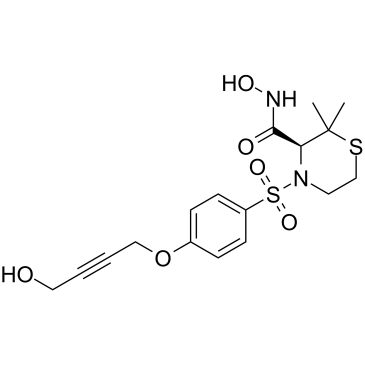
Cas No.: 287405-51-0
Sample solution is provided at 25 µL, 10mM.
Apratastat is an orally active, reversible dual inhibitor. Apratastat suppresses the activity of tumor necrosis factor-α converting enzyme (TACE; IC₅₀=81.7ng/mL) and matrix metalloproteinases (MMPs)[1-2]. Apratastat has potential as a therapeutic agent for cancer and rheumatoid arthritis[3-4].
In vitro, treatment of SUM149 breast cancer cells with Apratastat (20μM) for 3 days inhibited cell growth[5]. Pretreatment of non-small cell lung cancer NCI-H358 cells with Apratastat (25μM) for 24–48 hours suppressed radiation-induced tumor cell migration via inhibiting MAPK pathway-mediated EphA2 S897 phosphorylation[6].
In vivo, in a COVID-19-associated lung injury model using C57BL/6 mice, Apratastat (10mg/kg) was administered via intraperitoneal injection (at 4 and 16 hours) or intranasally (at 24 hours). Apratastat significantly improved lung histopathology scores and alleviated features of acute lung injury, such as edema, fibrosis, and vascular congestion[7]. In OVE26 diabetic model mice, Apratastat (10mg/kg; twice daily) was administered via intraperitoneal injection for three consecutive weeks. Apratastat significantly inhibited ADAM17 activity in the renal cortex, reduced Nox4 expression and NADPH oxidase activity, thereby mitigating the progression of diabetes-related kidney injury[8].
References:
[1] Talele TT, Khedkar SA, Rigby AC. Successful applications of computer aided drug discovery: moving drugs from concept to the clinic. Curr Top Med Chem. 2010;10(1):127-41.
[2] Shu C, Zhou H, Afsharvand M, et al. Pharmacokinetic-pharmacodynamic modeling of apratastat: a population-based approach. J Clin Pharmacol. 2011 Apr;51(4):472-81.
[3] Moss ML, Sklair-Tavron L, Nudelman R. Drug insight: tumor necrosis factor-converting enzyme as a pharmaceutical target for rheumatoid arthritis. Nat Clin Pract Rheumatol. 2008 Jun;4(6):300-9.
[4] Sharma A, Bender S, Zimmermann M, et al. Secretome Signature Identifies ADAM17 as Novel Target for Radiosensitization of Non-Small Cell Lung Cancer. Clin Cancer Res. 2016 Sep 1;22(17):4428-39.
[5] Mezil L, Berruyer-Pouyet C, Cabaud O, et al. Tumor selective cytotoxic action of a thiomorpholin hydroxamate inhibitor (TMI-1) in breast cancer. PLoS One. 2012;7(9):e43409.
[6] Waller V, Tschanz F, Winkler R, et al. The role of EphA2 in ADAM17- and ionizing radiation-enhanced lung cancer cell migration. Front Oncol. 2023 Mar 14;13:1117326.
[7] Lartey NL, Valle-Reyes S, Vargas-Robles H, et al. ADAM17/MMP inhibition prevents neutrophilia and lung injury in a mouse model of COVID-19. J Leukoc Biol. 2022 Jun;111(6):1147-1158.
[8] Ford BM, Eid AA, Göőz M, et al. ADAM17 mediates Nox4 expression and NADPH oxidase activity in the kidney cortex of OVE26 mice. Am J Physiol Renal Physiol. 2013 Aug 1;305(3):F323-32.
| Cell experiment [1]: | |
Cell lines | NCI-H358 and A549 cells |
Preparation Method | Cells were cultured in RPMI-1640 medium supplemented with 10% fetal bovine serum (FBS) at 37°C, 5% CO₂. Cells were treated with the ADAM17/MMP inhibitor Apratastat at 25µM for 24–48 hours. |
Reaction Conditions | 25µM; 24-48h |
Applications | Apratastat suppressed cancer cell migration in transwell assays by blocking MAPK pathway-dependent EphA2 activation and paracrine signaling. |
| Animal experiment [2]: | |
Animal models | OVE26 diabetic mice and C57BL/6 control mice |
Preparation Method | Mice were intraperitoneally administered Apratastat at 10mg/kg for a specified duration. |
Dosage form | 10mg/kg/day; i.p.; twice daily for 3 weeks. |
Applications | Apratastat significantly inhibited ADAM17 activity in the renal cortex, reduced Nox4 expression and NADPH oxidase activity, thereby alleviating the progression of diabetes-related kidney injury. |
References: | |
| Cas No. | 287405-51-0 | SDF | |
| Synonyms | TMI-005 | ||
| Chemical Name | (3S)-N-hydroxy-4-[[4-[(4-hydroxy-2-butyn-1-yl)oxy]phenyl]sulfonyl]-2,2-dimethyl-3-thiomorpholinecarboxamide | ||
| Canonical SMILES | CC1(C)[C@H](C(NO)=O)N(S(=O)(C2=CC=C(OCC#CCO)C=C2)=O)CCS1 | ||
| Formula | C17H22N2O6S2 | M.Wt | 414.5 |
| Solubility | 10mg/mL in ethanol, 25mg/mL in DMSO, or in DMF | Storage | Store at -20°C |
| General tips | Please select the appropriate solvent to prepare the stock solution according to the
solubility of the product in different solvents; once the solution is prepared, please store it in
separate packages to avoid product failure caused by repeated freezing and thawing.Storage method
and period of the stock solution: When stored at -80°C, please use it within 6 months; when stored
at -20°C, please use it within 1 month. To increase solubility, heat the tube to 37°C and then oscillate in an ultrasonic bath for some time. |
||
| Shipping Condition | Evaluation sample solution: shipped with blue ice. All other sizes available: with RT, or with Blue Ice upon request. | ||
| Prepare stock solution | |||

|
1 mg | 5 mg | 10 mg |
| 1 mM | 2.4125 mL | 12.0627 mL | 24.1255 mL |
| 5 mM | 482.5 μL | 2.4125 mL | 4.8251 mL |
| 10 mM | 241.3 μL | 1.2063 mL | 2.4125 mL |
Step 1: Enter information below (Recommended: An additional animal making an allowance for loss during the experiment)
 g
μL
g
μL
Step 2: Enter the in vivo formulation (This is only the calculator, not formulation. Please contact us first if there is no in vivo formulation at the solubility Section.)
Calculation results:
Working concentration: mg/ml;
Method for preparing DMSO master liquid: mg drug pre-dissolved in μL DMSO ( Master liquid concentration mg/mL, Please contact us first if the concentration exceeds the DMSO solubility of the batch of drug. )
Method for preparing in vivo formulation: Take μL DMSO master liquid, next addμL PEG300, mix and clarify, next addμL Tween 80, mix and clarify, next add μL saline, mix and clarify.
Method for preparing in vivo formulation: Take μL DMSO master liquid, next add μL Corn oil, mix and clarify.
Note: 1. Please make sure the liquid is clear before adding the next solvent.
2. Be sure to add the solvent(s) in order. You must ensure that the solution obtained, in the previous addition, is a clear solution before proceeding to add the next solvent. Physical methods such as vortex, ultrasound or hot water bath can be used to aid dissolving.
3. All of the above co-solvents are available for purchase on the GlpBio website.
Quality Control & SDS
- View current batch:
- Purity: >99.00% Appearance: A solid
- COA (Certificate of Analysis)
- SDS (Safety Data Sheet)
- Datasheet
Average Rating: 5 (Based on Reviews and 10 reference(s) in Google Scholar.)