

Levomefolic acid |
Catalog No.GC36443
 One-Click Copy Product Info
|

Levomefolic acid is an orally available, bioactive form of folic acid that crosses the blood-brain barrier.
Products are for research use only. Not for human use. We do not sell to patients.
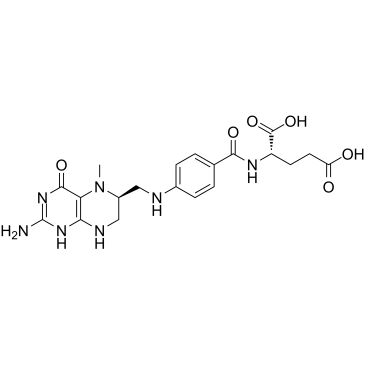
Cas No.: 31690-09-2
Sample solution is provided at 25 µL, 10mM.
_1-3.$$$39978408@51.jpg');)
_1-9.$$$38538795@65.jpg');)
_1-9.$$$39112701@51.jpg');)
_1-7.$$$37316672@70.jpg');)
_366-372.$$$36198801@70.jpg');)
.$$$38565142@65.jpg');)
_1867-1883.$$$33248023@67.jpg');)
_eads6055.$$$39977546@45.jpg');)
_eadm9805.$$$40080571@45.jpg');)
_eadj3020.$$$39666821@45.jpg');)
_1-20.$$$39757301@28.jpg');)
_1-24.$$$38898113@28.jpg');)
_273-287.$$$36806353@46.jpg');)
_1-16.$$$37156877@44.jpg');)
_1-19.$$$37460805@44.jpg');)
_1291-1307.$$$34518654@46.jpg');)
Levomefolic acid is an orally available, bioactive form of folic acid that crosses the blood-brain barrier[1]. Levomefolic acid, a ligand with low binding energy, can form three hydrogen bonds with Arg169, Asp305 and Tyr276 of COVID-19 PLpro protein and form π-π stacking interaction with Tyr271[2]. Levomefolic acid has been widely used as a model compound and an internal reference to develop novel LC-MS/MS methods for the identification of related compounds[3].
In vitro, Levomefolic acid treatment at 10µg/ml for 24 hours significantly inhibited Caco-2 cell proliferation and induced cell cycle arrest[4]. Treatment of BEAS-2B cells with 0.012g/L Levomefolic acid for 24h protected BEAS-2B cells from oxidative stress and inflammatory injury induced by glucose (50mM) and restored cell viability[5]. Treatment with 50µM Levomefolic acid for 48h significantly induced DNA damage in MRC5 and IMR90 cells, resulting in decreased MTR gene expression and increased MTHFD1, EGFR, XRCC1, and DNA Polβ gene expression[6].
In vivo, intraperitoneal injection of Levomefolic acid (3µg/kg) at 30 minutes before ischemia and again 3 hours after reperfusion can improve renal function in Sprague-Dawley rats, alleviate oxidative stress, restore glutathione levels in the kidneys, and reduce lipid peroxidation[7]. Within 5 weeks after weaning, oral administration of 4ml of drinking water containing a dose of 47μg/ml of Levomefolic acid daily significantly increased the body weight of female mice and promoted the maturation of oocytes[8].
References:
[1] Lam N S K, Long X X, Li X, et al. The potential use of folate and its derivatives in treating psychiatric disorders: A systematic review[J]. Biomedicine & Pharmacotherapy, 2022, 146: 112541.
[2] Hosseini M, Chen W, Xiao D, et al. Computational molecular docking and virtual screening revealed promising SARS-CoV-2 drugs[J]. Precision clinical medicine, 2021, 4(1): 1-16.
[3] Golja M V, Trontelj J, Geršak K, et al. Simultaneous quantification of intracellular concentrations of clinically important metabolites of folate-homocysteine cycle by LC-MS/MS[J]. Analytical biochemistry, 2020, 605: 113830.
[4] Akoglu B, Milovic V, Caspary W F, et al. Hyperproliferation of homocysteinetreated colon cancer cells is reversed by folate and 5-methyltetrahydrofolate[J]. European journal of Nutrition, 2004, 43(2): 93-99.
[5] Pathikkal A, Puthusseri B, Divya P, et al. Folate derivatives, 5-methyltetrahydrofolate and 10-formyltetrahydrofolate, protect BEAS-2B cells from high glucose–induced oxidative stress and inflammation[J]. In Vitro Cellular & Developmental Biology-Animal, 2022, 58(5): 419-428.
[6] Karkera C, Senejani A G. Evaluating toxicity and level of DNA damage in human fetal lung cells upon exposure to 5-methyltetrahydrofolate (bioactive folate)[J]. Nutrition and Health, 2024: 02601060241302895.
[7] Wijerathne C U B, Au-Yeung K K W, Siow Y L, et al. 5-methyltetrahydrofolate attenuates oxidative stress and improves kidney function in acute kidney injury through activation of Nrf2 and antioxidant defense[J]. Antioxidants, 2022, 11(6): 1046.
[8] Nasr‐Esfahani F, Jafarpour F, Varnosfaderani S R, et al. Differential Effects of Folic Acid and 5‐Methyltetrahydrofolate on Mice Oocytes and Embryo Development In Vitro and In Vivo: Implications for Reproductive Health[J]. The FASEB Journal, 2025, 39(20): e71090.
| Cell experiment [1]: | |
Cell lines | BEAS-2B cells |
Preparation Method | BEAS-2B cells were cultured in DMEM medium supplemented with 10% fetal bovine serum (FBS), 100IU/ml penicillin and 100µg/ml streptomycin, and cultured at 37℃ in a humidified atmosphere with 5% CO2. Cells were seeded in 96-well microplate at a density of 2×10⁴ cells/well, and 100µl culture medium was added to each well. After 24 hours of stable culture, cells were exposed to 50mM glucose and Levomefolic acid (0.012g/L) for 24 hours. At the end of the treatment, 40µl of MTT solution (2mg/ml) was added and incubated for 4h at 37°C. The medium was discarded, and the resulting purple formazan crystals were dissolved in 200µl dimethyl sulfoxide (DMSO), and the absorbance was measured at a wavelength of 540nm. |
Reaction Conditions | 0.012g/L; 24h |
Applications | Levomefolic acid treatment significantly restored the viability of BEAS-2B cells exposed to high glucose. |
| Animal experiment [2]: | |
Animal models | Male Sprague-Dawley rats |
Preparation Method | Male Sprague-Dawley rats (6 weeks old, 250-300 grams) were housed in a standard environment. The rats were randomly divided into three groups: (1) the renal ischemia-reperfusion group (IR group), (2) the renal ischemia-reperfusion combined with Levomefolic acid injection group (IR+5-MTHF group), and (3) the sham operation control group (Sham group) (n = 8 in each group). The left renal pedicle was clamped non-invasively with an intravascular clamp for 45 minutes to induce renal ischemia. After the ischemia ended, the vascular clamp was removed to restore the blood flow to the left kidney (reperfusion), and then the right kidney was removed. In IR+5-MTHF group of rats, Levomefolic acid (3µg/kg) was intraperitoneally injected 30 minutes before ischemia and 3 hours after reperfusion. The sham operation group was injected with normal saline. Kidney samples were collected from the rats 24 hours later for analysis. |
Dosage form | 3µg/kg for twice; i.p. |
Applications | Levomefolic acid treatment improved kidney morphology in rats with ischemia-reperfusion injury and attenuated kidney injury. |
References: | |
| Cas No. | 31690-09-2 | SDF | |
| Canonical SMILES | O=C(O)CC[C@@H](C(O)=O)NC(C1=CC=C(NC[C@@H]2N(C)C3=C(NC(N)=NC3=O)NC2)C=C1)=O | ||
| Formula | C20H25N7O6 | M.Wt | 459.46 |
| Solubility | 23 mg/mL DMSO(ultrasonic and warming and heat to 45°C) | Storage | Store at -20°C |
| General tips | Please select the appropriate solvent to prepare the stock solution according to the
solubility of the product in different solvents; once the solution is prepared, please store it in
separate packages to avoid product failure caused by repeated freezing and thawing.Storage method
and period of the stock solution: When stored at -80°C, please use it within 6 months; when stored
at -20°C, please use it within 1 month. To increase solubility, heat the tube to 37°C and then oscillate in an ultrasonic bath for some time. |
||
| Shipping Condition | Evaluation sample solution: shipped with blue ice. All other sizes available: with RT, or with Blue Ice upon request. | ||
| Prepare stock solution | |||

|
1 mg | 5 mg | 10 mg |
| 1 mM | 2.1765 mL | 10.8823 mL | 21.7647 mL |
| 5 mM | 435.3 μL | 2.1765 mL | 4.3529 mL |
| 10 mM | 217.6 μL | 1.0882 mL | 2.1765 mL |
Step 1: Enter information below (Recommended: An additional animal making an allowance for loss during the experiment)
 g
μL
g
μL
Step 2: Enter the in vivo formulation (This is only the calculator, not formulation. Please contact us first if there is no in vivo formulation at the solubility Section.)
Calculation results:
Working concentration: mg/ml;
Method for preparing DMSO master liquid: mg drug pre-dissolved in μL DMSO ( Master liquid concentration mg/mL, Please contact us first if the concentration exceeds the DMSO solubility of the batch of drug. )
Method for preparing in vivo formulation: Take μL DMSO master liquid, next addμL PEG300, mix and clarify, next addμL Tween 80, mix and clarify, next add μL saline, mix and clarify.
Method for preparing in vivo formulation: Take μL DMSO master liquid, next add μL Corn oil, mix and clarify.
Note: 1. Please make sure the liquid is clear before adding the next solvent.
2. Be sure to add the solvent(s) in order. You must ensure that the solution obtained, in the previous addition, is a clear solution before proceeding to add the next solvent. Physical methods such as vortex, ultrasound or hot water bath can be used to aid dissolving.
3. All of the above co-solvents are available for purchase on the GlpBio website.
Quality Control & SDS
- View current batch:
- Purity: >98.50% Appearance: A solid
- COA (Certificate of Analysis)
- SDS (Safety Data Sheet)
- Datasheet
Average Rating: 5 (Based on Reviews and 38 reference(s) in Google Scholar.)