

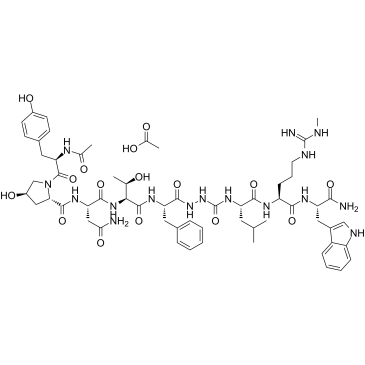
TAK-448 acetate (Synonyms: MVT-602 acetate) |
Catalog No.GC37722
 One-Click Copy Product Info
|

TAK-448 acetate is an oligopeptide analog that acts as a potent agonist of the KISS1 receptor (GPR54; IC₅₀=460pM, EC₅₀=632pM).
Products are for research use only. Not for human use. We do not sell to patients.
Cas No.: 1470374-22-1
Sample solution is provided at 25 µL, 10mM.
_1-3.$$$39978408@51.jpg');)
_1-9.$$$38538795@65.jpg');)
_1-9.$$$39112701@51.jpg');)
_1-7.$$$37316672@70.jpg');)
_366-372.$$$36198801@70.jpg');)
.$$$38565142@65.jpg');)
_1867-1883.$$$33248023@67.jpg');)
_eads6055.$$$39977546@45.jpg');)
_eadm9805.$$$40080571@45.jpg');)
_eadj3020.$$$39666821@45.jpg');)
_1-20.$$$39757301@28.jpg');)
_1-24.$$$38898113@28.jpg');)
_273-287.$$$36806353@46.jpg');)
_1-16.$$$37156877@44.jpg');)
_1-19.$$$37460805@44.jpg');)
_1291-1307.$$$34518654@46.jpg');)
TAK-448 acetate is an oligopeptide analog that acts as a potent agonist of the KISS1 receptor (GPR54; IC₅₀=460pM, EC₅₀=632pM)[1-2]. TAK-448 acetate is a C‑terminal analog of endogenous kisspeptin‑54. Acute administration stimulates the release of luteinizing hormone (LH) and follicle‑stimulating hormone (FSH), while sustained exposure downregulates the pituitary‑gonadal axis, thereby rapidly reducing testosterone levels. TAK‑448 acetate is primarily utilized in research related to endocrine regulation and prostate cancer therapy [3-4].
In vivo, TAK-448 acetate (in the form of the sustained‑release formulation TAK-448‑SR(1M)) was administered as a single subcutaneous injection (0.03–3mg/kg) to male F344/N Jcl‑rnu/rnu rats bearing VCaP prostate cancer xenografts (starting from week 7 post‑implantation, repeated every 4 weeks). TAK-448 acetate significantly reduced plasma testosterone and LH levels, suppressed the growth of testes, prostate, and seminal vesicles, and rapidly lowered plasma prostate‑specific antigen levels[5]. In a mouse model of metabolic dysfunction‑associated steatotic liver disease (MASLD) using DIAMOND male mice, continuous subcutaneous infusion of TAK‑448 acetate (0.3nmol/h) via osmotic minipumps for 6 weeks, TAK‑448 acetate significantly inhibited hepatic de novo lipogenesis, reduced the synthesis of free fatty acids associated with obesity, diabetes, and hepatocellular carcinoma, ameliorated hepatic steatosis and insulin resistance, and down‑regulated the expression of key lipid‑droplet regulators such as CIDEA and the transcription factor SREBP‑1c[6].
References:
[1] Nishizawa N, Takatsu Y, Kumano S, et al. Design and Synthesis of an Investigational Nonapeptide KISS1 Receptor (KISS1R) Agonist, Ac-d-Tyr-Hydroxyproline (Hyp)-Asn-Thr-Phe-azaGly-Leu-Arg(Me)-Trp-NH2 (TAK-448), with Highly Potent Testosterone-Suppressive Activity and Excellent Water Solubility. J Med Chem. 2016 Oct 13;59(19):8804-8811.
[2] Stalewski J, Hargrove DM, Wolfe M, et al. Additive effect of simultaneous continuous administration of degarelix and TAK-448 on LH suppression in a castrated rat model. Eur J Pharmacol. 2018 Apr 5;824:24-29.
[3] MacLean DB, Matsui H, Suri A, et al. Sustained exposure to the investigational Kisspeptin analog, TAK-448, down-regulates testosterone into the castration range in healthy males and in patients with prostate cancer: results from two phase 1 studies. J Clin Endocrinol Metab. 2014 Aug;99(8):E1445-53.
[4] Matsui H, Tanaka A, Yokoyama K, et al. Chronic administration of the metastin/kisspeptin analog KISS1-305 or the investigational agent TAK-448 suppresses hypothalamic pituitary gonadal function and depletes plasma testosterone in adult male rats. Endocrinology. 2012 Nov;153(11):5297-308.
[5] Ishikawa K, Tanaka A, Kogame A, et al. Usefulness of pharmacokinetic/efficacy analysis of an investigational kisspeptin analog, TAK-448, in quantitatively evaluating anti-tumor growth effect in the rat VCaP androgen-sensitive prostate cancer model. Eur J Pharmacol. 2018 Jun 5;828:126-134.
[6] Izarraras K, Shah A, Prasad K, et al. Kisspeptin Mitigates Hepatic De Novo Lipogenesis in Metabolic Dysfunction-Associated Steatotic Liver Disease. Cells. 2025 Aug 20;14(16):1289.
| Animal experiment [1]: | |
Animal models | DIAMOND mice (C57BL/6J × 129S1/Svlm background) |
Preparation Method | Mice were fed a Western diet with sugar water (WDSW) for 6 weeks to induce metabolic dysfunction-associated steatotic liver disease (MASLD), then subcutaneously administered TAK-448 acetate (0.3nmol/h) via osmotic minipumps for 6 weeks while maintaining WDSW. Deuterium-labeled water (²H₂O) was provided during the final week to trace de novo lipogenesis (DNL). Mice were sacrificed for hepatic and metabolic analyses. |
Dosage form | 0.3nmol/h; subcutaneous continuous infusion; 6-week duration. |
Applications | TAK-448 acetate significantly reduced hepatic DNL, decreased intrahepatic fatty acid synthesis, and lowered liver triglyceride content, serum free fatty acids, and ALT levels. TAK-448 acetate improved insulin sensitivity and glucose tolerance, and downregulated key lipogenic regulators via AMPK activation, demonstrating therapeutic potential against MASLD. |
References: | |
| Cas No. | 1470374-22-1 | SDF | |
| Synonyms | MVT-602 acetate | ||
| Formula | C60H84N16O16 | M.Wt | 1285.41 |
| Solubility | DMSO: ≥ 100 mg/mL (77.80 mM); Water: 50 mg/mL (38.90 mM) | Storage | Store at -20°C |
| General tips | Please select the appropriate solvent to prepare the stock solution according to the
solubility of the product in different solvents; once the solution is prepared, please store it in
separate packages to avoid product failure caused by repeated freezing and thawing.Storage method
and period of the stock solution: When stored at -80°C, please use it within 6 months; when stored
at -20°C, please use it within 1 month. To increase solubility, heat the tube to 37°C and then oscillate in an ultrasonic bath for some time. |
||
| Shipping Condition | Evaluation sample solution: shipped with blue ice. All other sizes available: with RT, or with Blue Ice upon request. | ||
| Prepare stock solution | |||

|
1 mg | 5 mg | 10 mg |
| 1 mM | 778 μL | 3.8898 mL | 7.7796 mL |
| 5 mM | 155.6 μL | 778 μL | 1.5559 mL |
| 10 mM | 77.8 μL | 389 μL | 778 μL |
Step 1: Enter information below (Recommended: An additional animal making an allowance for loss during the experiment)
 g
μL
g
μL
Step 2: Enter the in vivo formulation (This is only the calculator, not formulation. Please contact us first if there is no in vivo formulation at the solubility Section.)
Calculation results:
Working concentration: mg/ml;
Method for preparing DMSO master liquid: mg drug pre-dissolved in μL DMSO ( Master liquid concentration mg/mL, Please contact us first if the concentration exceeds the DMSO solubility of the batch of drug. )
Method for preparing in vivo formulation: Take μL DMSO master liquid, next addμL PEG300, mix and clarify, next addμL Tween 80, mix and clarify, next add μL saline, mix and clarify.
Method for preparing in vivo formulation: Take μL DMSO master liquid, next add μL Corn oil, mix and clarify.
Note: 1. Please make sure the liquid is clear before adding the next solvent.
2. Be sure to add the solvent(s) in order. You must ensure that the solution obtained, in the previous addition, is a clear solution before proceeding to add the next solvent. Physical methods such as vortex, ultrasound or hot water bath can be used to aid dissolving.
3. All of the above co-solvents are available for purchase on the GlpBio website.
Quality Control & SDS
- View current batch:
- Purity: >99.00% Appearance: A solid
- COA (Certificate of Analysis)
- SDS (Safety Data Sheet)
- Datasheet
Average Rating: 5 (Based on Reviews and 10 reference(s) in Google Scholar.)