

UNC2025 hydrochloride |
Catalog No.GC37857
 One-Click Copy Product Info
|

UNC2025 hydrochloride is an orally bioavailable Mer/Flt3 dual inhibitor (IC50=0.74nM, 0.8nM).
Products are for research use only. Not for human use. We do not sell to patients.
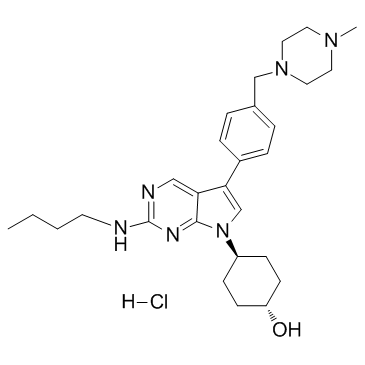
Cas No.: 2070015-17-5
Sample solution is provided at 25 µL, 10mM.
_1-3.$$$39978408@51.jpg');)
_1-9.$$$38538795@65.jpg');)
_1-9.$$$39112701@51.jpg');)
_1-7.$$$37316672@70.jpg');)
_366-372.$$$36198801@70.jpg');)
.$$$38565142@65.jpg');)
_1867-1883.$$$33248023@67.jpg');)
_eads6055.$$$39977546@45.jpg');)
_eadm9805.$$$40080571@45.jpg');)
_eadj3020.$$$39666821@45.jpg');)
_1-20.$$$39757301@28.jpg');)
_1-24.$$$38898113@28.jpg');)
_273-287.$$$36806353@46.jpg');)
_1-16.$$$37156877@44.jpg');)
_1-19.$$$37460805@44.jpg');)
_1291-1307.$$$34518654@46.jpg');)
UNC2025 hydrochloride is an orally bioavailable Mer/Flt3 dual inhibitor (IC50=0.74nM, 0.8nM). UNC2025 hydrochloride downregulates MERTK-dependent downstream signaling pathways including STAT6, AKT, and ERK1/2. UNC2025 hydrochloride inhibits tumor cell proliferation and induces apoptosis. UNC2025 hydrochloride can be used in studies related to acute leukemia, non-small cell lung cancer, and other conditions[1-4].
In vitro, treatment of A172, SF188, and U251 glioblastoma cells with 50-200nM UNC2025 hydrochloride for 1-120 hours reduced viable cell number, inhibited colony formation, and decreased neurosphere diameter[5]. Treatment of HMCB, G361, A101D, SK-MEL-5, SK-MEL-2, SK-MEL-119, MeWo, MB2141, MB2204, and MB2724 melanoma cells with 50-1000nM UNC2025 hydrochloride for 2-10 days dose-dependently reduced colony formation number and increased the number of apoptotic and dead cells[6]. Treatment of H2228, A549, Colo699, and H1299 non-small cell lung cancer cells with 300nM UNC2025 hydrochloride for 72 hours decreased Survivin protein levels and increased the proportion of apoptotic and dead cells[7].
In vivo, C57BL/6 mice bearing TRP-MSCV-luc glioblastoma xenografts received daily oral gavage of 65mg/kg UNC2025 hydrochloride until survival endpoint. UNC2025 hydrochloride significantly prolonged mouse survival[8]. NSG or NSGS mice were inoculated via tail vein with 697 B-ALL-luc cells, NOMO-1 AML cells, or primary MERTK-positive AML patient mononuclear cells. These mice then received daily oral gavage of 50mg/kg or 75mg/kg UNC2025 hydrochloride until survival endpoint. UNC2025 hydrochloride dose-dependently reduced MERTK phosphorylation in bone marrow leukemia cells, decreased tumor burden, and prolonged median survival[9]. NU(NCR)-Foxn1nu mice bearing MKN45 cell subcutaneous xenograft tumors reaching 100mm³ received daily oral gavage of 50mg/kg or 75mg/kg UNC2025 hydrochloride until experimental endpoint. UNC2025 hydrochloride significantly reduced tumor volume[10].
References:
[1] Zhang W, DeRyckere D, Hunter D, et al. UNC2025, a potent and orally bioavailable MER/FLT3 dual inhibitor. J Med Chem. 2014 Aug 28;57(16):7031-41.
[2] Yu L, Deng Y, Wang X, et al. Co-targeting JAK1/STAT6/GAS6/TAM signaling improves chemotherapy efficacy in Ewing sarcoma. Nat Commun. 2024 Jun 21;15(1):5292.
[3] Shofolawe-Bakare O, Toragall VB, Hulugalla K, et al. Glycopolymeric Nanoparticles Block Breast Cancer Growth by Inhibiting Efferocytosis in the Tumor Microenvironment. ACS Appl Nano Mater. 2024 Dec 27;7(24):28851-28863.
[4] Powell RM, Peeters MJW, Rahbech A, et al. Small Molecule Inhibitors of MERTK and FLT3 Induce Cell Cycle Arrest in Human CD8+ T Cells. Vaccines (Basel). 2021 Nov 8;9(11):1294.
[5] Sufit A, Lee-Sherick AB, DeRyckere D, et al. MERTK Inhibition Induces Polyploidy and Promotes Cell Death and Cellular Senescence in Glioblastoma Multiforme. PLoS One. 2016 Oct 26;11(10):e0165107.
[6] Sinik L, Minson KA, Tentler JJ, et al. Inhibition of MERTK promotes suppression of tumor growth in BRAF mutant and BRAF wild-type melanoma. Mol Cancer Ther. 2019 Feb;18(2):278-288.
[7] Cummings CT, Zhang W, Davies KD, et al. Small molecule inhibition of MERTK is efficacious in non-small cell lung cancer models independent of driver oncogene status. Mol Cancer Ther. 2015 Sep;14(9):2014-2022.
[8] Wu J, Frady LN, Bash RE, et al. MerTK as a therapeutic target in glioblastoma. Neuro Oncol. 2018 Jan;20(1):92-102.
[9] DeRyckere D, Lee-Sherick AB, Huey MG, et al. UNC2025, a MERTK small molecule inhibitor, is therapeutically effective alone and in combination with methotrexate in leukemia models. Clin Cancer Res. 2017 Mar 15;23(6):1481-1492.
[10] Wirsik NM, Chen M, He L, et al. Targeting the receptor tyrosine kinase MerTK shows therapeutic value in gastric adenocarcinoma. Cancer Med. 2024;13:e6866.
| Cell experiment [1]: | |
|
Cell lines |
A172 cells, SF188 cells, U251 cells (glioblastoma multiforme cell lines) |
|
Preparation Method |
A172, SF188 and U251 cells were cultured in DMEM with 10% FBS at 37°C, 5% CO2. Cells were treated with UNC2025 hydrochloride at 50-200nM for 120h for cell count, 50-400nM for 48h on pre-formed neurospheres. After treatment, MERTK phosphorylation was measured by immunoprecipitation-Western, cell number by trypan blue, colony number by crystal violet, neurosphere diameter by microscopy. |
|
Reaction Conditions |
50-200nM; 1-120h |
|
Applications |
UNC2025 hydrochloride reduced MERTK phosphorylation at Tyr749/753/754 in A172, SF188 and U251 cells in a dose-dependent manner. UNC2025 hydrochloride reduced viable cell number, blocked colony formation completely, accumulated cells in G2/M phase. UNC2025 hydrochloride reduced neurosphere diameter in SF188 and U251. UNC2025 hydrochloride increased apoptotic and dead cells, increased PARP cleavage and reduced Survivin. UNC2025 hydrochloride increased p21 in A172, and elevated IL-6 and IL-8 secretion. |
| Animal experiment [2]: | |
|
Animal models |
C57BL/6 mice (syngeneic, immune competent) bearing orthotopic TRP-MSCV-luc glioblastoma allografts |
|
Preparation Method |
Mice were injected intracranially with 1×10⁵ TRP-MSCV-luc cells. Tumors were established for 7 days. Mice were randomized to receive vehicle (sham water oral gavage) or UNC2025 hydrochloride (65mg/kg) by oral gavage daily starting day 7 until endpoint. Bioluminescence imaging was performed twice weekly; mice surviving >62 days were censored. Tumor tissues were collected for CD206/F4-80 dual immunohistochemistry. |
|
Dosage form |
65mg/kg; oral gavage; daily from day 7 to endpoint |
|
Applications |
UNC2025 hydrochloride alone produced a median overall survival of 22 days. UNC2025 hydrochloride alone produced a tumor bioluminescence doubling time of 4.6 days. UNC2025 hydrochloride decreased the percentage of CD206+ M2 glioma-associated macrophages in tumors. |
References: [1] Sufit A, Lee-Sherick AB, DeRyckere D, et al. MERTK Inhibition Induces Polyploidy and Promotes Cell Death and Cellular Senescence in Glioblastoma Multiforme. PLoS One. 2016 Oct 26;11(10):e0165107. [2] Wu J, Frady LN, Bash RE, et al. MerTK as a therapeutic target in glioblastoma. Neuro Oncol. 2018 Jan;20(1):92-102. | |
| Cas No. | 2070015-17-5 | SDF | |
| Canonical SMILES | CN1CCN(CC2=CC=C(C3=CN([C@@H]4CC[C@@H](O)CC4)C5=NC(NCCCC)=NC=C53)C=C2)CC1.[H]Cl | ||
| Formula | C28H41ClN6O | M.Wt | 513.12 |
| Solubility | DMSO: 6.66 mg/mL (12.98 mM) | Storage | Store at -20°C |
| Shipping Condition | Evaluation sample solution: shipped with blue ice. All other sizes available: with RT, or with Blue Ice upon request. | ||
| Prepare stock solution | |||

|
1 mg | 5 mg | 10 mg |
| 1 mM | 1.9489 mL | 9.7443 mL | 19.4886 mL |
| 5 mM | 389.8 μL | 1.9489 mL | 3.8977 mL |
| 10 mM | 194.9 μL | 974.4 μL | 1.9489 mL |
Step 1: Enter information below (Recommended: An additional animal making an allowance for loss during the experiment)
 g
μL
g
μL
Step 2: Enter the in vivo formulation (This is only the calculator, not formulation. Please contact us first if there is no in vivo formulation at the solubility Section.)
Calculation results:
Working concentration: mg/ml;
Method for preparing DMSO master liquid: mg drug pre-dissolved in μL DMSO ( Master liquid concentration mg/mL, Please contact us first if the concentration exceeds the DMSO solubility of the batch of drug. )
Method for preparing in vivo formulation: Take μL DMSO master liquid, next addμL PEG300, mix and clarify, next addμL Tween 80, mix and clarify, next add μL saline, mix and clarify.
Method for preparing in vivo formulation: Take μL DMSO master liquid, next add μL Corn oil, mix and clarify.
Note: 1. Please make sure the liquid is clear before adding the next solvent.
2. Be sure to add the solvent(s) in order. You must ensure that the solution obtained, in the previous addition, is a clear solution before proceeding to add the next solvent. Physical methods such as vortex, ultrasound or hot water bath can be used to aid dissolving.
3. All of the above co-solvents are available for purchase on the GlpBio website.
Quality Control & SDS
- View current batch:
- Purity: >98.00% Appearance: A solid
- COA (Certificate of Analysis)
- SDS (Safety Data Sheet)
- Datasheet
Average Rating: 5 (Based on Reviews and 1 reference(s) in Google Scholar.)