

GDC-0941 (Synonyms: GDC-0941) |
Catalog No.GC10816
 One-Click Copy Product Info
|

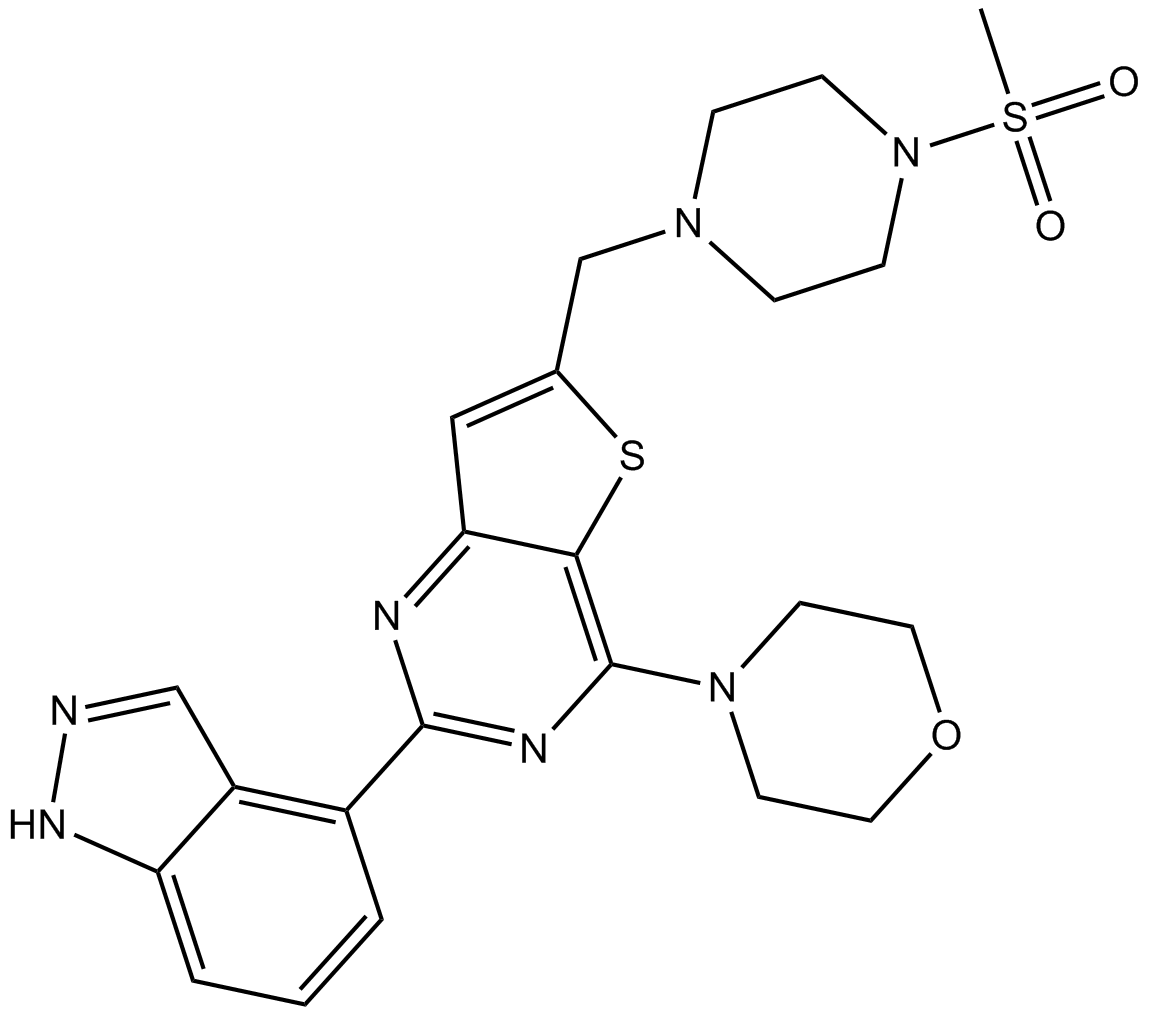
GDC-0941 is an oral, potent, selective pan-inhibitor of class I PI3K, with IC50 values of 3nM, 33nM, 3nM, and 75nM for p110α, p110β, p110δ, and p110γ, respectively.
Products are for research use only. Not for human use. We do not sell to patients.
Cas No.: 957054-30-7
Sample solution is provided at 25 µL, 10mM.
_1-3.$$$39978408@51.jpg');)
_1-9.$$$38538795@65.jpg');)
_1-9.$$$39112701@51.jpg');)
_1-7.$$$37316672@70.jpg');)
_366-372.$$$36198801@70.jpg');)
.$$$38565142@65.jpg');)
_1867-1883.$$$33248023@67.jpg');)
_eads6055.$$$39977546@45.jpg');)
_eadm9805.$$$40080571@45.jpg');)
_eadj3020.$$$39666821@45.jpg');)
_1-20.$$$39757301@28.jpg');)
_1-24.$$$38898113@28.jpg');)
_273-287.$$$36806353@46.jpg');)
_1-16.$$$37156877@44.jpg');)
_1-19.$$$37460805@44.jpg');)
_1291-1307.$$$34518654@46.jpg');)
GDC-0941 is an oral, potent, selective pan-inhibitor of class I PI3K, with IC50 values of 3nM, 33nM, 3nM, and 75nM for p110α, p110β, p110δ, and p110γ, respectively[1]. GDC-0941 inhibits the AKT signaling pathway by suppressing PI3K expression, mainly including the inhibition of AKT phosphorylation as well as phosphorylation levels of AKT downstream proteins[2]. GDC-0941 has been widely used in both cell and animal models to inhibit the progression of cancer, and has been employed in the development of combined therapies targeting tumors[3].
In vitro, GDC-0941 treatment for 96 hours significantly inhibited the viability of U87MG, PC3 and MDA-MB-361 cells, with IC50 values of 0.95μM, 0.28μM and 0.72μM, respectively[4]. Treatment with 10μM GDC-0941 for 48 hours significantly inhibited the proliferation of Daoy cells and induced cell apoptosis, causing the cells to undergo cell cycle arrest[5]. GDC-0941 (1μM) treatment for 18 hours inhibited hypoxia-induced HIF-1α and HIF-2α expression and HIF activity in thyroid cancer cells[6].
In vivo, GDC-0941 treatment via oral administration at a dose of 50mg/kg/day for 15 weeks resulted in a significant reduction in the levels of p-Akt-S473 and Ki-67 in the mammary tissues of MMTV-neu mice, delaying tumor occurrence and prolonging the tumor-free survival period[7]. Oral administration of 100mg/kg/day dose of GDC-0941 for 2 weeks can inhibit tumor growth in RIP1-Tag2 mice without affecting tumor blood vessels[8].
References:
[1] Sarker D, Ang J E, Baird R, et al. First-in-human phase I study of pictilisib (GDC-0941), a potent pan–class I phosphatidylinositol-3-kinase (PI3K) inhibitor, in patients with advanced solid tumors[J]. Clinical cancer research, 2015, 21(1): 77-86.
[2] Chen H, Cheng M, Gao P, et al. GDC-0941 activates integrin linked kinase (ILK) expression to cause resistance to GDC-0941 in breast cancer by the tumor necrosis factor (TNF)-α signaling pathway[J]. Bioengineered, 2022, 13(4): 10944-10955.
[3] Usman M W, Gao J, Zheng T, et al. Macrophages confer resistance to PI3K inhibitor GDC-0941 in breast cancer through the activation of NF-κB signaling[J]. Cell death & disease, 2018, 9(8): 809.
[4] Folkes A J, Ahmadi K, Alderton W K, et al. The identification of 2-(1 H-indazol-4-yl)-6-(4-methanesulfonyl-piperazin-1-ylmethyl)-4-morpholin-4-yl-thieno [3, 2-d] pyrimidine (GDC-0941) as a potent, selective, orally bioavailable inhibitor of class I PI3 kinase for the treatment of cancer[J]. Journal of medicinal chemistry, 2008, 51(18): 5522-5532.
[5] Ehrhardt M, Craveiro R B, Holst M I, et al. The PI3K inhibitor GDC-0941 displays promising in vitro and in vivo efficacy for targeted medulloblastoma therapy[J]. Oncotarget, 2014, 6(2): 802.
[6] Burrows N, Babur M, Resch J, et al. GDC-0941 inhibits metastatic characteristics of thyroid carcinomas by targeting both the phosphoinositide-3 kinase (PI3K) and hypoxia-inducible factor-1α (HIF-1α) pathways[J]. The journal of clinical endocrinology & metabolism, 2011, 96(12): E1934-E1943.
[7] Wang J, Zhang Y, Xiao Y, et al. Boosting immune surveillance by low-dose PI3K inhibitor facilitates early intervention of breast cancer[J]. American journal of cancer research, 2021, 11(5): 2005.
[8] Soler A, Figueiredo A M, Castel P, et al. Therapeutic benefit of selective inhibition of p110α PI3-kinase in pancreatic neuroendocrine tumors[J]. Clinical Cancer Research, 2016, 22(23): 5805-5817.
| Cell experiment [1]: | |
Cell lines | Daoy cells |
Preparation Method | Daoy cells were cultured in Dulbecco Modified Eagle Medium (DMEM) supplemented with L-glutamine, 1mM sodium pyruvate (PAA), 1% penicillin/streptomycin (Invitrogen), and 10% fetal bovine serum (FBS), at 37°C and 5% CO2. 2.5×10³ Daoy cells were seeded in 96-well plates and treated with different concentrations of GDC-0941 (0, 1, 2, 5, and 10μM) for 48 hours. MTS reagent was added and absorbance was measured at 490nm. |
Reaction Conditions | 0, 1, 2, 5, and 10μM; 48h |
Applications | GDC-0941 treatment significantly inhibited the cell viability of Daoy cells in a concentration-dependent manner. |
| Animal experiment [2]: | |
Animal models | Female MMTV-neu mice |
Preparation Method | Female MMTV-neu mice at 10 weeks of age were treated with GDC-0941 (50mg/kg) or vehicle (0.5% hydroxypropyl methylcellulose containing 0.1% Tween 80) by gavage once daily until the tumors became palpable. The median tumor-free survival time was recorded as T(50). At 15 weeks after treatment, 4-5 mice in each group were sacrificed, and a fourth pair of normal-looking mammary fat pads (MFP) were isolated for immunohistochemical analysis. |
Dosage form | 50mg/kg/day for 15 weeks; p.o. |
Applications | GDC-0941 treatment resulted in a significant decrease in the levels of p-Akt-S473 and Ki-67 in the mouse mammary tissue. |
References: | |
| Cas No. | 957054-30-7 | SDF | |
| Synonyms | GDC-0941 | ||
| Chemical Name | 4-[2-(1H-indazol-4-yl)-6-[(4-methylsulfonylpiperazin-1-yl)methyl]thieno[3,2-d]pyrimidin-4-yl]morpholine | ||
| Canonical SMILES | CS(=O)(=O)N1CCN(CC1)CC2=CC3=C(S2)C(=NC(=N3)C4=C5C=NNC5=CC=C4)N6CCOCC6 | ||
| Formula | C23H27N7O3S2 | M.Wt | 513.64 |
| Solubility | ≥ 25.7mg/mL in DMSO, ≥ 3.59 mg/mL in EtOH with ultrasonic and warming | Storage | Store at -20°C |
| General tips | Please select the appropriate solvent to prepare the stock solution according to the
solubility of the product in different solvents; once the solution is prepared, please store it in
separate packages to avoid product failure caused by repeated freezing and thawing.Storage method
and period of the stock solution: When stored at -80°C, please use it within 6 months; when stored
at -20°C, please use it within 1 month. To increase solubility, heat the tube to 37°C and then oscillate in an ultrasonic bath for some time. |
||
| Shipping Condition | Evaluation sample solution: shipped with blue ice. All other sizes available: with RT, or with Blue Ice upon request. | ||
| Prepare stock solution | |||

|
1 mg | 5 mg | 10 mg |
| 1 mM | 1.9469 mL | 9.7344 mL | 19.4689 mL |
| 5 mM | 389.4 μL | 1.9469 mL | 3.8938 mL |
| 10 mM | 194.7 μL | 973.4 μL | 1.9469 mL |
Step 1: Enter information below (Recommended: An additional animal making an allowance for loss during the experiment)
 g
μL
g
μL
Step 2: Enter the in vivo formulation (This is only the calculator, not formulation. Please contact us first if there is no in vivo formulation at the solubility Section.)
Calculation results:
Working concentration: mg/ml;
Method for preparing DMSO master liquid: mg drug pre-dissolved in μL DMSO ( Master liquid concentration mg/mL, Please contact us first if the concentration exceeds the DMSO solubility of the batch of drug. )
Method for preparing in vivo formulation: Take μL DMSO master liquid, next addμL PEG300, mix and clarify, next addμL Tween 80, mix and clarify, next add μL saline, mix and clarify.
Method for preparing in vivo formulation: Take μL DMSO master liquid, next add μL Corn oil, mix and clarify.
Note: 1. Please make sure the liquid is clear before adding the next solvent.
2. Be sure to add the solvent(s) in order. You must ensure that the solution obtained, in the previous addition, is a clear solution before proceeding to add the next solvent. Physical methods such as vortex, ultrasound or hot water bath can be used to aid dissolving.
3. All of the above co-solvents are available for purchase on the GlpBio website.
Quality Control & SDS
- View current batch:
- Purity: ≥98% Appearance: A solid
- COA (Certificate of Analysis)
- SDS (Safety Data Sheet)
- Datasheet
Average Rating: 5 (Based on Reviews and 30 reference(s) in Google Scholar.)