

Genistein (Synonyms: CI-75610, NSC 36586) |
Catalog No.GC14102
 One-Click Copy Product Info
|

Genistein, a precursor of phytoalexins in legumes, is an important nutraceutical molecule found in soybean seeds.
Products are for research use only. Not for human use. We do not sell to patients.
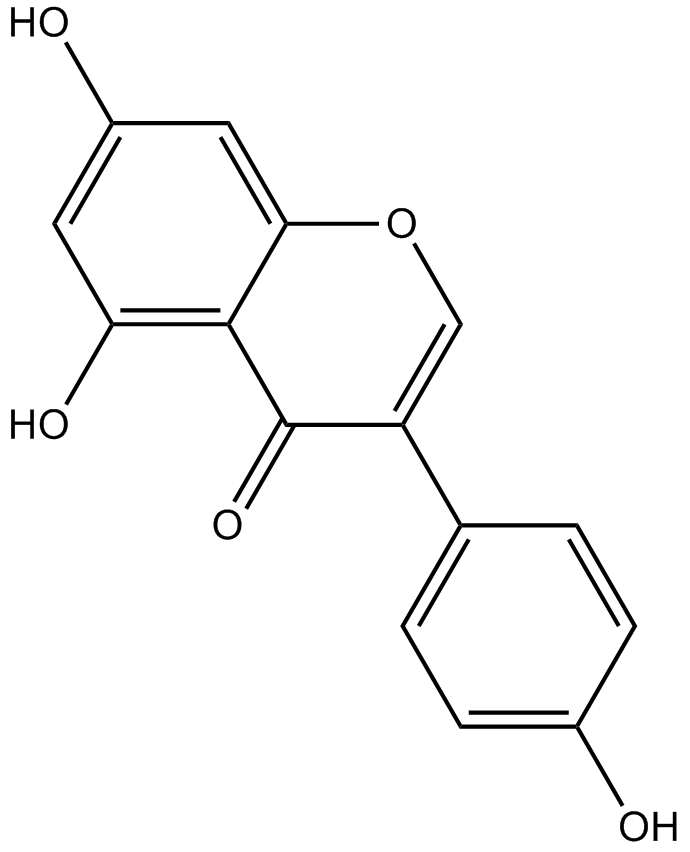
Cas No.: 446-72-0
Sample solution is provided at 25 µL, 10mM.
Genistein, a precursor of phytoalexins in legumes, is an important nutraceutical molecule found in soybean seeds[1]. Genistein acts as an inhibitor of Epidermal Growth Factor Receptor (EGFR) and inhibits the activity of topoisomerases, further promotes FOXO3 activity, and leads to increased expression of the p27kip1 cell cycle inhibitor[2]. Genistein has been widely used in tumor research to restrain the progression of various cancer cells and prevent angiogenesis[3].
In vitro, Genistein treatment for 72 hours significantly inhibited the viability of HCT116, A549, and LoVo cells, with IC50 values of 34.90µM, 43.09µM, and 15.88µM, respectively[4]. Treatment with 50µM Genistein for 48 hours induced apoptosis in HT29 cells, accompanied by activation of the caspase-3 pathway and a decrease in the expression level of p38 MAPK[5]. Treatment with 25µM Genistein for 4 days led to G2/M phase cell cycle arrest in PC3 and DU145 cells, and downregulated the expression of the oncogene HOTAIR[6].
In vivo, Genistein treatment via intraperitoneal injection at a dose of 15mg/kg/day for 5 days markedly inhibited tumor growth and angiogenesis in B16 xenograft tumor mice[7]. Intraperitoneal injection of Genistein at a dose of 10mg/kg/day three times per week for 10 weeks alleviated renal inflammation and injury and reduced blood glucose levels in streptozotocin-induced diabetic mice[8].
References:
[1] Dixon R A, Ferreira D. Genistein[J]. Phytochemistry, 2002, 60(3): 205-211.
[2] Ganai A A, Farooqi H. Bioactivity of genistein: A review of in vitro and in vivo studies[J]. Biomedicine & pharmacotherapy, 2015, 76: 30-38.
[3] Polkowski K, Mazurek A P. Biological properties of genistein. A review of in vitro and in vivo data[J]. Acta poloniae pharmaceutica, 2000, 57(2): 135-155.
[4] Rusin A, Zawisza-Puchałka J, Kujawa K, et al. Synthetic conjugates of genistein affecting proliferation and mitosis of cancer cells[J]. Bioorganic & medicinal chemistry, 2011, 19(1): 295-305.
[5] Shafiee G, Saidijam M, Tavilani H, et al. Genistein induces apoptosis and inhibits proliferation of HT29 colon cancer cells[J]. International journal of molecular and cellular medicine, 2016, 5(3): 178.
[6] Chiyomaru T, Yamamura S, Fukuhara S, et al. Genistein inhibits prostate cancer cell growth by targeting miR-34a and oncogenic HOTAIR[J]. PloS one, 2013, 8(8): e70372.
[7] Farina H G, Pomies M, Alonso D F, et al. Antitumor and antiangiogenic activity of soy isoflavone genistein in mouse models of melanoma and breast cancer[J]. Oncology reports, 2006, 16(4): 885-891.
[8] Elmarakby A A, Ibrahim A S, Faulkner J, et al. Tyrosine kinase inhibitor, genistein, reduces renal inflammation and injury in streptozotocin-induced diabetic mice[J]. Vascular pharmacology, 2011, 55(5-6): 149-156.
| Cell experiment [1]: | |
|
Cell lines |
HCT116 cells |
|
Preparation Method |
HCT116 cells were cultured in McCoy′s 5A medium, supplemented with 10% fetal bovine serum (FBS), and 1% penicillin/streptomycin at 37°C in an incubator with 5% CO2. Cells were seeded in a 96-well plate at a density of 2×10³ cells/well overnight and incubated with different concentrations of Genistein (0, 1, 10, 100, and 200µM) for 72h, the cell proliferation was tested. |
|
Reaction Conditions |
0, 1, 10, 100, and 200µM; 72h |
|
Applications |
Genistein treatment reduced cell proliferation of HCT116 cells in a dose-dependent manner. |
| Animal experiment [2]: | |
|
Animal models |
Male C57BL/6 mice |
|
Preparation Method |
Male C57BL/6 mice (8 weeks old) were given daily injection of streptozotocin (45mg/kg; i.p.) for 5 days after a 4-hour fast; control mice received the vehicle (citrate buffer; 0.01M; pH: 4.5). Diabetes was confirmed by measurement of fasting blood glucose levels of > 250mg/dl three days after streptozotocin injection. Diabetic mice were randomly subdivided to receive Genistein (10mg/kg; i.p.) three times a week or injections of the vehicle, 5% DMSO (n=10/group). Ten weeks after initiation of Genistein treatment, kidneys of mice were collected for analysis. |
|
Dosage form |
10mg/kg; three times a week; 10 weeks; i.p. |
|
Applications |
Genistein treatment reduced renal inflammation, oxidative stress, and apoptosis in streptozotocin-induced diabetic mice. |
References: [1] Rusin A, Zawisza-Puchałka J, Kujawa K, et al. Synthetic conjugates of genistein affecting proliferation and mitosis of cancer cells[J]. Bioorganic & medicinal chemistry, 2011, 19(1): 295-305. [2] Elmarakby A A, Ibrahim A S, Faulkner J, et al. Tyrosine kinase inhibitor, genistein, reduces renal inflammation and injury in streptozotocin-induced diabetic mice[J]. Vascular pharmacology, 2011, 55(5-6): 149-156. | |
| Cas No. | 446-72-0 | SDF | |
| Synonyms | CI-75610, NSC 36586 | ||
| Chemical Name | 5,7-dihydroxy-3-(4-hydroxyphenyl)chromen-4-one | ||
| Canonical SMILES | C1=CC(=CC=C1C2=COC3=CC(=CC(=C3C2=O)O)O)O | ||
| Formula | C15H10O5 | M.Wt | 270.24 |
| Solubility | ≥ 55.6mg/mL in DMSO | Storage | Store at -20°C |
| Shipping Condition | Evaluation sample solution: shipped with blue ice. All other sizes available: with RT, or with Blue Ice upon request. | ||
| Prepare stock solution | |||

|
1 mg | 5 mg | 10 mg |
| 1 mM | 3.7004 mL | 18.5021 mL | 37.0041 mL |
| 5 mM | 740.1 μL | 3.7004 mL | 7.4008 mL |
| 10 mM | 370 μL | 1.8502 mL | 3.7004 mL |
Step 1: Enter information below (Recommended: An additional animal making an allowance for loss during the experiment)
 g
μL
g
μL
Step 2: Enter the in vivo formulation (This is only the calculator, not formulation. Please contact us first if there is no in vivo formulation at the solubility Section.)
Calculation results:
Working concentration: mg/ml;
Method for preparing DMSO master liquid: mg drug pre-dissolved in μL DMSO ( Master liquid concentration mg/mL, Please contact us first if the concentration exceeds the DMSO solubility of the batch of drug. )
Method for preparing in vivo formulation: Take μL DMSO master liquid, next addμL PEG300, mix and clarify, next addμL Tween 80, mix and clarify, next add μL saline, mix and clarify.
Method for preparing in vivo formulation: Take μL DMSO master liquid, next add μL Corn oil, mix and clarify.
Note: 1. Please make sure the liquid is clear before adding the next solvent.
2. Be sure to add the solvent(s) in order. You must ensure that the solution obtained, in the previous addition, is a clear solution before proceeding to add the next solvent. Physical methods such as vortex, ultrasound or hot water bath can be used to aid dissolving.
3. All of the above co-solvents are available for purchase on the GlpBio website.
Quality Control & SDS
- View current batch:
- Purity: >99.50% Appearance: A solid
- COA (Certificate of Analysis)
- SDS (Safety Data Sheet)
- Datasheet

Average Rating: 5 (Based on Reviews and 1 reference(s) in Google Scholar.)