

Gentamicin (Synonyms: Gentamicin; Centicin; Lyramycin; Oksitselanim; Refobacin; Septigen; Uromycine; ) |
Catalog No.GC19553
 One-Click Copy Product Info
|

Gentamicin is an aminoglycoside antibiotic that exhibits bactericidal activity against aerobic Gram-negative bacteria.
Products are for research use only. Not for human use. We do not sell to patients.
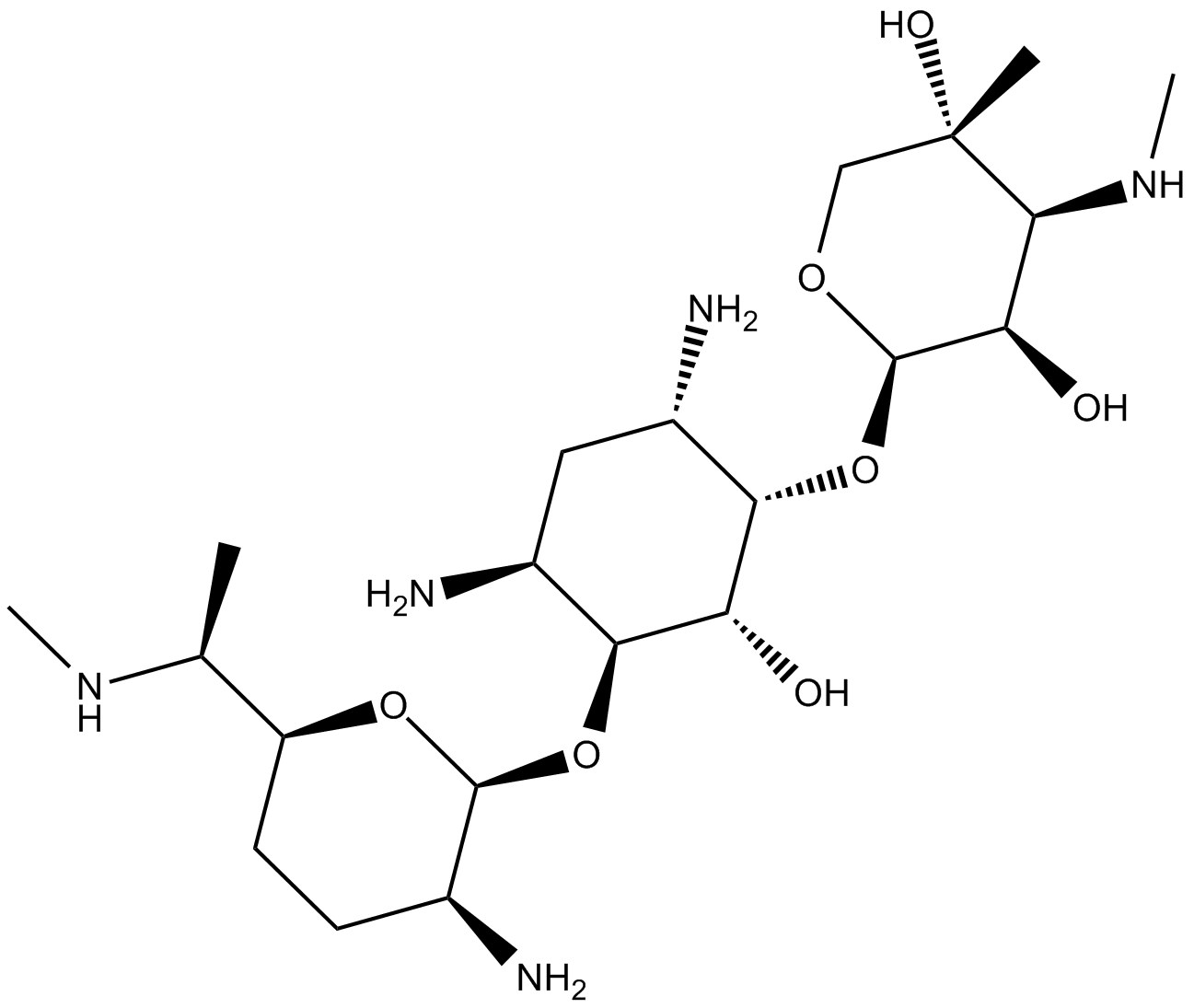
Cas No.: 1403-66-3
Sample solution is provided at 25 µL, 10mM.
_1-3.$$$39978408@51.jpg');)
_1-9.$$$38538795@65.jpg');)
_1-9.$$$39112701@51.jpg');)
_1-7.$$$37316672@70.jpg');)
_366-372.$$$36198801@70.jpg');)
.$$$38565142@65.jpg');)
_1867-1883.$$$33248023@67.jpg');)
_eads6055.$$$39977546@45.jpg');)
_eadm9805.$$$40080571@45.jpg');)
_eadj3020.$$$39666821@45.jpg');)
_1-20.$$$39757301@28.jpg');)
_1-24.$$$38898113@28.jpg');)
_273-287.$$$36806353@46.jpg');)
_1-16.$$$37156877@44.jpg');)
_1-19.$$$37460805@44.jpg');)
_1291-1307.$$$34518654@46.jpg');)
Gentamicin is an aminoglycoside antibiotic that exhibits bactericidal activity against aerobic Gram-negative bacteria[1]. Gentamicin passes through the Gram-negative membrane in an oxygen-dependent active transport, and binds to the 16s rRNA at the 30S ribosomal subunit, disturbing mRNA translation and, thus leading to the formation of truncated or non-functional proteins[2]. Gentamicin has been widely used to develop combined therapies for effectively killing drug-resistant bacteria, and has been employed to establish animal models of kidney injury for screening compounds with anti-toxicity properties[3].
In vitro, Gentamicin treatment (2mM) for 4 days significantly induced apoptosis in MDCK cells, accompanied by DNA fragmentation and increased caspase activity[4]. Treatment with 50µM Gentamicin for 48 hours reduced the viability of OC-k3 cells, leading to an increase in PKCα activity and a rise in malondialdehyde levels[5]. Treatment with 2mM Gentamicin for 24 hours promoted the death of cochlear hair cells, inducing phosphorylation of p38 MAPK, release of cytochrome c, and activation of caspase 3[6].
In vivo, Gentamicin treatment via subcutaneous injection at a dose of 100mg/kg/day for 6 days induced acute renal failure in rats and promoted glomerular cell apoptosis[7].
References:
[1] Chen C, Chen Y, Wu P, et al. Update on new medicinal applications of gentamicin: evidence-based review[J]. Journal of the Formosan Medical Association, 2014, 113(2): 72-82.
[2] Balakumar P, Rohilla A, Thangathirupathi A. Gentamicin-induced nephrotoxicity: do we have a promising therapeutic approach to blunt it?[J]. Pharmacological research, 2010, 62(3): 179-186.
[3] Ali B H, Al Za’abi M, Blunden G, et al. Experimental gentamicin nephrotoxicity and agents that modify it: a mini‐review of recent research[J]. Basic & clinical pharmacology & toxicology, 2011, 109(4): 225-232.
[4] El Mouedden M, Laurent G, Mingeot-Leclercq M P, et al. Gentamicin-induced apoptosis in renal cell lines and embryonic rat fibroblasts[J]. Toxicological Sciences, 2000, 56(1): 229-239.
[5] Bertolaso L, Bindini D, Previati M, et al. Gentamicin-induced cytotoxicity involves protein kinase C activation, glutathione extrusion and malondialdehyde production in an immortalized cell line from the organ of corti[J]. Audiology and Neurotology, 2003, 8(1): 38-48.
[6] Wei X, Zhao L, Liu J, et al. Minocycline prevents gentamicin-induced ototoxicity by inhibiting p38 MAP kinase phosphorylation and caspase 3 activation[J]. Neuroscience, 2005, 131(2): 513-521.
[7] Martínez-Salgado C, Eleno N, Morales A I, et al. Gentamicin treatment induces simultaneous mesangial proliferation and apoptosis in rats[J]. Kidney international, 2004, 65(6): 2161-2171.
| Cell experiment [1]: | |
|
Cell lines |
MDCK cells |
|
Preparation Method |
MDCK cells were cultured in DMEM medium, supplemented with 10% fetal bovine serum (FBS), and 1% penicillin/streptomycin at 37°C in an incubator with 5% CO2. Cells were seeded in a 96-well plate at a density of 5×10⁴ cells/well overnight and incubated with different concentrations of Gentamicin (0, 1, 2, 3, and 4mM) for 4 days, the cell viability was tested. |
|
Reaction Conditions |
0, 1, 2, 3, and 4mM; 4 days |
|
Applications |
Gentamicin treatment reduced cell viability of MDCK cells in a dose-dependent manner. |
| Animal experiment [2]: | |
|
Animal models |
Wistar rats |
|
Preparation Method |
Wistar rats (250g) were placed into metabolic cages in a temperature (20°C), light-, and humidity-controlled animal house. Daily subcutaneous injections of Gentamicin in saline solution (100mg/kg) were administered. After 6 days, Rats were anesthetized with ketamine (50mg/kg; intramuscular injection), and kidneys were collected for analysis. |
|
Dosage form |
100mg/kg/day; 6 days; s.c. |
|
Applications |
Gentamicin treatment caused kidney damage and led to patchy cell necrosis in proximal tubules in rats. |
References: [1] El Mouedden M, Laurent G, Mingeot-Leclercq M P, et al. Gentamicin-induced apoptosis in renal cell lines and embryonic rat fibroblasts[J]. Toxicological Sciences, 2000, 56(1): 229-239. [2] Martínez-Salgado C, Eleno N, Morales A I, et al. Gentamicin treatment induces simultaneous mesangial proliferation and apoptosis in rats[J]. Kidney international, 2004, 65(6): 2161-2171. | |
| Cas No. | 1403-66-3 | SDF | |
| Synonyms | Gentamicin; Centicin; Lyramycin; Oksitselanim; Refobacin; Septigen; Uromycine; | ||
| Canonical SMILES | N[C@H]1CC[C@@H]([C@H](C)NC)O[C@H]1O[C@@H]([C@H](C[C@@H]2N)N)[C@@H](O)[C@H]2O[C@@H]3[C@H](O)[C@H](NC)[C@@](O)(CO3)C | ||
| Formula | C60H123N15O21 | M.Wt | 1390.71 |
| Solubility | Water:> 30 mg/mL | Storage | Store at -20°C |
| Shipping Condition | Evaluation sample solution: shipped with blue ice. All other sizes available: with RT, or with Blue Ice upon request. | ||
| Prepare stock solution | |||

|
1 mg | 5 mg | 10 mg |
| 1 mM | 719.1 μL | 3.5953 mL | 7.1906 mL |
| 5 mM | 143.8 μL | 719.1 μL | 1.4381 mL |
| 10 mM | 71.9 μL | 359.5 μL | 719.1 μL |
Step 1: Enter information below (Recommended: An additional animal making an allowance for loss during the experiment)
 g
μL
g
μL
Step 2: Enter the in vivo formulation (This is only the calculator, not formulation. Please contact us first if there is no in vivo formulation at the solubility Section.)
Calculation results:
Working concentration: mg/ml;
Method for preparing DMSO master liquid: mg drug pre-dissolved in μL DMSO ( Master liquid concentration mg/mL, Please contact us first if the concentration exceeds the DMSO solubility of the batch of drug. )
Method for preparing in vivo formulation: Take μL DMSO master liquid, next addμL PEG300, mix and clarify, next addμL Tween 80, mix and clarify, next add μL saline, mix and clarify.
Method for preparing in vivo formulation: Take μL DMSO master liquid, next add μL Corn oil, mix and clarify.
Note: 1. Please make sure the liquid is clear before adding the next solvent.
2. Be sure to add the solvent(s) in order. You must ensure that the solution obtained, in the previous addition, is a clear solution before proceeding to add the next solvent. Physical methods such as vortex, ultrasound or hot water bath can be used to aid dissolving.
3. All of the above co-solvents are available for purchase on the GlpBio website.
Quality Control & SDS
- View current batch:
- Potency: 667 IU/mg Appearance: A solid
- COA (Certificate of Analysis)
- SDS (Safety Data Sheet)
- Datasheet
Average Rating: 5 (Based on Reviews and 24 reference(s) in Google Scholar.)