

Gliotoxin (Synonyms: Aspergillin) |
Catalog No.GC17255
 One-Click Copy Product Info
|

Gliotoxin, an immunosuppressive mycotoxin produced by pathogenic strains of Aspergillus and other fungi, is a specific inhibitor of 20S proteasomal chymotrypsin activity with an IC50 of 10μM.
Products are for research use only. Not for human use. We do not sell to patients.
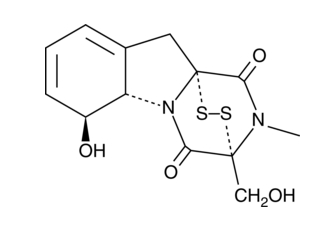
Cas No.: 67-99-2
Sample solution is provided at 25 µL, 10mM.
Gliotoxin, an immunosuppressive mycotoxin produced by pathogenic strains of Aspergillus and other fungi, is a specific inhibitor of 20S proteasomal chymotrypsin activity with an IC50 of 10μM[1]. Gliotoxin blocks the degradation of IκBα, thereby preventing the activation of NF-κB by inhibiting proteasome activity[2]. Additionally, Gliotoxin inhibits the activity of farnesyltransferase (FTase) and geranylgeranyltransferase I (GGTase I), with IC50 values of 80μM and 17μM, respectively[3]. Gliotoxin can also inhibit phagocytosis by macrophages and the immune functions of other immune cells, and is commonly used in research related to immunology, inflammation, and tumors [4][5].
In vitro, A549 and L132 cells were treated with different concentrations of Gliotoxin (0, 2, 4, 6, 8, 10μM; 24h) caused dose-dependent increase in cytotoxicity and the measured IC50 was 2.7 and 4.25μM. In addition, treatment of A549 and L132 cells with IC50 concentrations of Gliotoxin for 6, 12, and 24 hours resulted a time-dependent increase in reactive oxygen species (ROS) levels[6].
In vivo, exogenous Gliotoxin (1.25ng; 72h; intranasal administration) helped Gliotoxin synthesis deficient strain gliP1 invade into the lung tissue and the lung fungal burden increased markedly in immunosuppressed mice[7].
References:
[1] Kroll, M., Arenzana-Seisdedos, F., Bachelerie, F., Thomas, D., Friguet, B., & Conconi, M. (1999). The secondary fungal metabolite gliotoxin targets proteolytic activities of the proteasome. Chemistry & biology, 6(10), 689–698.
[2] Pahl, H. L., Krauss, B., Schulze-Osthoff, K., Decker, T., Traenckner, E. B., Vogt, M., Myers, C., Parks, T., Warring, P., Mühlbacher, A., Czernilofsky, A. P., & Baeuerle, P. A. (1996). The immunosuppressive fungal metabolite gliotoxin specifically inhibits transcription factor NF-kappaB. The Journal of experimental medicine, 183(4), 1829–1840.
[3] Vigushin, D. M., Mirsaidi, N., Brooke, G., Sun, C., Pace, P., Inman, L., Moody, C. J., & Coombes, R. C. (2004). Gliotoxin is a dual inhibitor of farnesyltransferase and geranylgeranyltransferase I with antitumor activity against breast cancer in vivo. Medical oncology (Northwood, London, England), 21(1), 21–30.
[4] Schlam, D., Canton, J., Carreño, M., Kopinski, H., Freeman, S. A., Grinstein, S., & Fairn, G. D. (2016). Gliotoxin Suppresses Macrophage Immune Function by Subverting Phosphatidylinositol 3,4,5-Trisphosphate Homeostasis. mBio, 7(2), e02242.
[5] Jia, X., Chen, F., Pan, W., Yu, R., Tian, S., Han, G., Fang, H., Wang, S., Zhao, J., Li, X., Zheng, D., Tao, S., Liao, W., Han, X., & Han, L. (2014). Gliotoxin promotes Aspergillus fumigatus internalization into type II human pneumocyte A549 cells by inducing host phospholipase D activation. Microbes and infection, 16(6), 491–501.
[6] Gayathri, L., Akbarsha, M. A., & Ruckmani, K. (2020). In vitro study on aspects of molecular mechanisms underlying invasive aspergillosis caused by gliotoxin and fumagillin, alone and in combination. Scientific reports, 10(1), 14473.
[7] Zhang, C., Chen, F., Liu, X., Han, X., Hu, Y., Su, X., Chen, Y., Sun, Y., & Han, L. (2019). Gliotoxin Induces Cofilin Phosphorylation to Promote Actin Cytoskeleton Dynamics and Internalization of Aspergillus fumigatus Into Type II Human Pneumocyte Cells. Frontiers in microbiology, 10, 1345.
| Cell experiment [1]: | |
|
Cell lines |
A549 and L132 cells |
|
Preparation Method |
A549 and L132 cells were seeded in 96 well plate at 5×10³cells/well and treated with different concentrations of Gliotoxin, FUM and combination of the two, dissolved in dimethyl sulfoxide (DMSO) for 24h, at 37°C. DMSO was used as the solvent control. Afer 24h incubation, 20μL of MTT [3-(4,5-dimethylthiazol-2-yl)-2,5-diphenyltetrazolium bromide] solution (5mg/mL in PBS) was added to each well, and incubated for 3h at 37°C. The medium was then removed and the purple formazan product was dissolved in 100μL of DMSO. The absorbance was measured at 570nm (measurement) and 630nm (reference) using a 96-well plate EnSpire multimode reader. Data were collected for triplicates and used to calculate the respective means and the standard deviations. |
|
Reaction Conditions |
0, 2, 4, 6, 8, 10μM; 24h |
|
Applications |
Gliotoxin caused dose-dependent increase in cytotoxicity. |
| Animal experiment [2]: | |
|
Animal models |
C57BL/6 mice |
|
Preparation Method |
Ten- to twelve-week-old male C57BL/6 mice were treated with hydrocortisone acetate (5mg/mouse, administered subcutaneously) every other day, beginning on day –4 relative to infection and ending on day +4, for a total of 5 doses. For inoculation, the mice were anesthetized with isoflurane, after which 5 × 10⁶ conidia in 25µl of PBS containing 0.1% Tween-20 was instilled intranasally. The mice were infected with A. fumigatus alone or with A. fumigatus mixed with exogenous 50ng/ml Gliotoxin. After 20h, the number of colonies in lung tissues (number of CFU/g) was also counted and calculated. For histopathological examination, the lung tissue sections obtained from mice from each group at 72h post-infection were dissected, fixed in 10% (vol/vol) formaldehyde, and stained with hematoxylin and eosin (HE) and periodic acid-Schiff (PAS). |
|
Dosage form |
1.25ng; 20, 72h; i.n. |
|
Applications |
Exogenous Gliotoxin helped Gliotoxin synthesis deficient strain gliP1 invade into the lung tissue and the lung fungal burden increased markedly in immunosuppressed mice. |
|
References: |
|
| Cas No. | 67-99-2 | SDF | |
| Synonyms | Aspergillin | ||
| Chemical Name | (3R,5aS,6S,10aR)-6-hydroxy-3-(hydroxymethyl)-2-methyl-2,3,5a,6-tetrahydro-1H-3,10a-epidithiopyrazino[1,2-a]indole-1,4(10H)-dione | ||
| Canonical SMILES | O[C@H]1C=CC=C2[C@@H]1N(C([C@@]3(N4C)CO)=O)[C@@](C4=O)(SS3)C2 | ||
| Formula | C13H14N2O4S2 | M.Wt | 326.38 |
| Solubility | 5mg/mL in DMSO, or in DMF | Storage | Store at -20°C, protect from light |
| General tips | Please select the appropriate solvent to prepare the stock solution according to the
solubility of the product in different solvents; once the solution is prepared, please store it in
separate packages to avoid product failure caused by repeated freezing and thawing.Storage method
and period of the stock solution: When stored at -80°C, please use it within 6 months; when stored
at -20°C, please use it within 1 month. To increase solubility, heat the tube to 37°C and then oscillate in an ultrasonic bath for some time. |
||
| Shipping Condition | Evaluation sample solution: shipped with blue ice. All other sizes available: with RT, or with Blue Ice upon request. | ||
| Prepare stock solution | |||

|
1 mg | 5 mg | 10 mg |
| 1 mM | 3.0639 mL | 15.3196 mL | 30.6391 mL |
| 5 mM | 612.8 μL | 3.0639 mL | 6.1278 mL |
| 10 mM | 306.4 μL | 1.532 mL | 3.0639 mL |
Step 1: Enter information below (Recommended: An additional animal making an allowance for loss during the experiment)
 g
μL
g
μL
Step 2: Enter the in vivo formulation (This is only the calculator, not formulation. Please contact us first if there is no in vivo formulation at the solubility Section.)
Calculation results:
Working concentration: mg/ml;
Method for preparing DMSO master liquid: mg drug pre-dissolved in μL DMSO ( Master liquid concentration mg/mL, Please contact us first if the concentration exceeds the DMSO solubility of the batch of drug. )
Method for preparing in vivo formulation: Take μL DMSO master liquid, next addμL PEG300, mix and clarify, next addμL Tween 80, mix and clarify, next add μL saline, mix and clarify.
Method for preparing in vivo formulation: Take μL DMSO master liquid, next add μL Corn oil, mix and clarify.
Note: 1. Please make sure the liquid is clear before adding the next solvent.
2. Be sure to add the solvent(s) in order. You must ensure that the solution obtained, in the previous addition, is a clear solution before proceeding to add the next solvent. Physical methods such as vortex, ultrasound or hot water bath can be used to aid dissolving.
3. All of the above co-solvents are available for purchase on the GlpBio website.
Quality Control & SDS
- View current batch:
- Purity: >98.00% Appearance: A solid
- COA (Certificate of Analysis)
- SDS (Safety Data Sheet)
- Datasheet
Average Rating: 5 (Based on Reviews and 30 reference(s) in Google Scholar.)