

Guanfacine |
Catalog No.GC14813
 One-Click Copy Product Info
|

Guanfacine is a selective, orally active norepinephrine α2A receptor agonist with high specificity for the α2A receptor subtype.
Products are for research use only. Not for human use. We do not sell to patients.
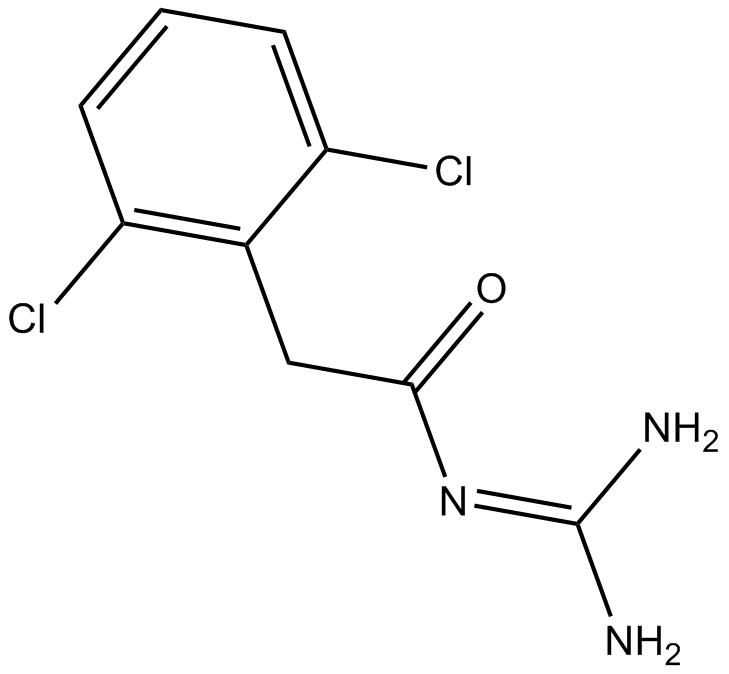
Cas No.: 29110-47-2
Sample solution is provided at 25 µL, 10mM.
Guanfacine is a selective, orally active norepinephrine α2A receptor agonist with high specificity for the α2A receptor subtype[1-2]. By activating α2A-adrenergic receptors in the prefrontal cortex, Guanfacine inhibits excessive norepinephrine release, thereby enhancing prefrontal cortical function and improving cognitive abilities such as attention, impulse control, and behavioral planning[3-4].
In vitro, incubation of P-glycoprotein-expressing LLC-PK1/MDR1 cells with Guanfacine (5μM and 50μM) for 60 minutes reduced P-glycoprotein levels[5]. Treatment of human mesenchymal stem cell (hMSC)-derived 3D spheroids with Guanfacine (17.7ng/mL) for 21 days (chondrogenic differentiation) or 28 days (osteogenic differentiation), Guanfacine significantly suppressed the proteoglycan synthesis, and reducing calcium nodule formation[6].
In vivo, a single intraperitoneal injection of Guanfacine (0.3–0.6mg/kg) in Wistar rats that had voluntarily consumed high amounts of alcohol (4.3 ± 0.2g/kg/24h; 5 months), Guanfacine significantly reduced 24-hour alcohol intake and attenuated alcohol deprivation effects as well as cue-induced alcohol-seeking behavior[7]. Daily intraperitoneal administration of Guanfacine (0.1–0.3mg/kg) for 6 consecutive days in 3–4 month old male Nf1+/- mice significantly improved impulsive choice behavior and behavioral inhibition deficits[8].
References:
[1] Arnsten AFT. Guanfacine's mechanism of action in treating prefrontal cortical disorders: Successful translation across species. Neurobiol Learn Mem. 2020 Dec;176:107327.
[2] Connor DF, Arnsten AF, Pearson GS, et al. Guanfacine extended release for the treatment of attention-deficit/hyperactivity disorder in children and adolescents. Expert Opin Pharmacother. 2014 Aug;15(11):1601-10..
[3] Rizzo R, Martino D. Guanfacine for the treatment of attention deficit hyperactivity disorder in children and adolescents. Expert Rev Neurother. 2015 Apr;15(4):347-54.
[4] Ota T, Yamamuro K, Okazaki K, et al. Evaluating Guanfacine Hydrochloride in the Treatment of Attention Deficit Hyperactivity Disorder (ADHD) in Adult Patients: Design, Development and Place in Therapy. Drug Des Devel Ther. 2021 May 11;15:1965-1969.
[5] Gillis NK, Zhu HJ, Markowitz JS. An in vitro evaluation of guanfacine as a substrate for P-glycoprotein. Neuropsychiatr Dis Treat. 2011;7:501-5.
[6] Wagener N, Lehmann W, Böker KO, et al. Chondral/Desmal Osteogenesis in 3D Spheroids Sensitized by Psychostimulants. J Clin Med. 2022 Oct 21;11(20):6218.
[7] Fredriksson I, Jayaram-Lindström N, Wirf M, et al. Evaluation of guanfacine as a potential medication for alcohol use disorder in long-term drinking rats: behavioral and electrophysiological findings. Neuropsychopharmacology. 2015 Mar 13;40(5):1130-40.
[8] Lukkes JL, Drozd HP, Fitz SD, et al. Guanfacine treatment improves ADHD phenotypes of impulsivity and hyperactivity in a neurofibromatosis type 1 mouse model. J Neurodev Disord. 2020 Jan 15;12(1):2.
| Cell experiment [1]: | |
Cell lines | Human mesenchymal stem cells (hMSC) and human osteoblast-like MG63 cells |
Preparation Method | hMSC and MG63 monolayers or 3D spheroids were cultured in DMEM/F12 medium with 10% fetal calf serum. For chondrogenic differentiation, hMSC spheroids were treated with Guanfacine (17.7ng/mL) in chondrogenic differentiation medium for 21 days; for osteogenic differentiation, spheroids were exposed to the same guanfacine concentration in osteogenic differentiation medium for 28 days. Medium and drug were refreshed every 2 days. |
Reaction Conditions | 17.7ng/mL; 21 days or 28 days |
Applications | Guanfacine significantly reduced chondrogenic differentiation, indicated by downregulation of key chondrogenic genes (SOX9, Aggrecan, COL2A1) and decreased proteoglycan synthesis. Guanfacine also inhibited osteogenic differentiation. |
| Animal experiment [2]: | |
Animal models | Adult male wild-type (WT) and Nf1+/- mice (3–4 months old, C57BL/6J background) |
Preparation Method | Mice were administered Guanfacine (0.1 or 0.3mg/kg, i.p.) daily for 6 days. Behavioral assessments were conducted 30 minutes post-injection using the open field test (OFT), cliff avoidance reaction (CAR) test, and delay discounting task (DDT). |
Dosage form | 0.1-0.3mg/kg; i.p.; Daily injection for 6 days. |
Applications | Guanfacine significantly reduced hyperactivity in Nf1+/- mice, decreasing total distance traveled in the OFT. Guanfacine improved behavioral inhibition in the CAR test by reducing entries into the edge zone and preventing falls. Guanfacine also attenuated impulsivity in the DDT, increasing the preference for larger delayed rewards over smaller immediate ones. |
References: | |
| Cas No. | 29110-47-2 | SDF | |
| Chemical Name | N-(diaminomethylidene)-2-(2,6-dichlorophenyl)acetamide | ||
| Canonical SMILES | C1=CC(=C(C(=C1)Cl)CC(=O)N=C(N)N)Cl | ||
| Formula | C9H9Cl2N3O | M.Wt | 246.09 |
| Solubility | Soluble in DMSO | Storage | Store at -20°C |
| General tips | Please select the appropriate solvent to prepare the stock solution according to the
solubility of the product in different solvents; once the solution is prepared, please store it in
separate packages to avoid product failure caused by repeated freezing and thawing.Storage method
and period of the stock solution: When stored at -80°C, please use it within 6 months; when stored
at -20°C, please use it within 1 month. To increase solubility, heat the tube to 37°C and then oscillate in an ultrasonic bath for some time. |
||
| Shipping Condition | Evaluation sample solution: shipped with blue ice. All other sizes available: with RT, or with Blue Ice upon request. | ||
| Prepare stock solution | |||

|
1 mg | 5 mg | 10 mg |
| 1 mM | 4.0636 mL | 20.3178 mL | 40.6355 mL |
| 5 mM | 812.7 μL | 4.0636 mL | 8.1271 mL |
| 10 mM | 406.4 μL | 2.0318 mL | 4.0636 mL |
Step 1: Enter information below (Recommended: An additional animal making an allowance for loss during the experiment)
 g
μL
g
μL
Step 2: Enter the in vivo formulation (This is only the calculator, not formulation. Please contact us first if there is no in vivo formulation at the solubility Section.)
Calculation results:
Working concentration: mg/ml;
Method for preparing DMSO master liquid: mg drug pre-dissolved in μL DMSO ( Master liquid concentration mg/mL, Please contact us first if the concentration exceeds the DMSO solubility of the batch of drug. )
Method for preparing in vivo formulation: Take μL DMSO master liquid, next addμL PEG300, mix and clarify, next addμL Tween 80, mix and clarify, next add μL saline, mix and clarify.
Method for preparing in vivo formulation: Take μL DMSO master liquid, next add μL Corn oil, mix and clarify.
Note: 1. Please make sure the liquid is clear before adding the next solvent.
2. Be sure to add the solvent(s) in order. You must ensure that the solution obtained, in the previous addition, is a clear solution before proceeding to add the next solvent. Physical methods such as vortex, ultrasound or hot water bath can be used to aid dissolving.
3. All of the above co-solvents are available for purchase on the GlpBio website.
Quality Control & SDS
- View current batch:
- Purity: >98.00% Appearance: A solid
- COA (Certificate of Analysis)
- SDS (Safety Data Sheet)
- Datasheet
Average Rating: 5 (Based on Reviews and 7 reference(s) in Google Scholar.)