

Kaempferol (Synonyms: Nimbecetin, NSC 407289, NSC 656277, Pelargidenon, Rhamnolutein, Swartziol, Trifolitin) |
Catalog No.GN10421
 One-Click Copy Product Info
|

Kaempferol is a flavonoid that acts as an inverse agonist of ERRα and ERRγ and possesses antioxidant, anti-inflammatory and antitumor activities.
Products are for research use only. Not for human use. We do not sell to patients.
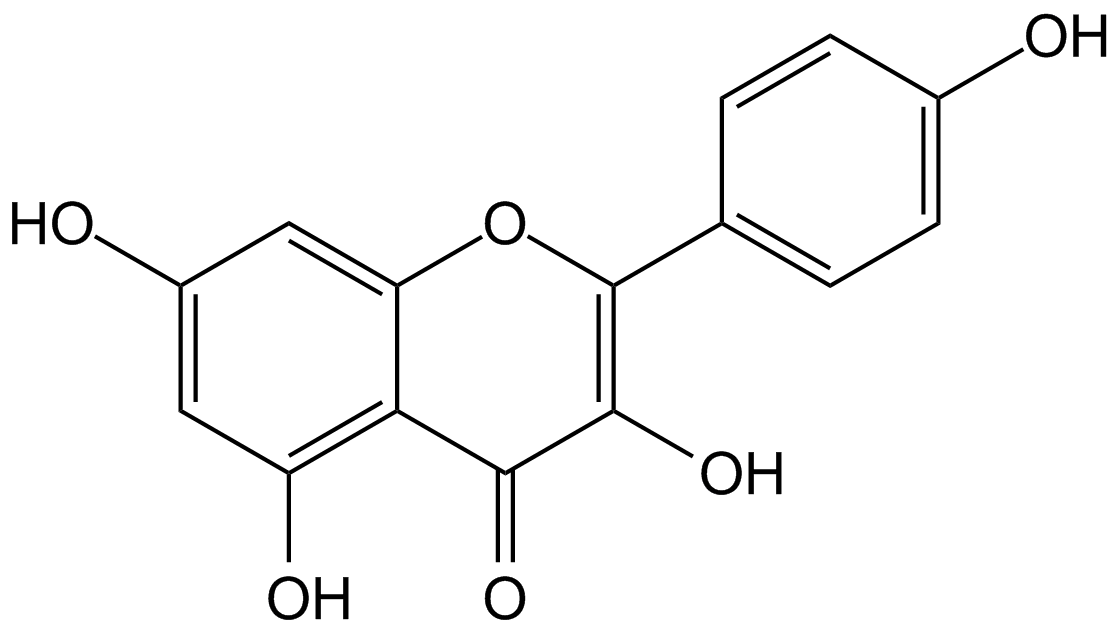
Cas No.: 520-18-3
Sample solution is provided at 25 µL, 10mM.
_1-3.$$$39978408@51.jpg');)
_1-9.$$$38538795@65.jpg');)
_1-9.$$$39112701@51.jpg');)
_1-7.$$$37316672@70.jpg');)
_366-372.$$$36198801@70.jpg');)
.$$$38565142@65.jpg');)
_1867-1883.$$$33248023@67.jpg');)
_eads6055.$$$39977546@45.jpg');)
_eadm9805.$$$40080571@45.jpg');)
_eadj3020.$$$39666821@45.jpg');)
_1-20.$$$39757301@28.jpg');)
_1-24.$$$38898113@28.jpg');)
_273-287.$$$36806353@46.jpg');)
_1-16.$$$37156877@44.jpg');)
_1-19.$$$37460805@44.jpg');)
_1291-1307.$$$34518654@46.jpg');)
Kaempferol is a flavonoid that acts as an inverse agonist of ERRα and ERRγ and possesses antioxidant, anti-inflammatory and antitumor activities[1-2].
Kaempferol significantly inhibited the activity of HCCC9810 and QBC939 cells in a time- and dose-dependent manner. The IC50 values of Kaempferol-treated cells for 72 h were 58.99 μM and 74.91 μM respectively. Kaempferol inhibits the migration and invasion of HCCC9810 and QBC939 cells in a dose-dependent manner and induces apoptosis[1]. In A2780 OC cells, Kaempferol promoted cell apoptosis (158%), inhibited cell viability (53.17%) and cell proliferation (49.17%). Kaempferol increased the protein levels of GRP78, PERK, ATF6, IRE-1, LC3II, beclin 1 and caspase 4, and activated cytotoxic autophagy[3].
Kaempferol (20 mg/kg) inhibited the growth of mouse tumors in a QBC939 cell xenograft model. In a lung metastasis model simulated by injecting QBC939 cells into nude mice, Kaempferol (20 mg/kg) significantly reduced the number and volume of lung metastatic nodules[1]. Kaempferol can reduce plasma glucose levels and increase insulin levels in diabetic rats. Compared with 50 and 200 mg/kg, 100 mg/kg of Kaempferol showed the greatest hypoglycemic effect. After Kaempferol was administered to diabetic rats, lipid peroxidation products, enzymes, and non-enzyme antioxidants all returned to near normal levels[4].
References:
[1] Youyou Qin, Wu Cui, Xuewei Yang, Baifeng Tong, Kaempferol inhibits the growth and metastasis of cholangiocarcinoma in vitro and in vivo, Acta Biochimica et Biophysica Sinica, Volume 48, Issue 3, March 2016, Pages 238–245.
[2] Wang J, Fang F, Huang Z, et al. Kaempferol is an estrogen-related receptor α and γ inverse agonist[J]. FEBS letters, 2009, 583(4): 643-647.
[3] El-Kott A F, Shati A A, Al-Kahtani M A, et al. Kaempferol Induces Cell Death in A2780 Ovarian Cancer Cells and Increases Their Sensitivity to Cisplatin by Activation of Cytotoxic Endoplasmic Reticulum-Mediated Autophagy and Inhibition of Protein Kinase B[J]. Folia Biologica (00155500), 2020, 66(1).
[4] Al-Numair K S, Chandramohan G, Veeramani C, et al. Ameliorative effect of kaempferol, a flavonoid, on oxidative stress in streptozotocin-induced diabetic rats[J]. Redox Report, 2015, 20(5): 198-209.
| Cell experiment [1]: | |
|
Cell lines |
The human cholangiocarcinoma (CCA) cell lines HCCC9810 and QBC939 |
|
Preparation Method |
CCA cells were incubated with 0, 30, 60, 90, 120 or 150 µM Kaempferol for 24, 48 or 72 h and cell viability was measured using the CCK8 assay. |
|
Reaction Conditions |
0, 30, 60, 90, 120 or 150 µM, 24, 48 or 72 h |
|
Applications |
Kaempferol significantly inhibited the viability of HCCC9810 and QBC939 cells in a time- and dose-dependent manner, with IC50 values of 58.99 and 74.91 at 72 h, respectively. |
| Animal experiment [1]: | |
|
Animal models |
Subcutaneous xenograft model in nude mice |
|
Preparation Method |
Eight mice were used in each group to establish subcutaneous xenograft model. When the tumor volume reached 100 mm3, Kaempferol (20 mg/kg/day) was injected intraperitoneally daily for 3 weeks. After the treatment, the tumor was removed and the tumor volume was calculated. |
|
Dosage form |
20 mg/kg/day, daily for 3 weeks, i.p. |
|
Applications |
Kaempferol significantly inhibited tumor growth, and the number of Ki-67-positive tumor cells in the kaempferol-treated group was significantly lower than that in the control group. |
|
References: [1] Youyou Qin, Wu Cui, Xuewei Yang, Baifeng Tong, Kaempferol inhibits the growth and metastasis of cholangiocarcinoma in vitro and in vivo, Acta Biochimica et Biophysica Sinica, Volume 48, Issue 3, March 2016, Pages 238–245. |
|
| Cas No. | 520-18-3 | SDF | |
| Synonyms | Nimbecetin, NSC 407289, NSC 656277, Pelargidenon, Rhamnolutein, Swartziol, Trifolitin | ||
| Chemical Name | 3,5,7-trihydroxy-2-(4-hydroxyphenyl)chromen-4-one | ||
| Canonical SMILES | C1=CC(=CC=C1C2=C(C(=O)C3=C(C=C(C=C3O2)O)O)O)O | ||
| Formula | C15H10O6 | M.Wt | 286.24 |
| Solubility | ≥ 12.25mg/mL in DMSO | Storage | Store at -20°C |
| General tips | Please select the appropriate solvent to prepare the stock solution according to the
solubility of the product in different solvents; once the solution is prepared, please store it in
separate packages to avoid product failure caused by repeated freezing and thawing.Storage method
and period of the stock solution: When stored at -80°C, please use it within 6 months; when stored
at -20°C, please use it within 1 month. To increase solubility, heat the tube to 37°C and then oscillate in an ultrasonic bath for some time. |
||
| Shipping Condition | Evaluation sample solution: shipped with blue ice. All other sizes available: with RT, or with Blue Ice upon request. | ||
| Prepare stock solution | |||

|
1 mg | 5 mg | 10 mg |
| 1 mM | 3.4936 mL | 17.4679 mL | 34.9357 mL |
| 5 mM | 698.7 μL | 3.4936 mL | 6.9871 mL |
| 10 mM | 349.4 μL | 1.7468 mL | 3.4936 mL |
Step 1: Enter information below (Recommended: An additional animal making an allowance for loss during the experiment)
 g
μL
g
μL
Step 2: Enter the in vivo formulation (This is only the calculator, not formulation. Please contact us first if there is no in vivo formulation at the solubility Section.)
Calculation results:
Working concentration: mg/ml;
Method for preparing DMSO master liquid: mg drug pre-dissolved in μL DMSO ( Master liquid concentration mg/mL, Please contact us first if the concentration exceeds the DMSO solubility of the batch of drug. )
Method for preparing in vivo formulation: Take μL DMSO master liquid, next addμL PEG300, mix and clarify, next addμL Tween 80, mix and clarify, next add μL saline, mix and clarify.
Method for preparing in vivo formulation: Take μL DMSO master liquid, next add μL Corn oil, mix and clarify.
Note: 1. Please make sure the liquid is clear before adding the next solvent.
2. Be sure to add the solvent(s) in order. You must ensure that the solution obtained, in the previous addition, is a clear solution before proceeding to add the next solvent. Physical methods such as vortex, ultrasound or hot water bath can be used to aid dissolving.
3. All of the above co-solvents are available for purchase on the GlpBio website.
Quality Control & SDS
- View current batch:
- Purity: >98.50% Appearance: A solid
- COA (Certificate of Analysis)
- SDS (Safety Data Sheet)
- Datasheet
Average Rating: 5 (Based on Reviews and 30 reference(s) in Google Scholar.)