

YM 58483 (Synonyms: BTP 2) |
Catalog No.GC14665
 One-Click Copy Product Info
|

YM 58483 is a pyrazole-derived inhibitor of CRAC channels that inhibits Ca2+ signals with an IC50 value of 100nM.
Products are for research use only. Not for human use. We do not sell to patients.
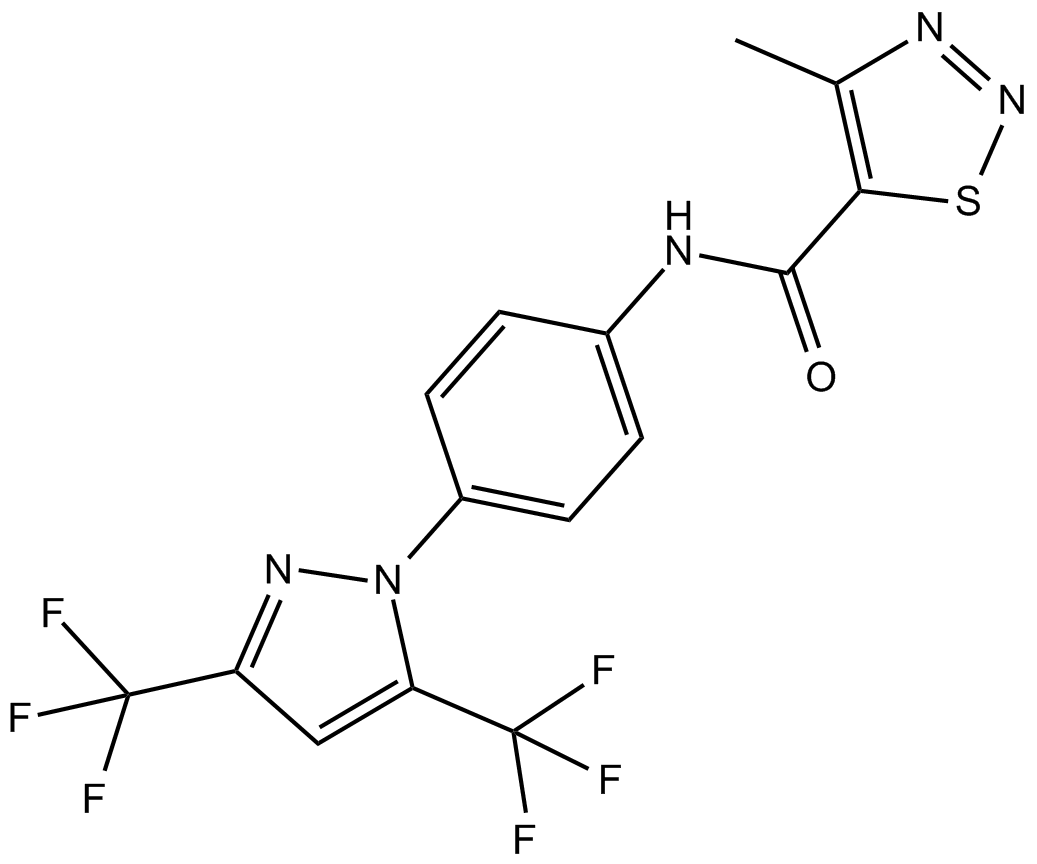
Cas No.: 223499-30-7
Sample solution is provided at 25 µL, 10mM.
_1-3.$$$39978408@51.jpg');)
_1-9.$$$38538795@65.jpg');)
_1-9.$$$39112701@51.jpg');)
_1-7.$$$37316672@70.jpg');)
_366-372.$$$36198801@70.jpg');)
.$$$38565142@65.jpg');)
_1867-1883.$$$33248023@67.jpg');)
_eads6055.$$$39977546@45.jpg');)
_eadm9805.$$$40080571@45.jpg');)
_eadj3020.$$$39666821@45.jpg');)
_1-20.$$$39757301@28.jpg');)
_1-24.$$$38898113@28.jpg');)
_273-287.$$$36806353@46.jpg');)
_1-16.$$$37156877@44.jpg');)
_1-19.$$$37460805@44.jpg');)
_1291-1307.$$$34518654@46.jpg');)
YM 58483 is a pyrazole-derived inhibitor of CRAC channels that inhibits Ca2+ signals with an IC50 value of 100nM [1]. YM 58483 suppresses the CRAC, TRPC3, and TRPC5 channels and facilitates the TRPM4 channel, reducing cytokine production and NFAT dephosphorylation [2]. YM 58483 has been widely used as a potent analgesic to alleviate thermal hyperalgesia and mechanical hyperalgesia in mice[3].
In vitro, YM 58483 treatment for 48 hours significantly inhibited the production of IL-5 and IL-13 in human peripheral blood cells induced by phytohemagglutinin-P (PHA), with IC50 values of 125nM and 148nM, respectively[4]. The pretreatment of YM 58483 for 1 hour inhibited the production of IL-4 and IL-5 in conalbumin-stimulated D10.G4.1 cells, with IC50 values of 200nM and 180nM, respectively[5]. Treatment with 30µM YM 58483 for 24 hours significantly reduced the proliferation of glioblastoma stem cells (GSC) and decreased the expression of SOX2[6].
In vivo, YM 58483 treatment via oral administration at a dose of 30mg/kg/day for 10 consecutive days significantly inhibited the activity of donor anti-host cytotoxic T lymphocytes (CTL) and the production of IFN-γ, and reduced the number of donor T cells in the spleen within the mouse model of graft-versus-host disease (GVHD)[7]. Oral administration of 10mg/kg dose of YM 58483 daily for 10 consecutive days significantly inhibited the development of collagen-induced paw edema in mice, alleviated joint damage in mice, and improved spontaneous movement defects[8].
References:
[1] Parekh A B. Store-operated CRAC channels: function in health and disease[J]. Nature reviews Drug discovery, 2010, 9(5): 399-410.
[2] Rubaiy H N. ORAI calcium channels: regulation, function, pharmacology, and therapeutic targets[J]. Pharmaceuticals, 2023, 16(2): 162.
[3] Gao R, Gao X, Xia J, et al. Potent analgesic effects of a store-operated calcium channel inhibitor[J]. PAIN®, 2013, 154(10): 2034-2044.
[4] Ohga K, Takezawa R, Yoshino T, et al. The suppressive effects of YM-58483/BTP-2, a store-operated Ca2+ entry blocker, on inflammatory mediator release in vitro and airway responses in vivo[J]. Pulmonary pharmacology & therapeutics, 2008, 21(2): 360-369.
[5] Yoshino T, Ishikawa J, Ohga K, et al. YM-58483, a selective CRAC channel inhibitor, prevents antigen-induced airway eosinophilia and late phase asthmatic responses via Th2 cytokine inhibition in animal models[J]. European journal of pharmacology, 2007, 560(2-3): 225-233.
[6] Terrié E, Déliot N, Benzidane Y, et al. Store-operated calcium channels control proliferation and self-renewal of cancer stem cells from glioblastoma[J]. Cancers, 2021, 13(14): 3428.
[7] Ohga K, Takezawa R, Arakida Y, et al. Characterization of YM-58483/BTP2, a novel store-operated Ca2+ entry blocker, on T cell-mediated immune responses in vivo[J]. International immunopharmacology, 2008, 8(13-14): 1787-1792.
[8] Gao X H, Gao R, Tian Y Z, et al. A store‐operated calcium channel inhibitor attenuates collagen‐induced arthritis[J]. British journal of pharmacology, 2015, 172(12): 2991-3002.
| Cell experiment [1]: | |
Cell lines | Patient-derived glioblastoma stem cells (GSCs) |
Preparation Method | GSCs were grown in DMEM/HAM-F12 medium with 2mM glutamine, 10% (v/v) fetal bovine serum (FBS), 2μg/ml heparin, 20ng/ml EGF and 25ng/ml bFGF, 100U/ml penicillin and 100μg/ml streptomycin at 37°C in 5% CO2/atmosphere. GSCs (3×10⁴ cells) were seeded on 96-well plates, incubated for 24h, and then treated with different concentrations of YM 58483 (0.1, 1, 10, 20, and 30µM) at 37°C. After 24h, cell viability was measured. |
Reaction Conditions | 0.1, 1, 10, 20, and 30µM; 24h |
Applications | YM 58483 treatment significantly reduced the cell viability of GSCs in a concentration-dependent manner. |
| Animal experiment [2]: | |
Animal models | Male DBA/1 mice |
Preparation Method | Male DBA/1 mice (7 weeks old) were housed singly in a standard environment with food and water ad libitum. Mice were acclimated for a week before starting the experiment. 100μg chicken type II collagen (CII) was mixed with 100μl complete Freund's adjuvant and injected i.d. on day 0 at the base of the tail. On day 21, a booster injection of 100μg chicken CII in 100μl of PBS was administered (i.p.). YM 58483 (10mg/kg) or vehicle was administered daily from days 28 to 37. The effect of YM 58483 on paw oedema in mice was measured. |
Dosage form | 10mg/kg/day for 10 days; i.p. |
Applications | YM 58483 treatment significantly reduced the CII-induced paw oedema in mice. |
References: | |
| Cas No. | 223499-30-7 | SDF | |
| Synonyms | BTP 2 | ||
| Chemical Name | N-(4-(3,5-bis(trifluoromethyl)-1H-pyrazol-1-yl)phenyl)-4-methyl-1,2,3-thiadiazole-5-carboxamide | ||
| Canonical SMILES | FC(F)(C1=CC(C(F)(F)F)=NN1C(C=C2)=CC=C2NC(C3=C(C)N=NS3)=O)F | ||
| Formula | C15H9F6N5OS | M.Wt | 421.32 |
| Solubility | ≥ 50 mg/mL in EtOH, ≥ 90 mg/mL in DMSO | Storage | Store at -20°C |
| General tips | Please select the appropriate solvent to prepare the stock solution according to the
solubility of the product in different solvents; once the solution is prepared, please store it in
separate packages to avoid product failure caused by repeated freezing and thawing.Storage method
and period of the stock solution: When stored at -80°C, please use it within 6 months; when stored
at -20°C, please use it within 1 month. To increase solubility, heat the tube to 37°C and then oscillate in an ultrasonic bath for some time. |
||
| Shipping Condition | Evaluation sample solution: shipped with blue ice. All other sizes available: with RT, or with Blue Ice upon request. | ||
| Prepare stock solution | |||

|
1 mg | 5 mg | 10 mg |
| 1 mM | 2.3735 mL | 11.8675 mL | 23.7349 mL |
| 5 mM | 474.7 μL | 2.3735 mL | 4.747 mL |
| 10 mM | 237.3 μL | 1.1867 mL | 2.3735 mL |
Step 1: Enter information below (Recommended: An additional animal making an allowance for loss during the experiment)
 g
μL
g
μL
Step 2: Enter the in vivo formulation (This is only the calculator, not formulation. Please contact us first if there is no in vivo formulation at the solubility Section.)
Calculation results:
Working concentration: mg/ml;
Method for preparing DMSO master liquid: mg drug pre-dissolved in μL DMSO ( Master liquid concentration mg/mL, Please contact us first if the concentration exceeds the DMSO solubility of the batch of drug. )
Method for preparing in vivo formulation: Take μL DMSO master liquid, next addμL PEG300, mix and clarify, next addμL Tween 80, mix and clarify, next add μL saline, mix and clarify.
Method for preparing in vivo formulation: Take μL DMSO master liquid, next add μL Corn oil, mix and clarify.
Note: 1. Please make sure the liquid is clear before adding the next solvent.
2. Be sure to add the solvent(s) in order. You must ensure that the solution obtained, in the previous addition, is a clear solution before proceeding to add the next solvent. Physical methods such as vortex, ultrasound or hot water bath can be used to aid dissolving.
3. All of the above co-solvents are available for purchase on the GlpBio website.
Quality Control & SDS
- View current batch:
- Purity: >98.00% Appearance: A solid
- COA (Certificate of Analysis)
- SDS (Safety Data Sheet)
- Datasheet
Average Rating: 5 (Based on Reviews and 9 reference(s) in Google Scholar.)