

KP-457 |
Catalog No.GC32452
 One-Click Copy Product Info
|

KP-457 is a selective inhibitor of A disintegrin and metalloproteinase 17 (ADAM17) with an IC50 of 11.1nM. KP-457 inhibits ADAM10 (IC50=748nM), MMP2 (IC50=717nM), MMP3 (IC50=9760nM), MMP7 (IC50=2200nM), MMP9 (IC50=5410nM), MMP13 (IC50=930nM), MMP14 (IC50=2140nM), and MMP17 (IC50=7100nM).
Products are for research use only. Not for human use. We do not sell to patients.
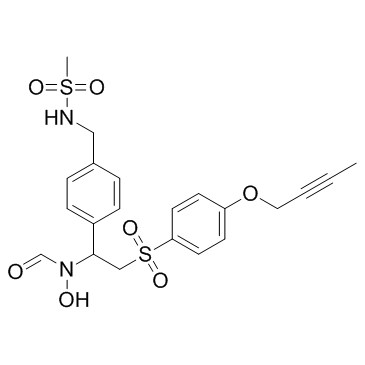
Cas No.: 1365803-52-6
Sample solution is provided at 25 µL, 10mM.
KP-457 is a selective inhibitor of A disintegrin and metalloproteinase 17 (ADAM17) with an IC50 of 11.1nM. KP-457 inhibits ADAM10 (IC50=748nM), MMP2 (IC50=717nM), MMP3 (IC50=9760nM), MMP7 (IC50=2200nM), MMP9 (IC50=5410nM), MMP13 (IC50=930nM), MMP14 (IC50=2140nM), and MMP17 (IC50=7100nM). KP-457 blocks Zn2+ chelation in the catalytic domain of ADAM17, inhibits GPIbα shedding, and effectively enhances the production of functional iPSC-derived platelets. KP-457 can be used for research related to protease/MMP pathways and iPSC-derived platelets[1-4].
In vitro, co-treatment of anti-TNP IgE-sensitized RBL-2H3 cells with 0.3-10μM KP-457 and TNP(26)-BSA for 1 hour significantly reduced soluble TNF protein release into the supernatant and decreased total TNF protein levels in allergen-triggered RBL-2H3 cells[5]. Co-treatment of L929 cells with 1nM-10μM KP-457 and 20μM (-)-vinigrol for 16 hours reversed the antagonistic effect of (-)-vinigrol on TNF-α-induced cytotoxicity[6]. Treatment of mouse germinal vesicle stage oocytes with greater than 10μM KP-457 for 1.5 hours had no significant effect on oocyte-zona pellucida detachment scores[7].
References:
[1] Hirata S, Murata T, Suzuki D, et al. Selective Inhibition of ADAM17 Efficiently Mediates Glycoprotein Ibα Retention During Ex Vivo Generation of Human Induced Pluripotent Stem Cell-Derived Platelets. Stem Cells Transl Med. 2017 Mar;6(3):720-730.
[2] Tang R, Jin L, Chen C, et al. Mapping cell type-resolved transcriptomic profiles to patient survival in pancreatic cancer. Cancer Cell. 2026 Aug 10;44(8):1623-1638.e11.
[3] Lee DH, Yao C, Bhan A, et al. Integrative Genomic Analysis Reveals Four Protein Biomarkers for Platelet Traits. Circ Res. 2020 Oct 9;127(9):1182-1194.
[4] Six KR, Debaene C, Van den Hauwe M, et al. GPIbα shedding in platelets is controlled by strict intracellular containment of both enzyme and substrate. J Thromb Haemost. 2023 Aug;21(8):2223-2235.
[5] Ayo TE, Adhikari P, Xu H. TNFR1 links TNF exocytosis to TNF production in allergen-activated RBL-2H3 cells. Cell Signal. 2023 May;105:110607.
[6] Zhu Y, Wang L, Li J, et al. Photoaffinity labeling coupled with proteomics identify PDI-ADAM17 module is targeted by (-)-vinigrol to induce TNFR1 shedding and ameliorate rheumatoid arthritis in mice. Cell Chemical Biology. 2024 Mar 21;31(3):452-464.
[7] Macaulay AD, Ortman CS, Moore KR, et al. Initial detachment of the mouse oocyte from the zona pellucida is mediated by metallopeptidase activity. Biol Reprod. 2023 Jan 4;108(1):81-97.
| Cell experiment [1]: | |
|
Cell lines |
RBL-2H3 cells (rat basophilic leukemia cell line, tumor analog of mucosal mast cells) |
|
Preparation Method |
RBL-2H3 cells were maintained in DMEM complete medium containing 4.5g/L D-Glucose, 110mg/L sodium pyruvate, 1x Glutamax, and 10% heat-inactivated FBS at 37°C and 5% CO₂. Cells were sensitized with 0.5μg/mL mouse anti-TNP IgE for 3 hours, then stimulated with 25ng/mL TNP(26)-BSA along with specified amounts of KP-457 (0.3μM, 1μM, 3μM, or 10μM) or solvent DMSO for 1 hour. After stimulation, β-hexosaminidase activities and TNF levels in the supernatant and cell lysates were quantified. |
|
Reaction Conditions |
0.3-10μM; 1h |
|
Applications |
KP-457 did not affect the exocytosis of β-hexosaminidase. KP-457 significantly reduced the amount of soluble TNF protein released into the supernatant. KP-457 inhibited the overall level of total TNF in allergen-triggered RBL-2H3 cells. |
References: [1] Ayo TE, Adhikari P, Xu H. TNFR1 Links TNF Exocytosis to TNF Production in Allergen-Activated RBL-2H3 Cells. Cell Signal. 2023 May;105:110607. | |
| Cas No. | 1365803-52-6 | SDF | |
| Canonical SMILES | CS(=O)(NCC1=CC=C(C(N(C=O)O)CS(=O)(C2=CC=C(OCC#CC)C=C2)=O)C=C1)=O | ||
| Formula | C21H24N2O7S2 | M.Wt | 480.55 |
| Solubility | DMSO : 125 mg/mL (260.12 mM) | Storage | Store at -20°C |
| General tips | Please select the appropriate solvent to prepare the stock solution according to the
solubility of the product in different solvents; once the solution is prepared, please store it in
separate packages to avoid product failure caused by repeated freezing and thawing.Storage method
and period of the stock solution: When stored at -80°C, please use it within 6 months; when stored
at -20°C, please use it within 1 month. To increase solubility, heat the tube to 37°C and then oscillate in an ultrasonic bath for some time. |
||
| Shipping Condition | Evaluation sample solution: shipped with blue ice. All other sizes available: with RT, or with Blue Ice upon request. | ||
| Prepare stock solution | |||

|
1 mg | 5 mg | 10 mg |
| 1 mM | 2.0809 mL | 10.4047 mL | 20.8095 mL |
| 5 mM | 416.2 μL | 2.0809 mL | 4.1619 mL |
| 10 mM | 208.1 μL | 1.0405 mL | 2.0809 mL |
Step 1: Enter information below (Recommended: An additional animal making an allowance for loss during the experiment)
 g
μL
g
μL
Step 2: Enter the in vivo formulation (This is only the calculator, not formulation. Please contact us first if there is no in vivo formulation at the solubility Section.)
Calculation results:
Working concentration: mg/ml;
Method for preparing DMSO master liquid: mg drug pre-dissolved in μL DMSO ( Master liquid concentration mg/mL, Please contact us first if the concentration exceeds the DMSO solubility of the batch of drug. )
Method for preparing in vivo formulation: Take μL DMSO master liquid, next addμL PEG300, mix and clarify, next addμL Tween 80, mix and clarify, next add μL saline, mix and clarify.
Method for preparing in vivo formulation: Take μL DMSO master liquid, next add μL Corn oil, mix and clarify.
Note: 1. Please make sure the liquid is clear before adding the next solvent.
2. Be sure to add the solvent(s) in order. You must ensure that the solution obtained, in the previous addition, is a clear solution before proceeding to add the next solvent. Physical methods such as vortex, ultrasound or hot water bath can be used to aid dissolving.
3. All of the above co-solvents are available for purchase on the GlpBio website.
Quality Control & SDS
- View current batch:
- Purity: >98.00% Appearance: A solid
- COA (Certificate of Analysis)
- SDS (Safety Data Sheet)
- Datasheet
Average Rating: 5 (Based on Reviews and 9 reference(s) in Google Scholar.)