

LY83583 |
Catalog No.GC13857
 One-Click Copy Product Info
|

LY83583 is a membrane-permeable soluble guanylate cyclase (sGC) inhibitor.
Products are for research use only. Not for human use. We do not sell to patients.
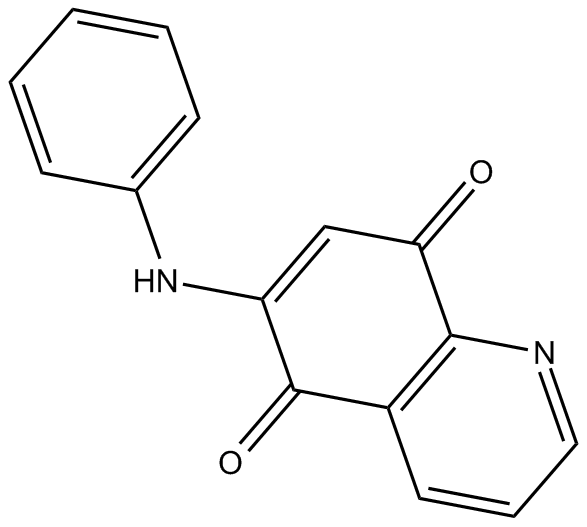
Cas No.: 91300-60-6
Sample solution is provided at 25 µL, 10mM.
_1-3.$$$39978408@51.jpg');)
_1-9.$$$38538795@65.jpg');)
_1-9.$$$39112701@51.jpg');)
_1-7.$$$37316672@70.jpg');)
_366-372.$$$36198801@70.jpg');)
.$$$38565142@65.jpg');)
_1867-1883.$$$33248023@67.jpg');)
_eads6055.$$$39977546@45.jpg');)
_eadm9805.$$$40080571@45.jpg');)
_eadj3020.$$$39666821@45.jpg');)
_1-20.$$$39757301@28.jpg');)
_1-24.$$$38898113@28.jpg');)
_273-287.$$$36806353@46.jpg');)
_1-16.$$$37156877@44.jpg');)
_1-19.$$$37460805@44.jpg');)
_1291-1307.$$$34518654@46.jpg');)
LY83583 is a membrane-permeable soluble guanylate cyclase (sGC) inhibitor. LY83583 reduces cGMP production and interferes with NO/cGMP signaling. LY83583 generates superoxide and inhibits leukotriene synthesis and neutrophil chemotaxis. LY83583 can be used in research on cardiovascular diseases, platelet activation, vascular smooth muscle dysfunction and inflammation[1-4].
In vitro, 100µM LY83583 and 100mM DMPO were used to stimulate HUVEC cells for 10 minutes to 24 hours. LY83583 generated DMPO/OH adduct signals and induced reactive oxygen species production in HUVEC cells[5]. 786-0 cells were treated with 0.03-1µM LY83583 for 24-96 hours. LY83583 reduced cell number and induced apoptosis in a time- and dose-dependent manner, caused MEK1/2 and ERK1/2 dephosphorylation, decreased Elk-1 phosphorylation and downregulated COX-2, increased ROS formation, decreased Bcl-xL and increased Bax, and promoted cytochrome c release, procaspase-3 processing and AIF translocation into the nucleus[6]. HN33 cells were pretreated with 1µM LY83583 for 1 hour and then treated with 50µM hemin for 24 hours. LY83583 attenuated hemin-induced neuroglobin protein and mRNA expression[7].
In vivo, Wistar rats received a single intravenous injection of 4.0-40.0μmol/kg LY83583. LY83583 did not affect resting diastolic blood pressure, nor did it affect the pressor response induced by 3.13nmol/kg norepinephrine or the pressor response induced by spinal sympathetic nerve stimulation[8]. Sprague-Dawley rats received a single intracerebroventricular injection of 1μg-100μg LY83583. LY83583 increased non-rapid eye movement sleep slow-wave activity, promoted non-rapid eye movement sleep during the light phase and suppressed rapid eye movement sleep[9]. Long Evans rats received an intravenous bolus of 1mg/kg LY83583 followed by infusion of 3mg/kg·hr LY83583 for 2 hours. LY83583 reduced plasma cGMP concentration[10].
References:
[1] Shaifta Y, Snetkov VA, Prieto-Lloret J, et al. Sphingosylphosphorylcholine potentialtes vasoreactivity and voltage-gated Ca2+ entry via NOX1 and reactive oxygen species. Cardiovasc Res. 2015;106(1):121-30.
[2] Shi R, Gao S, Smith AH, et al. Superoxide-induced Type I Collagen Secretion Depends on Prolyl 4-Hydroxylases. Biochem Biophys Res Commun. 2020 Sep 3;529(4):1011-7.
[3] Akahori M, Yamada S, Takeyama N, et al. Nitric oxide ameliorates actinomycin D/endotoxin-induced apoptotic liver failure in mice. J Surg Res. 1999 Aug;85(2):286-93.
[4] Kajimura M, Michel CC. Flow modulates the transport of K+ through the walls of single perfused mesenteric venules in anaesthetised rats. J Physiol. 1999 Dec 1;521(3):665-77.
[5] Horinouchi Y, Tsuchiya K, Taoka C, et al. Antioxidant effects of photodegradation product of nifedipine. Chem Pharm Bull. 2011 Feb;59(2):208-214.
[6] Ambrose M, Ryan A, O'Sullivan GC, et al. Induction of apoptosis in renal cell carcinoma by reactive oxygen species: involvement of extracellular signal-regulated kinase 1/2, p38δ/γ, cyclooxygenase-2 down-regulation, and translocation of apoptosis-inducing factor. Mol Pharmacol. 2006 Jun;69(6):1879-90.
[7] Zhu Y, Sun Y, Jin K, et al. Hemin induces neuroglobin expression in neural cells. Blood. 2002 Oct 1;100(7):2494-8.
[8] Abdullah K, Cawley T, Connolly C, et al. Comparison of the effects of nitric oxide synthase inhibition and guanylate cyclase inhibition on vascular contraction in vitro and in vivo in the rat. Naunyn Schmiedebergs Arch Pharmacol. 1997;356(4):481-7.
[9] Ribeiro AC, Kapás L. The effects of intracerebroventricular application of 8-Br-cGMP and LY-83,583, a guanylyl cyclase inhibitor, on sleep-wake activity in rats. Brain Res. 2005 Jun 7;1049(1-2):25-33.
[10] Brandt MA, Conrad KP. In vivo and in vitro studies of a putative inhibitor of cyclic guanosine 3',5'-monophosphate production. Proc Soc Exp Biol Med. 1991;196(1):30-34.
| Cell experiment [1]: | |
|
Cell lines |
786-0 cells (human renal cell carcinoma cell line), HRE cells (normal human renal epithelial cells) |
|
Preparation Method |
786-0 cells and HRE cells were cultured in RPMI 1640 medium with 10% FCS; 786-0 cells were treated with 0.03-1µM LY83583 for 24-96h, then cell number, apoptosis, ROS, MAPK phosphorylation, COX-2, Bcl-xL/Bax, cytochrome c release, caspase-3 processing and AIF translocation were examined. |
|
Reaction Conditions |
0.03-1µM; 24-96h |
|
Applications |
LY83583 reduced 786-0 cell number and induced apoptosis in a time- and dose-dependent manner, increased ROS formation, caused MEK1/2 and ERK1/2 dephosphorylation, decreased Elk-1 phosphorylation and COX-2 expression, lowered Bcl-xL and raised Bax, promoted cytochrome c release, procaspase-3 processing and AIF nuclear translocation. LY83583 did not reduce HRE cell number or increase HRE apoptosis. |
| Animal experiment [2]: | |
|
Animal models |
Sprague-Dawley rats |
|
Preparation Method |
Male Sprague-Dawley rats (275-400g) were implanted with EEG/EMG electrodes and a lateral ventricle guide cannula, then received intracerebroventricular 1μg LY83583 in 5μl saline or 100μg LY83583 in 5μl 20% DMSO 5-15min prior to dark/light onset; EEG/EMG and sleep-wake states were recorded for 23h and 2 days, and FFT-based EEG power in delta/theta/alpha/beta bands was analyzed. |
|
Dosage form |
1μg or 100μg; i.c.v.; single injection |
|
Applications |
LY83583 at 1μg increased NREMS slow-wave activity mainly in the light phase without changing NREMS, REMS or wakefulness amounts. LY83583 at 100μg increased NREMS amount, suppressed REMS amount during the light period, increased NREMS delta-wave activity across the recording period, and decreased theta, alpha and beta EEG power during NREMS and wakefulness while decreasing REMS theta activity. |
References: [1] Ambrose M, Ryan A, O'Sullivan GC, et al. Induction of apoptosis in renal cell carcinoma by reactive oxygen species: involvement of extracellular signal-regulated kinase 1/2, p38δ/γ, cyclooxygenase-2 down-regulation, and translocation of apoptosis-inducing factor. Mol Pharmacol. 2006 Jun;69(6):1879-90. [2] Ribeiro AC, Kapás L. The effects of intracerebroventricular application of 8-Br-cGMP and LY-83,583, a guanylyl cyclase inhibitor, on sleep-wake activity in rats. Brain Res. 2005 Jun 7;1049(1-2):25-33. | |
| Cas No. | 91300-60-6 | SDF | |
| Chemical Name | 6-(phenylamino)-5,8-quinolinedione | ||
| Canonical SMILES | O=C1C=C(Nc2ccccc2)C(=O)c2cccnc12 | ||
| Formula | C15H10N2O2 | M.Wt | 250.3 |
| Solubility | 25mg/ml in DMSO;25mg/ml in dimethyl formamide | Storage | Store at -20°C |
| General tips | Please select the appropriate solvent to prepare the stock solution according to the
solubility of the product in different solvents; once the solution is prepared, please store it in
separate packages to avoid product failure caused by repeated freezing and thawing.Storage method
and period of the stock solution: When stored at -80°C, please use it within 6 months; when stored
at -20°C, please use it within 1 month. To increase solubility, heat the tube to 37°C and then oscillate in an ultrasonic bath for some time. |
||
| Shipping Condition | Evaluation sample solution: shipped with blue ice. All other sizes available: with RT, or with Blue Ice upon request. | ||
| Prepare stock solution | |||

|
1 mg | 5 mg | 10 mg |
| 1 mM | 3.9952 mL | 19.976 mL | 39.9521 mL |
| 5 mM | 799 μL | 3.9952 mL | 7.9904 mL |
| 10 mM | 399.5 μL | 1.9976 mL | 3.9952 mL |
Step 1: Enter information below (Recommended: An additional animal making an allowance for loss during the experiment)
 g
μL
g
μL
Step 2: Enter the in vivo formulation (This is only the calculator, not formulation. Please contact us first if there is no in vivo formulation at the solubility Section.)
Calculation results:
Working concentration: mg/ml;
Method for preparing DMSO master liquid: mg drug pre-dissolved in μL DMSO ( Master liquid concentration mg/mL, Please contact us first if the concentration exceeds the DMSO solubility of the batch of drug. )
Method for preparing in vivo formulation: Take μL DMSO master liquid, next addμL PEG300, mix and clarify, next addμL Tween 80, mix and clarify, next add μL saline, mix and clarify.
Method for preparing in vivo formulation: Take μL DMSO master liquid, next add μL Corn oil, mix and clarify.
Note: 1. Please make sure the liquid is clear before adding the next solvent.
2. Be sure to add the solvent(s) in order. You must ensure that the solution obtained, in the previous addition, is a clear solution before proceeding to add the next solvent. Physical methods such as vortex, ultrasound or hot water bath can be used to aid dissolving.
3. All of the above co-solvents are available for purchase on the GlpBio website.
Quality Control & SDS
- View current batch:
- Purity: >99.00% Appearance: A solid
- COA (Certificate of Analysis)
- SDS (Safety Data Sheet)
- Datasheet
Average Rating: 5 (Based on Reviews and 40 reference(s) in Google Scholar.)