

Mebendazole (Synonyms: NSC 184849,R 17635) |
Catalog No.GC17649
 One-Click Copy Product Info
|

Mebendazole is an orally active broad-spectrum benzimidazole anti-parasitic drug, capable of inhibiting the Hedgehog pathway and tubulin polymerization.
Products are for research use only. Not for human use. We do not sell to patients.
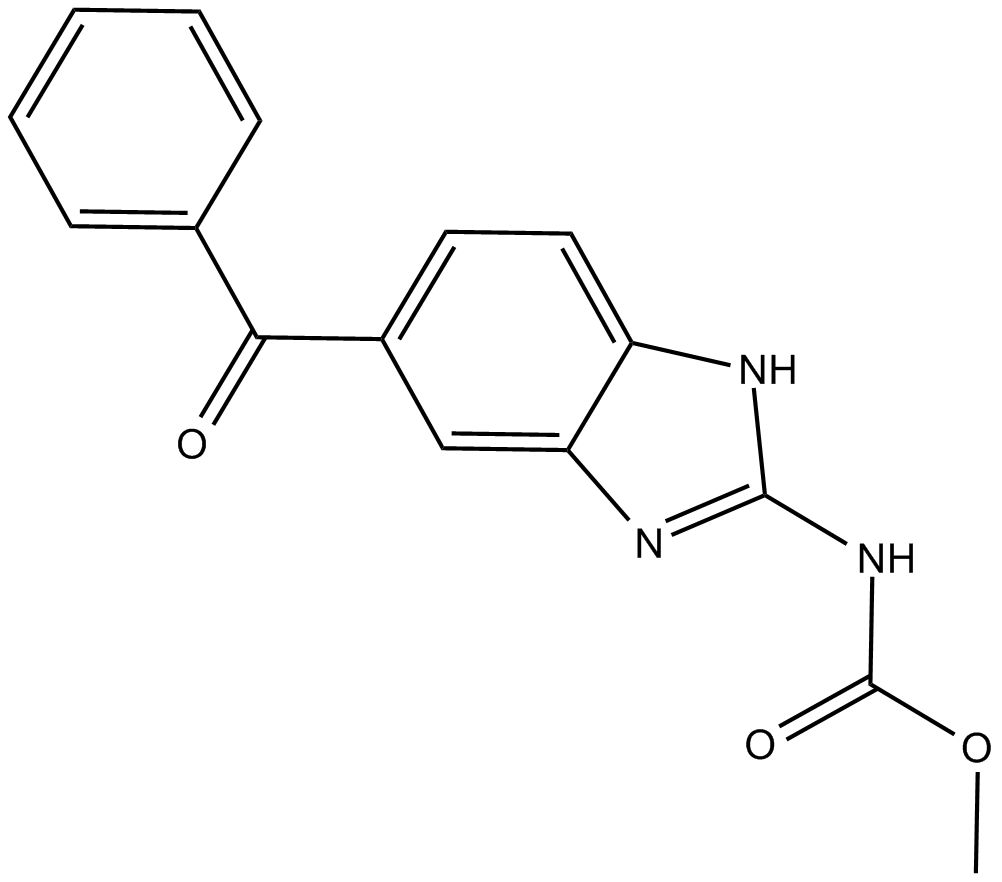
Cas No.: 31431-39-7
Sample solution is provided at 25 µL, 10mM.
_1-3.$$$39978408@51.jpg');)
_1-9.$$$38538795@65.jpg');)
_1-9.$$$39112701@51.jpg');)
_1-7.$$$37316672@70.jpg');)
_366-372.$$$36198801@70.jpg');)
.$$$38565142@65.jpg');)
_1867-1883.$$$33248023@67.jpg');)
_eads6055.$$$39977546@45.jpg');)
_eadm9805.$$$40080571@45.jpg');)
_eadj3020.$$$39666821@45.jpg');)
_1-20.$$$39757301@28.jpg');)
_1-24.$$$38898113@28.jpg');)
_273-287.$$$36806353@46.jpg');)
_1-16.$$$37156877@44.jpg');)
_1-19.$$$37460805@44.jpg');)
_1291-1307.$$$34518654@46.jpg');)
Mebendazole is an orally active broad-spectrum benzimidazole anti-parasitic drug, capable of inhibiting the Hedgehog pathway and tubulin polymerization. Mebendazole binds to the colchicine-binding site of β-tubulin to inhibit microtubule formation, blocks microtubule dimer polymerization within parasite intestinal cells, and interrupts glucose uptake, digestion and reproductive capabilities to exert anti-worm effects. Mebendazole has antibacterial activity against gastrointestinal nematode infections such as Necator americanus, Ancylostoma duodenale, Ascaris lumbricoides, Enterobius vermicularis and Trichuris trichiura. Mebendazole is often combined with conventional deworming regimens to enhance antiparasitic effects. Mebendazole can be used for research on intestinal nematode infections, echinococcosis, trichinellosis, toxocariasis and oncological repositioning[1-4].
In vitro, treatment of OVCAR3 and OAW42 cells with 0.156-2.5μM Mebendazole for 24-72 hours inhibited cell proliferation, inhibited cell migration, three-dimensional spheroid invasion and colony formation, reduced actin polymerization, induced G2/M phase arrest, decreased mitochondrial membrane potential, and promoted early and late apoptosis[5]. Treatment of HT-29, MCF-7 and MDA-MB-231 cells with 0.1nM-500μM Mebendazole for 24-48 hours reduced cell viability, increased phosphatidylserine exposure, sub-G1 DNA content and mitochondrial membrane permeability, decreased reduced thiol concentration, and presented apoptotic nuclear morphology[6]. Treatment of H295R, SW-13 and WI-38 cells with 0.1-100μM Mebendazole for 3 days inhibited proliferation. Treatment of H295R three-dimensional spheroids with 1μM Mebendazole for 20 days disintegrated spheroids and killed cancer cells[7].
In vivo, a single intraperitoneal injection of 40mg/kg Mebendazole in C57BL/6 mice reduced Ddx4-positive germ cells in seminiferous epithelium and decreased Plzf-positive spermatogonia and γH2AX-positive spermatocyte numbers[8]. Intraperitoneal injection of 50mg/kg Mebendazole every other day for 4 weeks in AML cell xenograft B-NDG mice reduced human CD45-positive cell proportions in spleen, liver, bone marrow and peripheral blood, and inhibited tumor cell invasion[9]. Oral gavage of 0.5mg Mebendazole twice daily for 4 weeks in C57BL/6J mice with femoral artery guide wire injury reduced neointimal area at the injury site, decreased intima/media area ratio, and reduced PCNA-positive proliferating cell proportion in the intima[10].
References:
[1] Keystone JS, Murdoch JK. Mebendazole. Ann Intern Med. 1979 Oct;91(4):582-6.
[2] Goodman HT. Mebendazole. Med J Aust. 1976 Oct 23;2(17):662.
[3] Chippaux JP. Mebendazole treatment of dracunculiasis. Trans R Soc Trop Med Hyg. 1991 Mar-Apr;85(2):280.
[4] Meco D, Attinà G, Mastrangelo S, et al. Emerging Perspectives on the Antiparasitic Mebendazole as a Repurposed Drug for the Treatment of Brain Cancers. Int J Mol Sci. 2023 Jan 10;24(2):1334.
[5] Gupta R, Roy D, Ghosh A, et al. Mebendazole exerts anticancer activity in ovarian cancer cell lines via novel Girdin-mediated AKT/IKKα/β/NF-κB signaling axis. Cells. 2025 Jan;14(2):113.
[6] Petersen JSSM, Baird SK. Treatment of breast and colon cancer cell lines with anti-helmintic benzimidazoles mebendazole or albendazole results in selective apoptotic cell death. J Cancer Res Clin Oncol. 2021;147(10):2945-2953.
[7] Martarelli D, Pompei P, Baldi C, et al. Mebendazole inhibits growth of human adrenocortical carcinoma cell lines implanted in nude mice. Cancer Chemother Pharmacol. 2008;61(5):809-17.
[8] Huang M, Wang C, Yao Y, et al. Mebendazole-Induced Blood-Testis Barrier Injury in Mice Testes by Disrupting Microtubules in Addition to Triggering Programmed Cell Death. Int J Mol Sci. 2022 Apr 11;23(8):4220.
[9] Yang W, Xu Y, Liu S, et al. Mebendazole induces ZBP-1 mediated PANoptosis of acute myeloid leukemia cells by targeting TUBA1A and exerts antileukemia effect. J Adv Res. 2025;78:487-496.
[10] Wang J, Wang H, Guo C, et al. Mebendazole Reduces Vascular Smooth Muscle Cell Proliferation and Neointimal Formation Following Vascular Injury in Mice. PLoS ONE. 2014 Feb 27;9(2):e90146
| Cell experiment [1]: | |
|
Cell lines |
HT-29 cells (human colorectal adenocarcinoma cell line), MCF-7 cells (human breast adenocarcinoma cell line), MDA-MB-231 cells (human triple-negative breast cancer cell line), RCB2157 cells (human bone marrow-derived mesenchymal stromal cell line) |
|
Preparation Method |
Cells were maintained in DMEM with 5% heat-inactivated FBS for cancer cell lines or 10% FBS for RCB2157 at 37°C, 5% CO2. Cells were treated with Mebendazole at 0.1nM-500μM for 24h or 48h. After treatment, cell viability was measured by MTT assay, cell cycle by PI staining and flow cytometry, microtubule structure by anti-α-tubulin and anti-acetyl-α-tubulin immunofluorescence after 8h treatment, caspase-3 activity by Ac-DEVD-AMC fluorometry, phosphatidylserine exposure by Annexin V/PI flow cytometry, DNA fragmentation by sub-G1 PI flow cytometry, mitochondrial membrane permeability by TMRE flow cytometry, and oxidative stress by DTNB reduced thiol assay. |
|
Reaction Conditions |
0.1nM-500μM; 24h or 48h |
|
Applications |
Mebendazole reduced cell viability. Mebendazole induced G2/M phase arrest in HT-29 cells. Mebendazole decreased α-tubulin and acetyl-α-tubulin fluorescence intensity indicating microtubule depolymerization. Mebendazole increased caspase-3 activity about 550-fold at 24h. Mebendazole increased Annexin V-positive early apoptotic cells, sub-G1 DNA content, and mitochondrial membrane permeability in HT-29 cells. |
| Animal experiment [2]: | |
|
Animal models |
C57BL/6J male mice (8 weeks old) |
|
Preparation Method |
Mice underwent femoral arterial wire injury (0.38mm guide wire inserted 4mm into femoral artery for 1 minute). After injury, mice were gavaged with 0.5mg Mebendazole suspended in PBS twice daily for 4 weeks. Mice were perfused with saline and formalin at the end of 4 weeks, femoral arteries were excised, paraffin-embedded, sectioned and stained with elastin; cross sections were immunostained with PCNA and TUNEL to assess intimal cell proliferation and apoptosis, CD31 for endothelium, and α-actin for smooth muscle cells; white blood cell counts were measured from blood samples. |
|
Dosage form |
0.5mg; p.o.; twice daily for 4 weeks |
|
Applications |
Mebendazole reduced neointimal area, reduced intima/media ratio, did not change medial area, reduced intimal PCNA-positive proliferating cell proportion, did not increase intimal TUNEL-positive apoptotic cell proportion, and did not alter white blood cell count. |
References: [1] Petersen JSSM, Baird SK. Treatment of breast and colon cancer cell lines with anti-helmintic benzimidazoles mebendazole or albendazole results in selective apoptotic cell death. J Cancer Res Clin Oncol. 2021;147(10):2945-2953. [2] Wang J, Wang H, Guo C, et al. Mebendazole Reduces Vascular Smooth Muscle Cell Proliferation and Neointimal Formation Following Vascular Injury in Mice. PLoS ONE. 2014 Feb 27;9(2):e90146. | |
| Cas No. | 31431-39-7 | SDF | |
| Synonyms | NSC 184849,R 17635 | ||
| Chemical Name | N-(6-benzoyl-1H-benzimidazol-2-yl)-carbamic acid, methyl ester | ||
| Canonical SMILES | O=C(C1=CC=C(NC(NC(OC)=O)=N2)C2=C1)C3=CC=CC=C3 | ||
| Formula | C16H13N3O3 | M.Wt | 295.3 |
| Solubility | ≥ 13mg/mL in DMSO | Storage | Store at -20°C |
| General tips | Please select the appropriate solvent to prepare the stock solution according to the
solubility of the product in different solvents; once the solution is prepared, please store it in
separate packages to avoid product failure caused by repeated freezing and thawing.Storage method
and period of the stock solution: When stored at -80°C, please use it within 6 months; when stored
at -20°C, please use it within 1 month. To increase solubility, heat the tube to 37°C and then oscillate in an ultrasonic bath for some time. |
||
| Shipping Condition | Evaluation sample solution: shipped with blue ice. All other sizes available: with RT, or with Blue Ice upon request. | ||
| Prepare stock solution | |||

|
1 mg | 5 mg | 10 mg |
| 1 mM | 3.3864 mL | 16.9319 mL | 33.8639 mL |
| 5 mM | 677.3 μL | 3.3864 mL | 6.7728 mL |
| 10 mM | 338.6 μL | 1.6932 mL | 3.3864 mL |
Step 1: Enter information below (Recommended: An additional animal making an allowance for loss during the experiment)
 g
μL
g
μL
Step 2: Enter the in vivo formulation (This is only the calculator, not formulation. Please contact us first if there is no in vivo formulation at the solubility Section.)
Calculation results:
Working concentration: mg/ml;
Method for preparing DMSO master liquid: mg drug pre-dissolved in μL DMSO ( Master liquid concentration mg/mL, Please contact us first if the concentration exceeds the DMSO solubility of the batch of drug. )
Method for preparing in vivo formulation: Take μL DMSO master liquid, next addμL PEG300, mix and clarify, next addμL Tween 80, mix and clarify, next add μL saline, mix and clarify.
Method for preparing in vivo formulation: Take μL DMSO master liquid, next add μL Corn oil, mix and clarify.
Note: 1. Please make sure the liquid is clear before adding the next solvent.
2. Be sure to add the solvent(s) in order. You must ensure that the solution obtained, in the previous addition, is a clear solution before proceeding to add the next solvent. Physical methods such as vortex, ultrasound or hot water bath can be used to aid dissolving.
3. All of the above co-solvents are available for purchase on the GlpBio website.
Quality Control & SDS
- View current batch:
- Purity: >99.00% Appearance: A solid
- COA (Certificate of Analysis)
- SDS (Safety Data Sheet)
- Datasheet
Average Rating: 5 (Based on Reviews and 15 reference(s) in Google Scholar.)