

Nesbuvir |
Catalog No.GC15891
 One-Click Copy Product Info
|

Products are for research use only. Not for human use. We do not sell to patients.
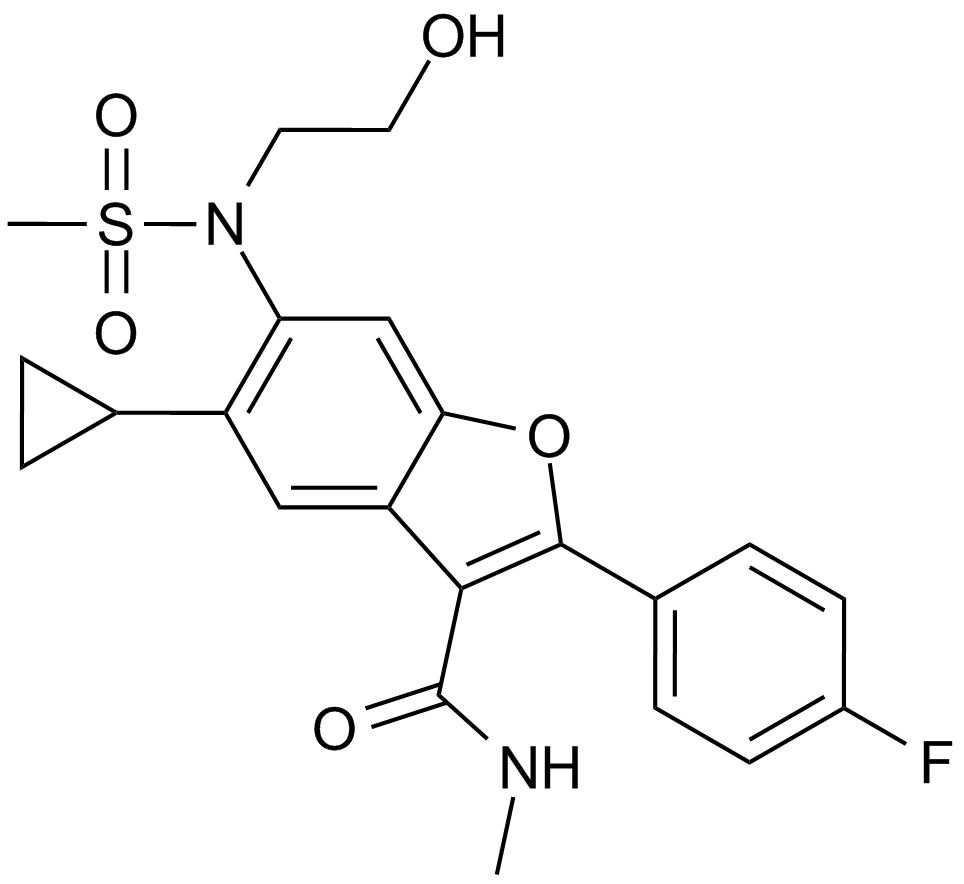
Cas No.: 691852-58-1
Sample solution is provided at 25 µL, 10mM.
_1-3.$$$39978408@51.jpg');)
_1-9.$$$38538795@65.jpg');)
_1-9.$$$39112701@51.jpg');)
_1-7.$$$37316672@70.jpg');)
_366-372.$$$36198801@70.jpg');)
.$$$38565142@65.jpg');)
_1867-1883.$$$33248023@67.jpg');)
_eads6055.$$$39977546@45.jpg');)
_eadm9805.$$$40080571@45.jpg');)
_eadj3020.$$$39666821@45.jpg');)
_1-20.$$$39757301@28.jpg');)
_1-24.$$$38898113@28.jpg');)
_273-287.$$$36806353@46.jpg');)
_1-16.$$$37156877@44.jpg');)
_1-19.$$$37460805@44.jpg');)
_1291-1307.$$$34518654@46.jpg');)
Nesbuvir is a novel selective inhibitor of nonstructural protein 5B (NS5B) polymerase with IC50 value of 5 nM [1].
NS5B (nonstructural protein 5B) is a viral protein found in HCV and plays an important role in HCV RNA replicate by using the viral positive RNA strand as its template and catalyzing the polymerization of rNTP during RNA replication. As the principal catalytic enzyme for HCV replication, NS5B is a viable target for HCV-RNA replication and used as a target for HCV therapy [2] [3].
Nesbuvir is a selective NS5B polymerase inhibitor and has a different selectivity with the reported ALK inhibitor crizotinib. When tested with Huh7.5 cell line, nesbuvir showed the highest selectivity for NS5B and mutations reduced the cells susceptibility [1]. In Clone A cells derived from Huh-7 cells containing approximately 1,000 genome copies of HCV genotype 1b replicon per cell, nesbuvir treatment with the concentration of 0.1 and 1 μM for 16-day reduced about 3.6 log10 and 4.2 log10 HCV RNA levels, respectively [2].
In the chimeric mouse model, nesbuvir treatment resulted in a 2.02 +/- 0.55 log reduction in HCV titer, whereas in combination with interferon using a suboptimal dose of 30 mg/kg three times per day showed a 2.44 log reduction and were better than interferon treatment only [4].
References:
[1]. Flint, M., et al., Selection and characterization of hepatitis C virus replicons dually resistant to the polymerase and protease inhibitors HCV-796 and boceprevir (SCH 503034). Antimicrob Agents Chemother, 2009. 53(2): p. 401-11.
[2]. Howe, A.Y., et al., Molecular mechanism of hepatitis C virus replicon variants with reduced susceptibility to a benzofuran inhibitor, HCV-796. Antimicrob Agents Chemother, 2008. 52(9): p. 3327-38.
[3]. Meshram, R.J. and R.N. Gacche, Effective epitope identification employing phylogenetic, mutational variability, sequence entropy, and correlated mutation analysis targeting NS5B protein of hepatitis C virus: from bioinformatics to therapeutics. J Mol Recognit, 2015.
[4]. Kneteman, N.M., et al., HCV796: A selective nonstructural protein 5B polymerase inhibitor with potent anti-hepatitis C virus activity in vitro, in mice with chimeric human livers, and in humans infected with hepatitis C virus. Hepatology, 2009. 49(3): p. 745-52.
| Cell experiment[1]: | |
|
Cell lines |
Huh7-BB7 cells |
|
Preparation method |
The solubility of this compound in DMSO is > 22.3 mg/mL. General tips for obtaining a higher concentration: Please warm the tube at 37 ℃ for 10 minutes and/or shake it in the ultrasonic bath for a while. Stock solution can be stored below -20℃ for several months. |
|
Reacting condition |
7 d, 40-80 nM |
|
Applications |
Nesbuvir is an inhibitor of the hepatitis C virus (HCV)nonstructural protein 5B (NS5B) polymerase. It has potent and specific inhibitory effect against the HCV RdRp, thus inhibiting RNA synthesis. When Nesbuvir is used in combination with boceprevir, it decreases the frequency with which resistant variants occur in Huh7-BB7 cells bearing a subgenomic genotype 1b HCV replicon. |
| Animal experiment [2]: | |
|
Animal models |
Urokinase plasminogen activator (uPA)/severe combined immunodeficient (SCID) mice |
|
Dosage form |
Oral administration, 50 mg/kg,three times daily for 5 days |
|
Application |
Treating mice with Nesbuvir resulted in a 2.02 ± 0.55 log10 decrease of HCV titer with one mouse below the level of detection, whereas HCV levels in the control group of mice were relatively stable (0.26 ± 0.16 log10 decline). |
|
Other notes |
Please test the solubility of all compounds indoor, and the actual solubility may slightly differ with the theoretical value. This is caused by an experimental system error and it is normal. |
|
References: [1]. Flint M, Mullen S, Deatly A M, et al. Selection and characterization of hepatitis C virus replicons dually resistant to the polymerase and protease inhibitors HCV-796 and boceprevir (SCH 503034)[J]. Antimicrobial agents and chemotherapy, 2009, 53(2): 401-411. [2]. Kneteman N M, Howe A Y M, Gao T, et al. HCV796: a selective nonstructural protein 5B polymerase inhibitor with potent anti‐hepatitis C virus activity in vitro, in mice with chimeric human livers, and in humans infected with hepatitis C virus[J]. Hepatology, 2009, 49(3): 745-752. | |
| Cas No. | 691852-58-1 | SDF | |
| Chemical Name | 5-cyclopropyl-2-(4-fluorophenyl)-6-[2-hydroxyethyl(methylsulfonyl)amino]-N-methyl-1-benzofuran-3-carboxamide | ||
| Canonical SMILES | CNC(=O)C1=C(OC2=CC(=C(C=C21)C3CC3)N(CCO)S(=O)(=O)C)C4=CC=C(C=C4)F | ||
| Formula | C22H23FN2O5S | M.Wt | 446.49 |
| Solubility | ≥ 22.3 mg/mL in DMSO, ≥ 97.8 mg/mL in EtOH with gentle warming | Storage | Store at -20°C |
| General tips | Please select the appropriate solvent to prepare the stock solution according to the
solubility of the product in different solvents; once the solution is prepared, please store it in
separate packages to avoid product failure caused by repeated freezing and thawing.Storage method
and period of the stock solution: When stored at -80°C, please use it within 6 months; when stored
at -20°C, please use it within 1 month. To increase solubility, heat the tube to 37°C and then oscillate in an ultrasonic bath for some time. |
||
| Shipping Condition | Evaluation sample solution: shipped with blue ice. All other sizes available: with RT, or with Blue Ice upon request. | ||
| Prepare stock solution | |||

|
1 mg | 5 mg | 10 mg |
| 1 mM | 2.2397 mL | 11.1985 mL | 22.3969 mL |
| 5 mM | 447.9 μL | 2.2397 mL | 4.4794 mL |
| 10 mM | 224 μL | 1.1198 mL | 2.2397 mL |
Step 1: Enter information below (Recommended: An additional animal making an allowance for loss during the experiment)
 g
μL
g
μL
Step 2: Enter the in vivo formulation (This is only the calculator, not formulation. Please contact us first if there is no in vivo formulation at the solubility Section.)
Calculation results:
Working concentration: mg/ml;
Method for preparing DMSO master liquid: mg drug pre-dissolved in μL DMSO ( Master liquid concentration mg/mL, Please contact us first if the concentration exceeds the DMSO solubility of the batch of drug. )
Method for preparing in vivo formulation: Take μL DMSO master liquid, next addμL PEG300, mix and clarify, next addμL Tween 80, mix and clarify, next add μL saline, mix and clarify.
Method for preparing in vivo formulation: Take μL DMSO master liquid, next add μL Corn oil, mix and clarify.
Note: 1. Please make sure the liquid is clear before adding the next solvent.
2. Be sure to add the solvent(s) in order. You must ensure that the solution obtained, in the previous addition, is a clear solution before proceeding to add the next solvent. Physical methods such as vortex, ultrasound or hot water bath can be used to aid dissolving.
3. All of the above co-solvents are available for purchase on the GlpBio website.
Quality Control & SDS
- View current batch:
- Purity: >98.50% Appearance: A solid
- COA (Certificate of Analysis)
- SDS (Safety Data Sheet)
- Datasheet
Average Rating: 5 (Based on Reviews and 30 reference(s) in Google Scholar.)