

NF-56-EJ40 |
Catalog No.GC38934
 One-Click Copy Product Info
|

NF-56-EJ40, a succinate receptor (SUCNR1) antagonist, blocks succinate's effect on promoting Treg numbers in CD4+ T cells isolated from healthy donor PBMCs with an IC50 value of 0.025μM.
Products are for research use only. Not for human use. We do not sell to patients.
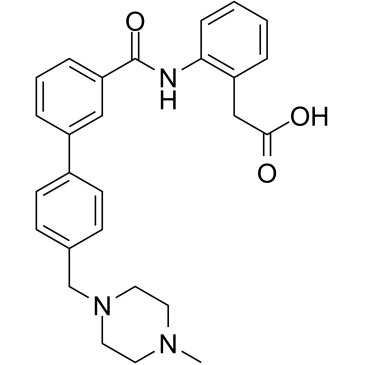
Cas No.: 2380230-73-7
Sample solution is provided at 25 µL, 10mM.
_1-3.$$$39978408@51.jpg');)
_1-9.$$$38538795@65.jpg');)
_1-9.$$$39112701@51.jpg');)
_1-7.$$$37316672@70.jpg');)
_366-372.$$$36198801@70.jpg');)
.$$$38565142@65.jpg');)
_1867-1883.$$$33248023@67.jpg');)
_eads6055.$$$39977546@45.jpg');)
_eadm9805.$$$40080571@45.jpg');)
_eadj3020.$$$39666821@45.jpg');)
_1-20.$$$39757301@28.jpg');)
_1-24.$$$38898113@28.jpg');)
_273-287.$$$36806353@46.jpg');)
_1-16.$$$37156877@44.jpg');)
_1-19.$$$37460805@44.jpg');)
_1291-1307.$$$34518654@46.jpg');)
NF-56-EJ40, a succinate receptor (SUCNR1) antagonist, blocks succinate's effect on promoting Treg numbers in CD4+ T cells isolated from healthy donor PBMCs with an IC50 value of 0.025μM[1-2]. NF-56-EJ40 enters SUCNR1 between TM-I and -II and does not unlock the extracellular loop (ECL)-2b[3].
In vitro, after 24 hours of treatment with NF-56-EJ40 (5μM) in lipopolysaccharide (LPS)-stimulated intestinal epithelial cells (IECs), the expression of IL-1β, IL-6, IL-10, and TNF-α in IECs was decreased[4]. The enteroids were pre-treated with 5μM NF-56-EJ40 for 30 minutes, and then cultured with 1mM succinate for 48 hours, resulting in a significant decrease in the promoting effects of succinate on the protein levels of leucine-rich repeat containing G protein-coupled receptor 5 (LGR5) and proliferating cell nuclear antigen protein (PCNA)[5]. NF-56-EJ40 (4μM; 24h) treatment could significantly interrupt succinate/IL-1β signal in human umbilical vein endothelial cells (HUVECs) and macrophages[6].
References:
[1] Sinéad Kinsella, Colton W Smith, Kelly McKenna, et al. Elevated Metabolite Secretion Facilitates a Treg-Mediated Immunosuppressive Microenvironment in the Solid Tumor. BLOOD. 2023; 142 (Supplement 1): 3458.
[2] Haffke M, Fehlmann D, Rummel G, et al. Structural basis of species-selective antagonist binding to the succinate receptor. Nature. 2019;574(7779):581-585.
[3] Shenol A, Lückmann M, Trauelsen M, et al. Molecular dynamics-based identification of binding pathways and two distinct high-affinity sites for succinate in succinate receptor 1/GPR91. Mol Cell. 2024;84(5):955-966.e4.
[4] Huo L, Chen Q, Jia S, et al. Gut microbiome promotes succinate-induced ulcerative colitis by enhancing glycolysis through SUCNR1/NF-κB signaling pathway. Am J Physiol Cell Physiol. Published online June 23, 2025.
[5] Luo D, Zou M, Rao X, et al. Lactobacillus salivarius metabolite succinate enhances chicken intestinal stem cell activities via the SUCNR1-mitochondria axis. Poult Sci. 2025;104(2):104754.
[6] Xu J, Zheng Y, Zhao Y, et al. Succinate/IL-1β Signaling Axis Promotes the Inflammatory Progression of Endothelial and Exacerbates Atherosclerosis. Front Immunol. 2022;13:817572.
| Cell experiment [1]: | |
Cell lines | intestinal epithelial cells (IECs) |
Preparation Method | IECs were plated in six-well plates and transferred to a 37℃ incubator to let them attach to treatment with 5μM NF-56-EJ40 for 24 hours. Subsequently, IECs were stimulated with lipopolysaccharide (LPS) and then treated with the NF-56-EJ40 for 24 hours, followed by detection of the levels of inflammatory factors in IECs. |
Reaction Conditions | 5μM; 24h |
Applications | The levels of IL-1β, IL-6, IL-10, and TNF-α were significantly increased in the LPS group. After the treatment of NF-56-EJ40, the expression of IL-1β, IL-6, IL-10, and TNF-α in IECs was decreased compared with the LPS group. |
References: | |
| Cas No. | 2380230-73-7 | SDF | |
| Canonical SMILES | O=C(NC1=C(CC(O)=O)C=CC=C1)C2=CC=CC(C3=CC=C(CN4CCN(C)CC4)C=C3)=C2 | ||
| Formula | C27H29N3O3 | M.Wt | 443.54 |
| Solubility | DMSO: 5 mg/mL (11.27 mM); Water: 4.55 mg/mL (10.26 mM; ultrasonic and adjust pH to 9 with NaOH) | Storage | Store at -20°C |
| General tips | Please select the appropriate solvent to prepare the stock solution according to the
solubility of the product in different solvents; once the solution is prepared, please store it in
separate packages to avoid product failure caused by repeated freezing and thawing.Storage method
and period of the stock solution: When stored at -80°C, please use it within 6 months; when stored
at -20°C, please use it within 1 month. To increase solubility, heat the tube to 37°C and then oscillate in an ultrasonic bath for some time. |
||
| Shipping Condition | Evaluation sample solution: shipped with blue ice. All other sizes available: with RT, or with Blue Ice upon request. | ||
| Prepare stock solution | |||

|
1 mg | 5 mg | 10 mg |
| 1 mM | 2.2546 mL | 11.2729 mL | 22.5459 mL |
| 5 mM | 450.9 μL | 2.2546 mL | 4.5092 mL |
| 10 mM | 225.5 μL | 1.1273 mL | 2.2546 mL |
Step 1: Enter information below (Recommended: An additional animal making an allowance for loss during the experiment)
 g
μL
g
μL
Step 2: Enter the in vivo formulation (This is only the calculator, not formulation. Please contact us first if there is no in vivo formulation at the solubility Section.)
Calculation results:
Working concentration: mg/ml;
Method for preparing DMSO master liquid: mg drug pre-dissolved in μL DMSO ( Master liquid concentration mg/mL, Please contact us first if the concentration exceeds the DMSO solubility of the batch of drug. )
Method for preparing in vivo formulation: Take μL DMSO master liquid, next addμL PEG300, mix and clarify, next addμL Tween 80, mix and clarify, next add μL saline, mix and clarify.
Method for preparing in vivo formulation: Take μL DMSO master liquid, next add μL Corn oil, mix and clarify.
Note: 1. Please make sure the liquid is clear before adding the next solvent.
2. Be sure to add the solvent(s) in order. You must ensure that the solution obtained, in the previous addition, is a clear solution before proceeding to add the next solvent. Physical methods such as vortex, ultrasound or hot water bath can be used to aid dissolving.
3. All of the above co-solvents are available for purchase on the GlpBio website.
Quality Control & SDS
- View current batch:
- Purity: >98.00% Appearance: A solid
- COA (Certificate of Analysis)
- SDS (Safety Data Sheet)
- Datasheet
Average Rating: 5 (Based on Reviews and 19 reference(s) in Google Scholar.)