

NSC 185058 |
Catalog No.GC34924
 One-Click Copy Product Info
|

NSC 185058 is a synthetic inhibitor of the ATG4B, with an IC50 value of 51μM.
Products are for research use only. Not for human use. We do not sell to patients.
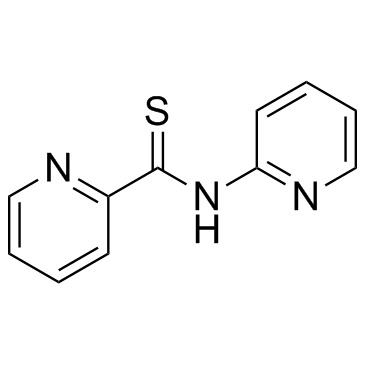
Cas No.: 39122-38-8
Sample solution is provided at 25 µL, 10mM.
_1-3.$$$39978408@51.jpg');)
_1-9.$$$38538795@65.jpg');)
_1-9.$$$39112701@51.jpg');)
_1-7.$$$37316672@70.jpg');)
_366-372.$$$36198801@70.jpg');)
.$$$38565142@65.jpg');)
_1867-1883.$$$33248023@67.jpg');)
_eads6055.$$$39977546@45.jpg');)
_eadm9805.$$$40080571@45.jpg');)
_eadj3020.$$$39666821@45.jpg');)
_1-20.$$$39757301@28.jpg');)
_1-24.$$$38898113@28.jpg');)
_273-287.$$$36806353@46.jpg');)
_1-16.$$$37156877@44.jpg');)
_1-19.$$$37460805@44.jpg');)
_1291-1307.$$$34518654@46.jpg');)
NSC 185058 is a synthetic inhibitor of the ATG4B, with an IC50 value of 51μM [1]. NSC 185058 inhibits autophagy, which in turn suppresses the activity of mTORC1 as well as the phosphorylation status of the P70S6K and 4EBP1, thereby preventing the increase in cellular protein anabolism[2]. NSC 185058 has been widely used to prevent the replication of Enterovirus 71 (EV71) and to inhibit the infection of virus-infected cells[3].
In vitro, NSC 185058 (100µM) treatment for 72 hours significantly reduced the protein content of ATG4B in A549 cells and inhibited cell proliferation[4]. Treatment with 10µM NSC 185058 for 6 days significantly inhibited the formation of osteoclasts induced by RANKL in mouse bone marrow cells, and induced cell death[5]. Treatment with 5µM NSC 185058 for 2 hours in combination with 3Gy ionizing radiation reduced the viability of mutant IDH1 glioma cells and increased cell radiosensitivity[6].
In vivo, NSC 185058 treatment via subcutaneous injection at a dose of 100mg/kg, every other day for 5 days, significantly inhibited the growth of Saos-2 osteosarcoma in mice within 30 days, without altering the body size of the mice[7].
References:
[1] Qiu Z, Kuhn B, Aebi J, et al. Discovery of fluoromethylketone-based peptidomimetics as covalent ATG4B (autophagin-1) inhibitors[J]. ACS medicinal chemistry letters, 2016, 7(8): 802-806.
[2] Ryan P J, Uranga S, Stanelle S T, et al. The autophagy inhibitor NSC185058 suppresses mTORC1-mediated protein anabolism in cultured skeletal muscle[J]. Scientific reports, 2024, 14(1): 8094.
[3] Sun Y, Zheng Q, Wang Y, et al. Activity-based protein profiling identifies ATG4B as a key host factor for enterovirus 71 proliferation[J]. Journal of Virology, 2019, 93(24): 10.1128/jvi. 01092-19.
[4] Ryan P J, Guerra B C, Uranga S, et al. ATG4B is required for mTORC1‐mediated anabolic activity and is associated with clinical outcomes in non‐small cell lung cancer[J]. FEBS Open Bio, 2026, 16(3): 570-583.
[5] Hiura F, Kawabata Y, Aoki T, et al. Inhibition of the ATG4-LC3 pathway suppressed osteoclast maturation[J]. Biochemical and biophysical research communications, 2022, 632: 40-47.
[6] Núñez F J, Banerjee K, Mujeeb A A, et al. Autophagy Upregulation in Mutant Isocitrate Dehydrogenase 1 (IDH1) Glioma Uncovers a Novel Therapeutic Target[J]. Research square, 2025: rs. 3. rs-7483444.
[7] Akin D, Wang S K, Habibzadegah-Tari P, et al. A novel ATG4B antagonist inhibits autophagy and has a negative impact on osteosarcoma tumors[J]. Autophagy, 2014, 10(11): 2021-2035.
| Cell experiment [1]: | |
Cell lines | A549 cells |
Preparation Method | A549 cells were cultured in RPMI-1640 medium containing 10% fetal bovine serum (FBS) in 5% CO2 at 37°C. Cells were placed in 96-well plates at a concentration of 1×10⁴ cells per well. Using 0.1% DMSO as a control, cells received NSC 185058 (100μM) treatment for 72h. At the end of administration, the supernatant was discarded, and the viable cell numbers were measured and the protein synthesis rates were measured. |
Reaction Conditions | 100μM; 72h |
Applications | NSC 185058 treatment significantly reduced cell proliferation in A549 cells and resulted in decreased protein synthesis rates. |
| Animal experiment [2]: | |
Animal models | Immunodeficient nu/nu nude female mice |
Preparation Method | Immunodeficient nu/nu nude female mice (20-24g) were housed in a specialized animal care facility, in a room with constant temperature (25°C), humidity control, and a 12/12h light/dark cycle with free access to food and water. Mice were injected subcutaneously with 6×10⁶ Saos-2 cells. Palpable Saos-2 tumors developed in 7 to 10 days, at which time, the mice were divided into 2 groups and injected i.p. every other day for 5 days, with either peanut oil vehicle or NSC 185058 (100mg/kg) dissolved in peanut oil. Over time, the tumor volumes and the body weight were measured. |
Dosage form | 100mg/kg; every other day for 5 days; i.p. |
Applications | NSC 185058 treatment significantly inhibited the growth of Saos-2 osteosarcoma in mice within 30 days, without altering the body size of the mice. |
References:
[1] Ryan P J, Guerra B C, Uranga S, et al. ATG4B is required for mTORC1‐mediated anabolic activity and is associated with clinical outcomes in non‐small cell lung cancer[J]. FEBS Open Bio, 2026, 16(3): 570-583.
[2] Akin D, Wang S K, Habibzadegah-Tari P, et al. A novel ATG4B antagonist inhibits autophagy and has a negative impact on osteosarcoma tumors[J]. Autophagy, 2014, 10(11): 2021-2035.
| Cas No. | 39122-38-8 | SDF | |
| Canonical SMILES | S=C(C1=NC=CC=C1)NC2=NC=CC=C2 | ||
| Formula | C11H9N3S | M.Wt | 215.27 |
| Solubility | DMSO : ≥ 125 mg/mL (580.67 mM) | Storage | 4°C, protect from light |
| General tips | Please select the appropriate solvent to prepare the stock solution according to the
solubility of the product in different solvents; once the solution is prepared, please store it in
separate packages to avoid product failure caused by repeated freezing and thawing.Storage method
and period of the stock solution: When stored at -80°C, please use it within 6 months; when stored
at -20°C, please use it within 1 month. To increase solubility, heat the tube to 37°C and then oscillate in an ultrasonic bath for some time. |
||
| Shipping Condition | Evaluation sample solution: shipped with blue ice. All other sizes available: with RT, or with Blue Ice upon request. | ||
| Prepare stock solution | |||

|
1 mg | 5 mg | 10 mg |
| 1 mM | 4.6453 mL | 23.2266 mL | 46.4533 mL |
| 5 mM | 929.1 μL | 4.6453 mL | 9.2907 mL |
| 10 mM | 464.5 μL | 2.3227 mL | 4.6453 mL |
Step 1: Enter information below (Recommended: An additional animal making an allowance for loss during the experiment)
 g
μL
g
μL
Step 2: Enter the in vivo formulation (This is only the calculator, not formulation. Please contact us first if there is no in vivo formulation at the solubility Section.)
Calculation results:
Working concentration: mg/ml;
Method for preparing DMSO master liquid: mg drug pre-dissolved in μL DMSO ( Master liquid concentration mg/mL, Please contact us first if the concentration exceeds the DMSO solubility of the batch of drug. )
Method for preparing in vivo formulation: Take μL DMSO master liquid, next addμL PEG300, mix and clarify, next addμL Tween 80, mix and clarify, next add μL saline, mix and clarify.
Method for preparing in vivo formulation: Take μL DMSO master liquid, next add μL Corn oil, mix and clarify.
Note: 1. Please make sure the liquid is clear before adding the next solvent.
2. Be sure to add the solvent(s) in order. You must ensure that the solution obtained, in the previous addition, is a clear solution before proceeding to add the next solvent. Physical methods such as vortex, ultrasound or hot water bath can be used to aid dissolving.
3. All of the above co-solvents are available for purchase on the GlpBio website.
Quality Control & SDS
- View current batch:
- Purity: >98.00% Appearance: A solid
- COA (Certificate of Analysis)
- SDS (Safety Data Sheet)
- Datasheet
Average Rating: 5 (Based on Reviews and 7 reference(s) in Google Scholar.)