

PFK-015 |
Catalog No.GC16993
 One-Click Copy Product Info
|

PFK-015 is a potent and selective inhibitor of PFKFB3 with an IC50 value of 110nM.
Products are for research use only. Not for human use. We do not sell to patients.
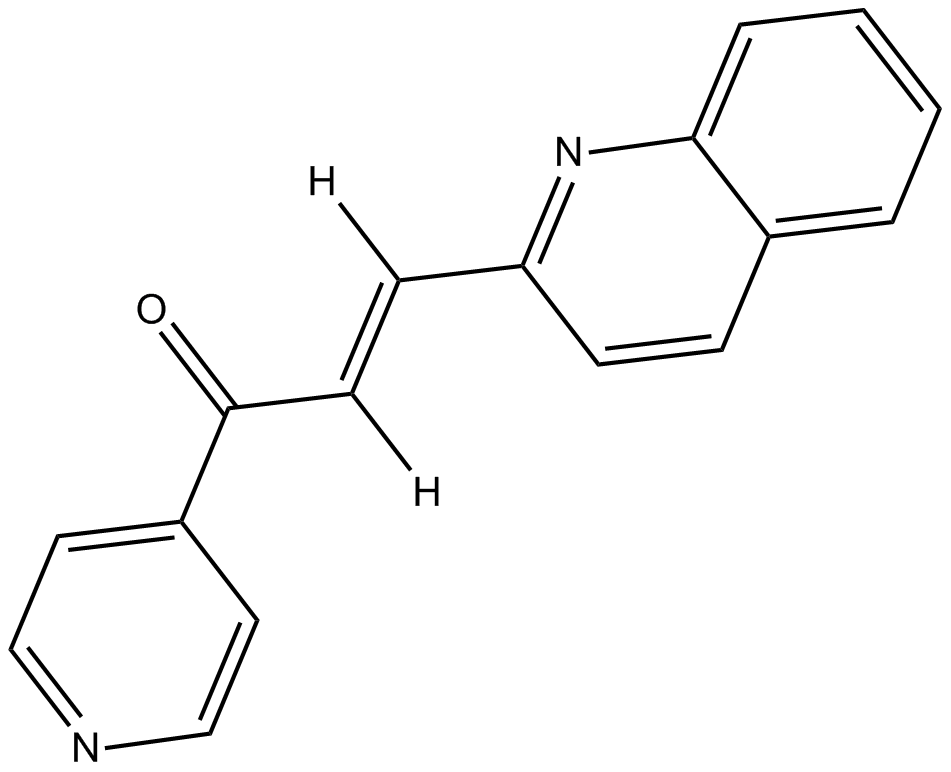
Cas No.: 4382-63-2
Sample solution is provided at 25 µL, 10mM.
PFK-015 is a potent and selective inhibitor of PFKFB3 with an IC50 value of 110nM[1]. As a key regulator of glycolytic metabolism, PFK-015 disrupts fructose-2,6-bisphosphate production and demonstrates significant anti-proliferative effects across multiple tumor cell lines[2]. The compound also induces autophagy and exhibits synergistic activity with chemotherapeutic agents in vivo[3].
In Peripheral blood mononuclear cells treatment with PFK-015(10μM; 80min) during IFN-γ-induced macrophage polarization reduced the expression of M1 surface markers CD80, iNOS, and HLA-DR[4]. In the 786-O and OS-RC-2 cell lines, the expression levels of glycolytic regulatory enzymes, key enzymes, and PD-L1 decreased after the addition of the PFKFB3 inhibitor PFK-015(10μM; 24h)[5].
In Lewis lung carcinoma (LLC)-bearing mice, PFK-015(25mg/kg; iv; every 3 days for 4 doses) inhibits the growth of Lewis lung carcinoma (LLC) xenografts by mediating the depletion of tumor-associated fructose-2,6-bisphosphate (F26BP), which consequently triggers apoptotic signaling and suppresses pulmonary metastasis of the subcutaneous tumors[6]. In the Hu-NOG mouse model, PFK-015(25mg/kg; ip; 21d)combined with PD-1 mAb therapy significantly inhibits tumor growth in human PBMC-engrafted NOG mice[7].
References:
[1].Clem B, Tapolsky G H, O'Neal J, et al. Characterization of a novel small molecule antagonist of 6-phosphofructo-2-kinase that suppresses glucose metabolism and tumor growth[J]. Cancer Research, 2011, 71(8_Supplement): 2825-2825.
[2].Ling X, Liu L, Jiang A, et al. PFKFB3 promotes endometriosis cell proliferation via enhancing the protein stability of β-catenin[J]. Molecular and Cellular Endocrinology, 2024, 579: 112083.
[3].Brooke D G, van Dam E M, Watts C K W, et al. Targeting the Warburg Effect in cancer; relationships for 2-arylpyridazinones as inhibitors of the key glycolytic enzyme 6-phosphofructo-2-kinase/2, 6-bisphosphatase 3 (PFKFB3)[J]. Bioorganic & medicinal chemistry, 2014, 22(3): 1029-1039.
[4].Chen R, Wang J, Dai X, et al. Augmented PFKFB3-mediated glycolysis by interferon-γ promotes inflammatory M1 polarization through the JAK2/STAT1 pathway in local vascular inflammation in Takayasu arteritis[J]. Arthritis research & therapy, 2022, 24(1): 266.
[5].Yu Y, Liang Y, Li D, et al. Glucose metabolism involved in PD-L1-mediated immune escape in the malignant kidney tumour microenvironment[J]. Cell Death Discovery, 2021, 7(1): 15.
[6].Clem B F, O'Neal J, Tapolsky G, et al. Targeting 6-phosphofructo-2-kinase (PFKFB3) as a therapeutic strategy against cancer[J]. Molecular cancer therapeutics, 2013, 12(8): 1461-1470.
[7].Zheng J B, Wong C W, Liu J, et al. Glucose metabolism inhibitor PFK-015 combined with immune checkpoint inhibitor is an effective treatment regimen in cancer[J]. Oncoimmunology, 2022, 11(1): 2079182.
| Cell experiment [1]: | |
Cell lines | Peripheral blood mononuclear cells |
Preparation Method | Peripheral blood mononuclear cells supplemented with 40ng/ml macrophage colony-stimulating factor (M-CSF) was used as a differentiation medium. To examine the role of PFKFB3 in macrophage polarization, PFKFB3 inhibitor PFK-015 (10μM) was used. |
Reaction Conditions | 10μM; 80min |
Applications | Treatment with PFK-015 during IFN-γ-induced macrophage polarization reduced the expression of M1 surface markers CD80, iNOS, and HLA-DR. |
| Animal experiment [2]: | |
Animal models | Xenograft modle |
Preparation Method | LL cells were obtained from DMEM medium containing 10% FCS in the exponential growth phase. After washing twice, the cells were resuspended in PBS buffer. 0.1mL of cell suspension (1×10⁶ cells) was subcutaneously injected into C57Bl6 mice. Mice carrying xenograft tumors (150–200mg) were randomly assigned to four groups: DMSO group, PFK-015 group (25mg/kg, intraperitoneal injection, every 3 days for 4 doses), irinotecan group (70mg/kg, intravenous injection, every 3 days for 4 doses), temozolomide group (30mg/kg, oral administration, 3 consecutive days followed by a 3-day break), and gemcitabine group (100mg/kg, every 3 days for 4 doses). Tumor size was measured daily using microcalipers. |
Dosage form | 25mg/kg; iv; every 3 days for 4 doses |
Applications | PFK-015 inhibits the growth of Lewis lung carcinoma (LLC) xenografts by mediating the depletion of tumor-associated fructose-2,6-bisphosphate (F26BP), which consequently triggers apoptotic signaling and suppresses pulmonary metastasis of the subcutaneous tumors. |
References: | |
| Cas No. | 4382-63-2 | SDF | |
| Canonical SMILES | O=C(C1=CC=NC=C1)/C([H])=C([H])/C2=NC3=CC=CC=C3C=C2 | ||
| Formula | C17H12N2O | M.Wt | 260.29 |
| Solubility | ≥ 13mg/mL in DMSO | Storage | Store at -20°C |
| General tips | Please select the appropriate solvent to prepare the stock solution according to the
solubility of the product in different solvents; once the solution is prepared, please store it in
separate packages to avoid product failure caused by repeated freezing and thawing.Storage method
and period of the stock solution: When stored at -80°C, please use it within 6 months; when stored
at -20°C, please use it within 1 month. To increase solubility, heat the tube to 37°C and then oscillate in an ultrasonic bath for some time. |
||
| Shipping Condition | Evaluation sample solution: shipped with blue ice. All other sizes available: with RT, or with Blue Ice upon request. | ||
| Prepare stock solution | |||

|
1 mg | 5 mg | 10 mg |
| 1 mM | 3.8419 mL | 19.2093 mL | 38.4187 mL |
| 5 mM | 768.4 μL | 3.8419 mL | 7.6837 mL |
| 10 mM | 384.2 μL | 1.9209 mL | 3.8419 mL |
Step 1: Enter information below (Recommended: An additional animal making an allowance for loss during the experiment)
 g
μL
g
μL
Step 2: Enter the in vivo formulation (This is only the calculator, not formulation. Please contact us first if there is no in vivo formulation at the solubility Section.)
Calculation results:
Working concentration: mg/ml;
Method for preparing DMSO master liquid: mg drug pre-dissolved in μL DMSO ( Master liquid concentration mg/mL, Please contact us first if the concentration exceeds the DMSO solubility of the batch of drug. )
Method for preparing in vivo formulation: Take μL DMSO master liquid, next addμL PEG300, mix and clarify, next addμL Tween 80, mix and clarify, next add μL saline, mix and clarify.
Method for preparing in vivo formulation: Take μL DMSO master liquid, next add μL Corn oil, mix and clarify.
Note: 1. Please make sure the liquid is clear before adding the next solvent.
2. Be sure to add the solvent(s) in order. You must ensure that the solution obtained, in the previous addition, is a clear solution before proceeding to add the next solvent. Physical methods such as vortex, ultrasound or hot water bath can be used to aid dissolving.
3. All of the above co-solvents are available for purchase on the GlpBio website.
Quality Control & SDS
- View current batch:
- Purity: >98.00% Appearance: A solid
- COA (Certificate of Analysis)
- SDS (Safety Data Sheet)
- Datasheet
Average Rating: 5 (Based on Reviews and 6 reference(s) in Google Scholar.)