

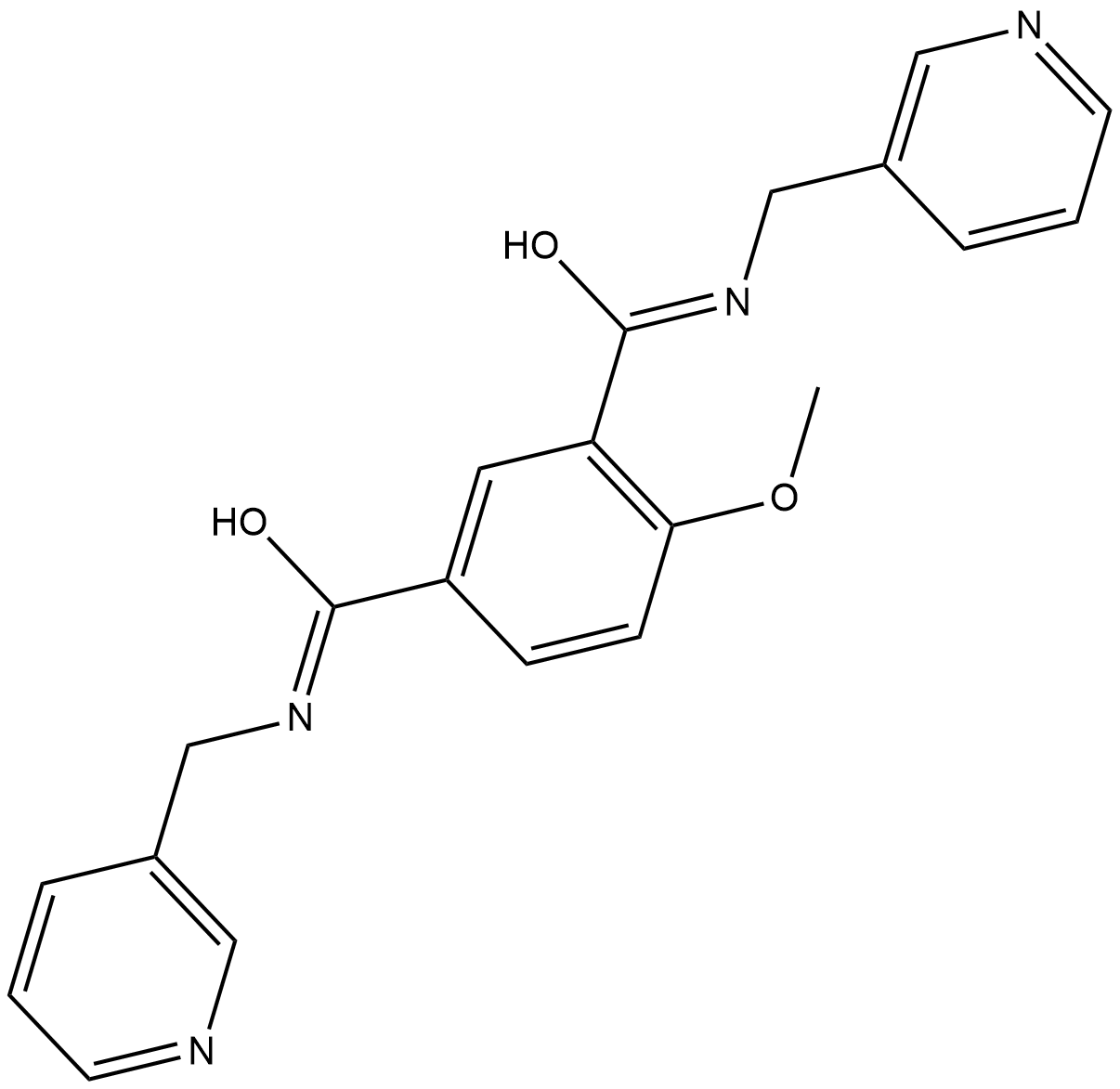
Picotamide |
Catalog No.GC18323
 One-Click Copy Product Info
|

Picotamide is a platelet aggregation inhibitor with an IC50 value of 0.76μM.
Products are for research use only. Not for human use. We do not sell to patients.
Cas No.: 32828-81-2
Sample solution is provided at 25 µL, 10mM.
_1-3.$$$39978408@51.jpg');)
_1-9.$$$38538795@65.jpg');)
_1-9.$$$39112701@51.jpg');)
_1-7.$$$37316672@70.jpg');)
_366-372.$$$36198801@70.jpg');)
.$$$38565142@65.jpg');)
_1867-1883.$$$33248023@67.jpg');)
_eads6055.$$$39977546@45.jpg');)
_eadm9805.$$$40080571@45.jpg');)
_eadj3020.$$$39666821@45.jpg');)
_1-20.$$$39757301@28.jpg');)
_1-24.$$$38898113@28.jpg');)
_273-287.$$$36806353@46.jpg');)
_1-16.$$$37156877@44.jpg');)
_1-19.$$$37460805@44.jpg');)
_1291-1307.$$$34518654@46.jpg');)
Picotamide is a platelet aggregation inhibitor with an IC50 value of 0.76μM[1]. Picotamide can inhibit the thromboxane A2 (TxA2) receptor and TxA2 synthase, prevent platelet aggregation, and regulate the inflammatory process of atherosclerotic plaques[2]. Picotamide has been widely used as a model compound to develop a series of derivatives for inhibiting platelet aggregation[3].
In vitro, Picotamide treatment at 300μM for 45 minutes inhibited the contraction of hyperplastic human prostate smooth muscle induced by adrenergic and thromboxane[4]. Treatment with 300μM Picotamide for 45 minutes inhibited in the smooth muscle contractions induced by the phenylephrine, U46619, and electric field stimulation (EFS) in the lower urinary tract tissues[5]. Treatment with 300μM Picotamide for 30 minutes inhibited the smooth muscle contraction of the interlobular arteries in porcine renal interloba induced by phenylephrine [6].
In vivo, Picotamide treatment via intraperitoneal injection at a single dose of 375mg/kg 1 hour before thrombotic challenge could protect mice from death caused by intravenous injection of collagen plus epinephrine, and reduced the decline in circulating platelet count and pulmonary thromboembolism[7].
References:
[1] Liu X J, Shi X X, Zhong Y L, et al. Design, synthesis and in vitro activities on anti-platelet aggregation of 4-methoxybenzene-1, 3-isophthalamides[J]. Bioorganic & medicinal chemistry letters, 2012, 22(21): 6591-6595.
[2] Celestini A, Violi F. A review of picotamide in the reduction of cardiovascular events in diabetic patients[J]. Vascular Health and Risk Management, 2007, 3(1): 93-98.
[3] Zou J, Gao P, Hao X, et al. Recent progress in the structural modification and pharmacological activities of ligustrazine derivatives[J]. European Journal of Medicinal Chemistry, 2018, 147: 150-162.
[4] Hennenberg M, Miljak M, Herrmann D, et al. The receptor antagonist picotamide inhibits adrenergic and thromboxane-induced contraction of hyperplastic human prostate smooth muscle[J]. American Journal of Physiology-Renal Physiology, 2013, 305(10): F1383-F1390.
[5] Hennenberg M, Tamalunas A, Wang Y, et al. Inhibition of agonist-induced smooth muscle contraction by picotamide in the male human lower urinary tract outflow region[J]. European journal of pharmacology, 2017, 803: 39-47.
[6] Li B, Huang R, Wang R, et al. Picotamide inhibits a wide spectrum of agonist‐induced smooth muscle contractions in porcine renal interlobar and coronary arteries[J]. Pharmacology Research & Perspectives, 2021, 9(3): e00771.
[7] Gresele P, Corona C, Alberti P, et al. Picotamide protects mice from death in a pulmonary embolism model by a mechanism independent from thromboxane suppression[J]. Thrombosis and haemostasis, 1990, 64(05): 080-086.
| Animal experiment [1]: | |
Animal models | Male Swiss CD1 mice |
Preparation Method | Male Swiss CD1 mice, weighing 20-25g, were caged and fed a regular diet for at least 1 week before use. Picotamide or vehicle was administered by intraperitoneal (i. p.) route, in a dose of 375mg/kg. One hour after the i. p. pretreatment of Picotamide, 100μl of a mixture of collagen (250μg/ml) and epinephrine (15μg/ml) in 0.154M NaCl was injected rapidly (in less than 2min) into a tail vein. Mouse blood anticoagulated with trisodium citrate 3.8% was collected by heart puncture under ether anesthesia and centrifuged for analysis. |
Dosage form | 375mg/kg for once; i.p. |
Applications | Picotamide treatment significantly reduced the drop in the number of circulating platelets in the blood of mice with pulmonary embolism. |
References: | |
| Cas No. | 32828-81-2 | SDF | |
| Chemical Name | 4-methoxy-N1,N3-bis(3-pyridinylmethyl)-1,3-benzenedicarboxamide | ||
| Canonical SMILES | O=C(C1=CC=C(OC)C(C(NCC2=CC=CN=C2)=O)=C1)NCC3=CN=CC=C3 | ||
| Formula | C21H20N4O3 | M.Wt | 376.4 |
| Solubility | 1mg/mL in ethanol, 5mg/ml in DMSO, 10mg/mL in DMF | Storage | Store at -20°C |
| General tips | Please select the appropriate solvent to prepare the stock solution according to the
solubility of the product in different solvents; once the solution is prepared, please store it in
separate packages to avoid product failure caused by repeated freezing and thawing.Storage method
and period of the stock solution: When stored at -80°C, please use it within 6 months; when stored
at -20°C, please use it within 1 month. To increase solubility, heat the tube to 37°C and then oscillate in an ultrasonic bath for some time. |
||
| Shipping Condition | Evaluation sample solution: shipped with blue ice. All other sizes available: with RT, or with Blue Ice upon request. | ||
| Prepare stock solution | |||

|
1 mg | 5 mg | 10 mg |
| 1 mM | 2.6567 mL | 13.2837 mL | 26.5675 mL |
| 5 mM | 531.3 μL | 2.6567 mL | 5.3135 mL |
| 10 mM | 265.7 μL | 1.3284 mL | 2.6567 mL |
Step 1: Enter information below (Recommended: An additional animal making an allowance for loss during the experiment)
 g
μL
g
μL
Step 2: Enter the in vivo formulation (This is only the calculator, not formulation. Please contact us first if there is no in vivo formulation at the solubility Section.)
Calculation results:
Working concentration: mg/ml;
Method for preparing DMSO master liquid: mg drug pre-dissolved in μL DMSO ( Master liquid concentration mg/mL, Please contact us first if the concentration exceeds the DMSO solubility of the batch of drug. )
Method for preparing in vivo formulation: Take μL DMSO master liquid, next addμL PEG300, mix and clarify, next addμL Tween 80, mix and clarify, next add μL saline, mix and clarify.
Method for preparing in vivo formulation: Take μL DMSO master liquid, next add μL Corn oil, mix and clarify.
Note: 1. Please make sure the liquid is clear before adding the next solvent.
2. Be sure to add the solvent(s) in order. You must ensure that the solution obtained, in the previous addition, is a clear solution before proceeding to add the next solvent. Physical methods such as vortex, ultrasound or hot water bath can be used to aid dissolving.
3. All of the above co-solvents are available for purchase on the GlpBio website.
Quality Control & SDS
- View current batch:
- Purity: >98.00% Appearance: A solid
- COA (Certificate of Analysis)
- SDS (Safety Data Sheet)
- Datasheet
Average Rating: 5 (Based on Reviews and 5 reference(s) in Google Scholar.)