

Rottlerin (Synonyms: Mallotoxin, NSC 94525, NSC 56346) |
Catalog No.GC10820
 One-Click Copy Product Info
|

Rottlerin, a natural product purified from Mallotus Philippinensis, is a specific PKC inhibitor, with IC50 values for PKCδ of 3-6μM, PKCα, β, γ of 30-42μM, PKCε, η, ζ of 80-100μM.
Products are for research use only. Not for human use. We do not sell to patients.
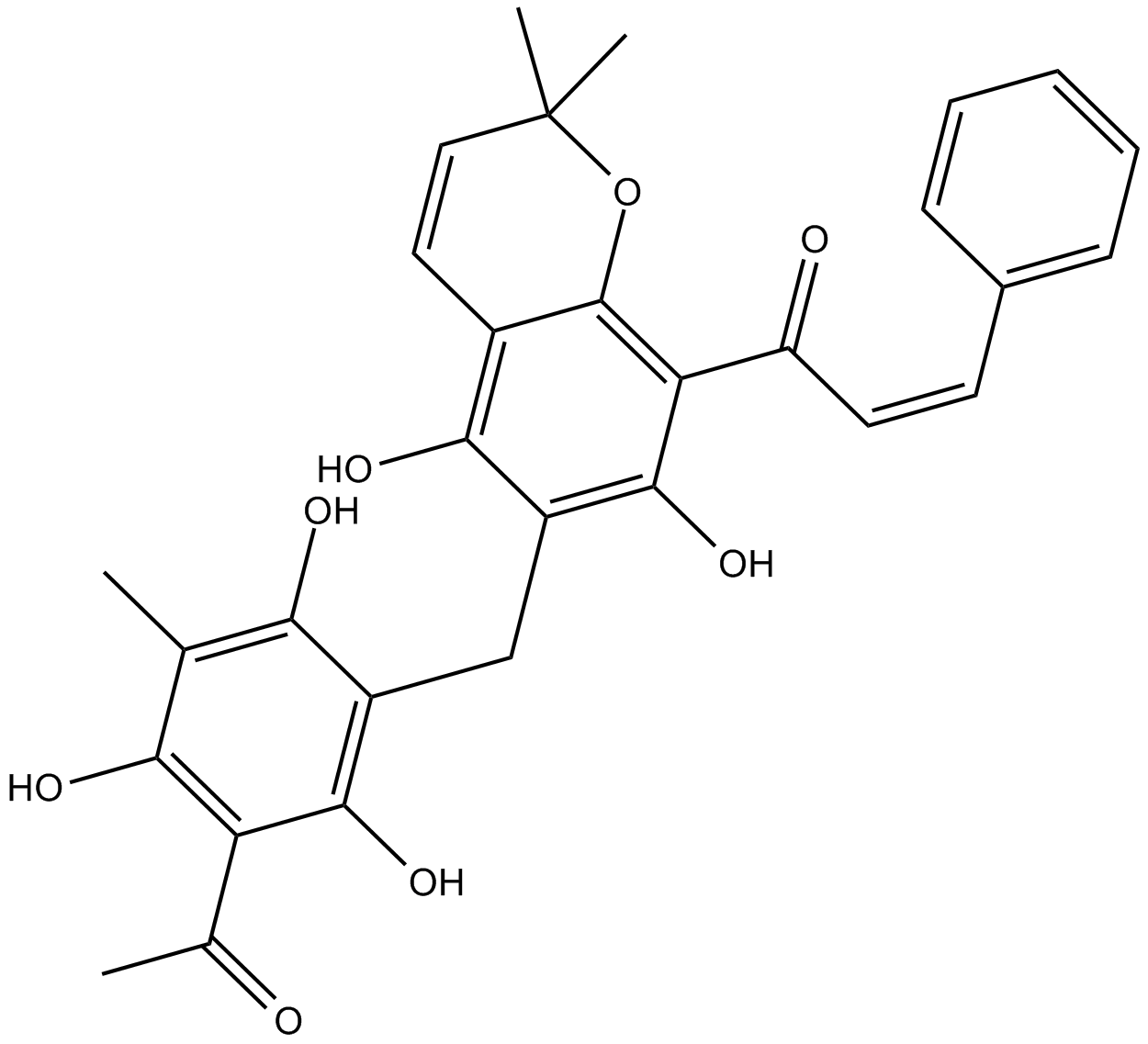
Cas No.: 82-08-6
Sample solution is provided at 25 µL, 10mM.
Rottlerin, a natural product purified from Mallotus Philippinensis, is a specific PKC inhibitor, with IC50 values for PKCδ of 3-6μM, PKCα, β, γ of 30-42μM, PKCε, η, ζ of 80-100μM[1]. Rottlerin also acts as a direct mitochondrial uncoupler, and stimulates autophagy by targeting a signaling cascade upstream of mTORC1[2]. Rottlerin is often used in the research of viral infections, neurodegenerative diseases and metabolic disorders[3][4].
In vitro, treatment of human microvascular endothelial cells (HMVECs) with Rottlerin (5 or 20μM; 2, 6, 24h) significantly inhibits the proliferation of cells by reducing thymidine incorporation by 75%–80%, dose-dependently inhibits tube formation on Matrigel with complete inhibition at 20μM after 18h, and reduces cyclin D-1 mRNA to 50%, 40%, and 20% of control levels at 2, 6, and 24h, respectively, with a similar trend observed for protein levels[5]. Additionally, Rottlerin exhibits significant antiproliferative effects on various cell lines, with IC50 values of 12μM for C6 cells (24h), 5μM for C6 cells (48h), 7μM for T98G cells (48h), and 9μM for U138MG cells (48h); reduces the number of S-phase cells in C6, T98G, and U138MG cells at 5μM (24h); and induces DNA laddering in HL-60 cells at 5μM (24h)[6].
In vivo, Rottlerin (20mg/kg/day; p.o.; 6 weeks) significantly inhibited the growth of AsPC-1 pancreatic cancer xenografts in Balb/c nude mice, decreased the expression of cell proliferation markers (Ki67 and PCNA) in tumor tissues, increased the activation of apoptosis markers (caspase-3 and PARP), and suppressed the expression of proteins related to angiogenesis (VEGF, VEGFR, Cox-2, IL-8) and epithelial–mesenchymal transition (Slug, Snail, MMP-2, MMP-9), while upregulating the expression of E-cadherin[7].
References:
[1] Gschwendt M, Müller HJ, Kielbassa K, et al. Rottlerin, a novel protein kinase inhibitor. Biochem Biophys Res Commun. 1994;199(1):93-98.
[2] Balgi AD, Fonseca BD, Donohue E, et al. Screen for chemical modulators of autophagy reveals novel therapeutic inhibitors of mTORC1 signaling. PLoS One. 2009;4(9):e7124.
[3] Lama Z, Gaudin Y, Blondel D, Lagaudrière-Gesbert C. Kinase inhibitors tyrphostin 9 and rottlerin block early steps of rabies virus cycle. Antiviral Res. 2019;168:51-60.
[4] Zhang D, Anantharam V, Kanthasamy A, Kanthasamy AG. Neuroprotective effect of protein kinase C delta inhibitor rottlerin in cell culture and animal models of Parkinson's disease. J Pharmacol Exp Ther. 2007;322(3):913-922.
[5] Valacchi G, Pecorelli A, Sticozzi C, et al. Rottlerin exhibits antiangiogenic effects in vitro. Chem Biol Drug Des. 2011;77(6):460-470.
[6] Parmer TG, Ward MD, Hait WN. Effects of rottlerin, an inhibitor of calmodulin-dependent protein kinase III, on cellular proliferation, viability, and cell cycle distribution in malignant glioma cells. Cell Growth Differ. 1997;8(3):327-334.
[7] Huang M, Tang SN, Upadhyay G, et al. Rottlerin suppresses growth of human pancreatic tumors in nude mice, and pancreatic cancer cells isolated from Kras(G12D) mice. Cancer Lett. 2014;353(1):32-40.
| Cell experiment [1]: | |
|
Cell lines |
HMVEC cells |
|
Preparation Method |
Primary HMVEC cells were cultured in EBM-2 medium supplemented with EGM-2 Single Quots. All experiments were performed on near-confluent cultures from passages 3–9 made quiescent by incubation for 18–24h in serumfree EBM-2 medium. Cells were treated with 5 or 20μM Rottlerin for different times(2, 6, 24h) and then with TNFa (10ng⁄mL) for 4h. After treatment, cells were lysed in RIPA buffer (50mM Hepes–KOH, pH 7.4, 250mM NaCl, 1% NP-40, 5mM DTT, protease inhibitors). Total protein concentrations were determined using Bio-Rad protein assay reagent according to the manufacturer's instructions. Equal amounts of proteins (30μg) were separated by SDS–PAGE using NOVEX 4–20% Tris-Glycine Pre-Cast Gel and transferred to a nitrocellulose membrane. The membranes were blocked for 1h with 5% non-fat dry milk in PBS, 0.1% Tween 20 and incubated with the primary antibodies for cyclin D-1, ECE-1, and β-actin. Then, the membranes were incubated with the appropriate secondary antibodies, and after washing, bound antibodies were visualized by enhanced chemiluminescence. Chemiluminescence was captured on X-ray film, and resulting band densities were scanned and quantified using NIH IMAGE software. |
|
Reaction Conditions |
5 or 20μM; 2, 6, 24h |
|
Applications |
Rottlerin reduces cyclin D-1 to 50%, 40%, and 20% of control levels at 2, 6, and 24h, respectively. |
| Animal experiment [2]: | |
|
Animal models |
Balb/c nude mice |
|
Preparation Method |
AsPC-1 cells (2×10⁶ cells mixed with Matrigel, 50:50 ratio) were injected subcutaneously into the flanks of Balb/c nu/nu mice (4–6 weeks old, n=7). Rottlerin (0 or 20mg/kg) was administered to tumor-bearing mice through gavage (5 days per week, once daily) for 6 weeks. At the end of the experiment, all the mice from control and rottlerin-treated groups (seven mice in each group) were euthanized. Tumors from each mouse were isolated and divided into two groups, the first group for the Western blot analysis and the second group for immunohistochemistry. |
|
Dosage form |
20mg/kg/day for 6 weeks; p.o. |
|
Applications |
Rottlerin significantly inhibited the growth of AsPC-1 pancreatic cancer xenografts in Balb/c nude mice, decreased the expression of cell proliferation markers (Ki67 and PCNA) in tumor tissues, increased the activation of apoptosis markers (caspase-3 and PARP), and suppressed the expression of proteins related to angiogenesis (VEGF, VEGFR, Cox-2, IL-8) and epithelial–mesenchymal transition (Slug, Snail, MMP-2, MMP-9), while upregulating the expression of E-cadherin. |
|
References: |
|
| Cas No. | 82-08-6 | SDF | |
| Synonyms | Mallotoxin, NSC 94525, NSC 56346 | ||
| Chemical Name | (Z)-1-(6-(3-acetyl-2,4,6-trihydroxy-5-methylbenzyl)-5,7-dihydroxy-2,2-dimethyl-2H-chromen-8-yl)-3-phenylprop-2-en-1-one | ||
| Canonical SMILES | OC1=C2C(OC(C)(C)C=C2)=C(C(/C=C\C3=CC=CC=C3)=O)C(O)=C1CC(C(O)=C(C)C(O)=C4C(C)=O)=C4O | ||
| Formula | C30H28O8 | M.Wt | 516.55 |
| Solubility | >12.5mg/mL in DMSO (ultrasonic and warming and heat to 60°C) | Storage | Store at -20°C |
| General tips | Please select the appropriate solvent to prepare the stock solution according to the
solubility of the product in different solvents; once the solution is prepared, please store it in
separate packages to avoid product failure caused by repeated freezing and thawing.Storage method
and period of the stock solution: When stored at -80°C, please use it within 6 months; when stored
at -20°C, please use it within 1 month. To increase solubility, heat the tube to 37°C and then oscillate in an ultrasonic bath for some time. |
||
| Shipping Condition | Evaluation sample solution: shipped with blue ice. All other sizes available: with RT, or with Blue Ice upon request. | ||
| Prepare stock solution | |||

|
1 mg | 5 mg | 10 mg |
| 1 mM | 1.9359 mL | 9.6796 mL | 19.3592 mL |
| 5 mM | 387.2 μL | 1.9359 mL | 3.8718 mL |
| 10 mM | 193.6 μL | 968 μL | 1.9359 mL |
Step 1: Enter information below (Recommended: An additional animal making an allowance for loss during the experiment)
 g
μL
g
μL
Step 2: Enter the in vivo formulation (This is only the calculator, not formulation. Please contact us first if there is no in vivo formulation at the solubility Section.)
Calculation results:
Working concentration: mg/ml;
Method for preparing DMSO master liquid: mg drug pre-dissolved in μL DMSO ( Master liquid concentration mg/mL, Please contact us first if the concentration exceeds the DMSO solubility of the batch of drug. )
Method for preparing in vivo formulation: Take μL DMSO master liquid, next addμL PEG300, mix and clarify, next addμL Tween 80, mix and clarify, next add μL saline, mix and clarify.
Method for preparing in vivo formulation: Take μL DMSO master liquid, next add μL Corn oil, mix and clarify.
Note: 1. Please make sure the liquid is clear before adding the next solvent.
2. Be sure to add the solvent(s) in order. You must ensure that the solution obtained, in the previous addition, is a clear solution before proceeding to add the next solvent. Physical methods such as vortex, ultrasound or hot water bath can be used to aid dissolving.
3. All of the above co-solvents are available for purchase on the GlpBio website.
Quality Control & SDS
- View current batch:
- Purity: >98.00% Appearance: A solid
- COA (Certificate of Analysis)
- SDS (Safety Data Sheet)
- Datasheet
Average Rating: 5 (Based on Reviews and 15 reference(s) in Google Scholar.)