

SB 204990 |
Catalog No.GC16952
 One-Click Copy Product Info
|

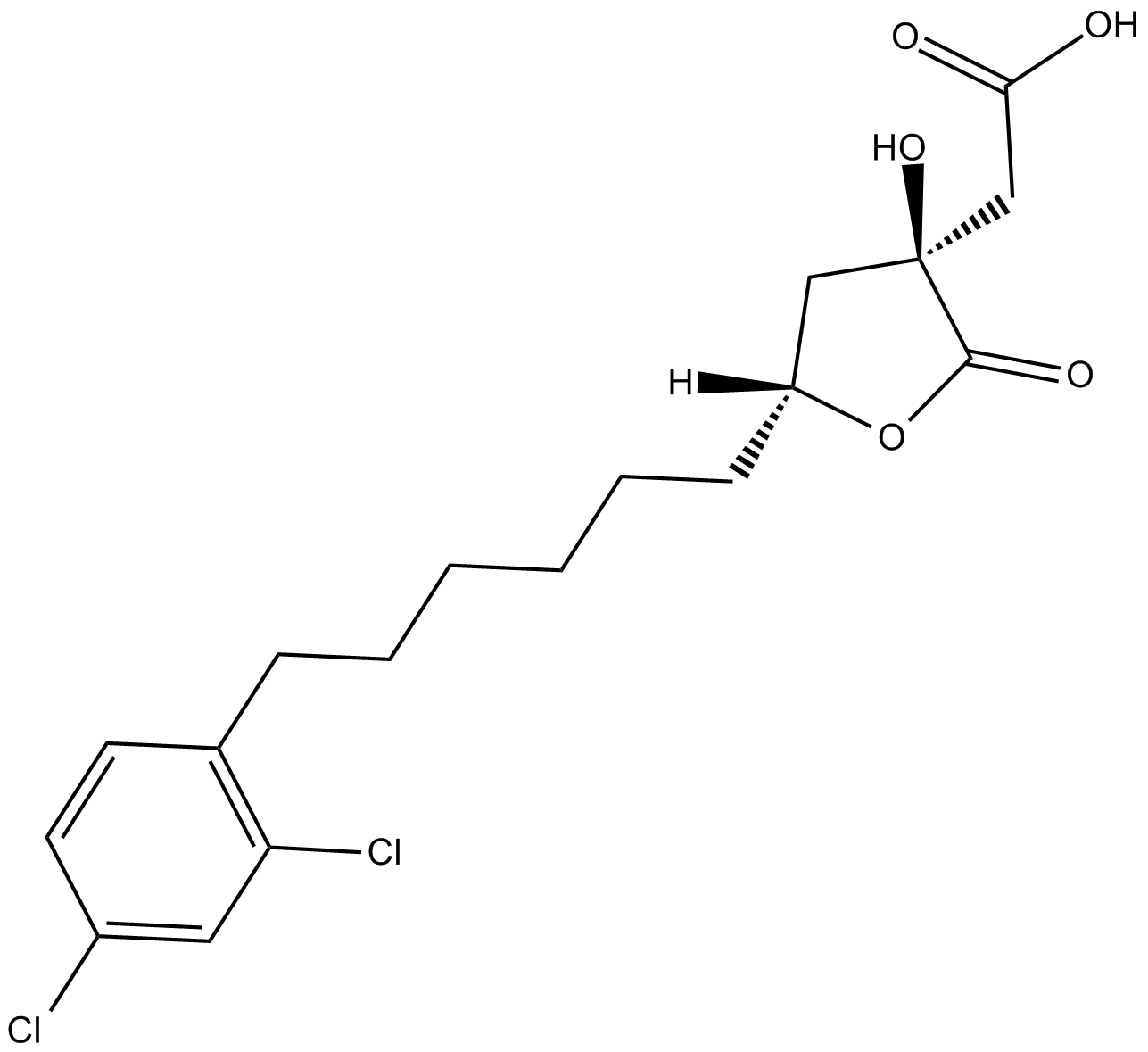
SB 204990, a lactone prodrug, potently inhibits ATP citrate-lyase.
Products are for research use only. Not for human use. We do not sell to patients.
Cas No.: 154566-12-8
Sample solution is provided at 25 µL, 10mM.
_1-3.$$$39978408@51.jpg');)
_1-9.$$$38538795@65.jpg');)
_1-9.$$$39112701@51.jpg');)
_1-7.$$$37316672@70.jpg');)
_366-372.$$$36198801@70.jpg');)
.$$$38565142@65.jpg');)
_1867-1883.$$$33248023@67.jpg');)
_eads6055.$$$39977546@45.jpg');)
_eadm9805.$$$40080571@45.jpg');)
_eadj3020.$$$39666821@45.jpg');)
_1-20.$$$39757301@28.jpg');)
_1-24.$$$38898113@28.jpg');)
_273-287.$$$36806353@46.jpg');)
_1-16.$$$37156877@44.jpg');)
_1-19.$$$37460805@44.jpg');)
_1291-1307.$$$34518654@46.jpg');)
SB 204990, a lactone prodrug, potently inhibits ATP citrate-lyase [1]. SB 204990 reduces plasma cholesterol levels and triglyceride levels in animals by inhibiting ATP citrate lyase[2]. SB 204990 has been widely used in animal models to regulate the renal dysfunction induced by obesity and type 2 diabetes[3].
In vitro, SB 204990 treatment for 24 hours effectively inhibited the replication of SARS-CoV-2 WT, Delta, and Omicron variants in Caco2 cells, with IC50 values of 15.7µM, 13.1µM and 11.7µM, respectively[4]. SB 204990 treatment (40µM) for 24h significantly inhibited MDA-MB-231 cell viability in a glutamine-deficient medium[5]. Treatment with 100µM SB 204990 for 48 hours reversed galactose-induced β-Catenin activity and inhibited MC3T3 E1 cell differentiation into osteoblasts[6]. Treatment with 30µM SB 204990 for 48 hours inhibited TGF-β-stimulated proliferation and fibrin expression in cultured human cardiac fibroblasts (HCFs), reduced H3K9 and H3K27 acetylation [7].
In vivo, SB 204990 treatment via intraperitoneal injection at a dose of 135mg/kg/day for 14 days markedly reduced tumor growth in nude mice carrying xenografts of mouse pancreatic ductal cell lines bearing oncogenic K-rasG12D alleles[8]. Oral administration of SB 204990 at a dose of 250mg/kg/day for 15 weeks significantly improved metabolic status and physical health in high-fat diet (HFD)-fed C57BL/6 mice[9].
References:
[1] Pearce N J, Yates J W, Berkhout T A, et al. The role of ATP citrate-lyase in the metabolic regulation of plasma lipids[J]. Biochemical Journal, 1998, 334(1): 113-119.
[2] van Vlijmenº B J M, Pearce N J, Bergö M, et al. Apolipoprotein E* 3-Leiden transgenic mice as a test model for hypolipidaemic drugs[J]. 1998.
[3] Li Y C, Chen Y, Deb D K. ATP‐Citrate Lyase is an Epigenetic Regulator to Promote Nephropathy in Obesity and Type 2 Diabetes[J]. The FASEB Journal, 2018, 32: 720.2-720.2.
[4] Yuen T T T, Chan J F W, Yan B, et al. Targeting ACLY efficiently inhibits SARS-CoV-2 replication[J]. International Journal of Biological Sciences, 2022, 18(12): 4714.
[5] Hatipoglu A, Menon D, Levy T, et al. Inhibiting glutamine utilization creates a synthetic lethality for suppression of ATP citrate lyase in KRas-driven cancer cells[J]. PLoS One, 2022, 17(10): e0276579.
[6] Busch M, White N, Shum L, et al. Active mitochondria support osteogenic differentiation by stimulating β-catenin acetylation[J]. Journal of Biological Chemistry, 2018, 293(41): 16019-16027.
[7] Kuwahara N, Nagao M, Shinohara M, et al. ACLY Promotes Cardiac Fibrosis via the Regulation of DNL and Histone Acetylation[J]. Hypertension, 2025, 82(6): 1116-1128.
[8] Hatzivassiliou G, Zhao F, Bauer D E, et al. ATP citrate lyase inhibition can suppress tumor cell growth[J]. Cancer cell, 2005, 8(4): 311-321.
[9] Sola-García A, Cáliz-Molina M Á, Espadas I, et al. Metabolic reprogramming by Acly inhibition using SB-204990 alters glucoregulation and modulates molecular mechanisms associated with aging[J]. Communications biology, 2023, 6(1): 250.
| Cell experiment [1]: | |
Cell lines | MDA-MB-231 cells |
Preparation Method | MDA-MB-231 cells were cultured in glutamine-free DMEM supplemented with 10% fetal bovine serum (FBS). A total of 5×10⁴ cells/500μl/well were seeded in 24-well plates. After 24 hours, cells were added to treatment medium containing 40μM SB 204990 or vehicle only and incubated at 37°C in 5% CO2, for 12 hours, 24 hours, 48 hours, and 96 hours, respectively. Cells were treated with 125μl XTT for 2h. Then, the samples were analyzed at a wavelength of 450nm. |
Reaction Conditions | 40µM; 12, 24, 48, and 96h |
Applications | SB 204990 significantly inhibited the viability of MDA-MB-231 cells in a time-dependent manner. |
| Animal experiment [2]: | |
Animal models | Athymic nude female mice |
Preparation Method | Mouse pancreatic duct cells bearing oncogenic K-rasG12D alleles were resuspended in PBS at a concentration of 5×10⁷ cells/ml. Tumors were established in athymic nude female mice (8-10 weeks of age) by subcutaneous injection of a 200μl volume of 1×10⁷ cells. Mice with similar tumor sizes were randomly divided into two groups 3-5 weeks after tumor cell injection: an untreated group (injected with vehicle only) and a treated group (injected with SB 204990). Mice were monitored daily until treatment was completed. Body weight and tumor size were measured every 2-3 days. Tumor growth was recorded by measuring (with calipers) the two vertical diameters of the tumor. Tumor mass was calculated by equation 1/2(a×b2), where a is the long diameterand b is the short diameter. Treated mice were intraperitoneally injected with SB 204990 at a dose of 135mg/kg/day for 14 days. |
Dosage form | 135mg/kg/day for 14 days; i.p. |
Applications | SB 204990 treatment remarkably reduced tumor growth in nude mice carrying xenografts of mouse pancreatic ductal cells. |
References: | |
| Cas No. | 154566-12-8 | SDF | |
| Chemical Name | 2-((3S,5R)-5-(6-(2,4-dichlorophenyl)hexyl)-3-hydroxy-2-oxotetrahydrofuran-3-yl)acetic acid | ||
| Canonical SMILES | ClC1=CC(Cl)=C(C=C1)CCCCCC[C@](O2)([H])C[C@](C2=O)(O)CC(O)=O | ||
| Formula | C18H22Cl2O5 | M.Wt | 389.27 |
| Solubility | DMF: 30 mg/ml,DMF:PBS(pH7.2) (1:2): 0.33 mg/ml,DMSO: 20 mg/ml,Ethanol: 1 mg/ml | Storage | Store at -20°C |
| General tips | Please select the appropriate solvent to prepare the stock solution according to the
solubility of the product in different solvents; once the solution is prepared, please store it in
separate packages to avoid product failure caused by repeated freezing and thawing.Storage method
and period of the stock solution: When stored at -80°C, please use it within 6 months; when stored
at -20°C, please use it within 1 month. To increase solubility, heat the tube to 37°C and then oscillate in an ultrasonic bath for some time. |
||
| Shipping Condition | Evaluation sample solution: shipped with blue ice. All other sizes available: with RT, or with Blue Ice upon request. | ||
| Prepare stock solution | |||

|
1 mg | 5 mg | 10 mg |
| 1 mM | 2.5689 mL | 12.8446 mL | 25.6891 mL |
| 5 mM | 513.8 μL | 2.5689 mL | 5.1378 mL |
| 10 mM | 256.9 μL | 1.2845 mL | 2.5689 mL |
Step 1: Enter information below (Recommended: An additional animal making an allowance for loss during the experiment)
 g
μL
g
μL
Step 2: Enter the in vivo formulation (This is only the calculator, not formulation. Please contact us first if there is no in vivo formulation at the solubility Section.)
Calculation results:
Working concentration: mg/ml;
Method for preparing DMSO master liquid: mg drug pre-dissolved in μL DMSO ( Master liquid concentration mg/mL, Please contact us first if the concentration exceeds the DMSO solubility of the batch of drug. )
Method for preparing in vivo formulation: Take μL DMSO master liquid, next addμL PEG300, mix and clarify, next addμL Tween 80, mix and clarify, next add μL saline, mix and clarify.
Method for preparing in vivo formulation: Take μL DMSO master liquid, next add μL Corn oil, mix and clarify.
Note: 1. Please make sure the liquid is clear before adding the next solvent.
2. Be sure to add the solvent(s) in order. You must ensure that the solution obtained, in the previous addition, is a clear solution before proceeding to add the next solvent. Physical methods such as vortex, ultrasound or hot water bath can be used to aid dissolving.
3. All of the above co-solvents are available for purchase on the GlpBio website.
Quality Control & SDS
- View current batch:
- Purity: >99.50% Appearance: A solid
- COA (Certificate of Analysis)
- SDS (Safety Data Sheet)
- Datasheet
Average Rating: 5 (Based on Reviews and 31 reference(s) in Google Scholar.)