

Cambinol (SIRT1/2 Inhibitor IV) (Synonyms: Cambinol,NSC 112546,SIRT1 Inhibitor II,SIRT2 Inhibitor VI) |
Catalog No.GC11716
 One-Click Copy Product Info
|

SIRT1/2 Inhibitor IV is a SIRT1 and SIRT2 inhibitor with IC50 values of 56 μM and 59 μM, respectively. SIRT1/2 Inhibitor IV is a potent brain penetrant neutral sphingomyelinase (N-SMase) inhibitor (exosome inhibitor).
Products are for research use only. Not for human use. We do not sell to patients.
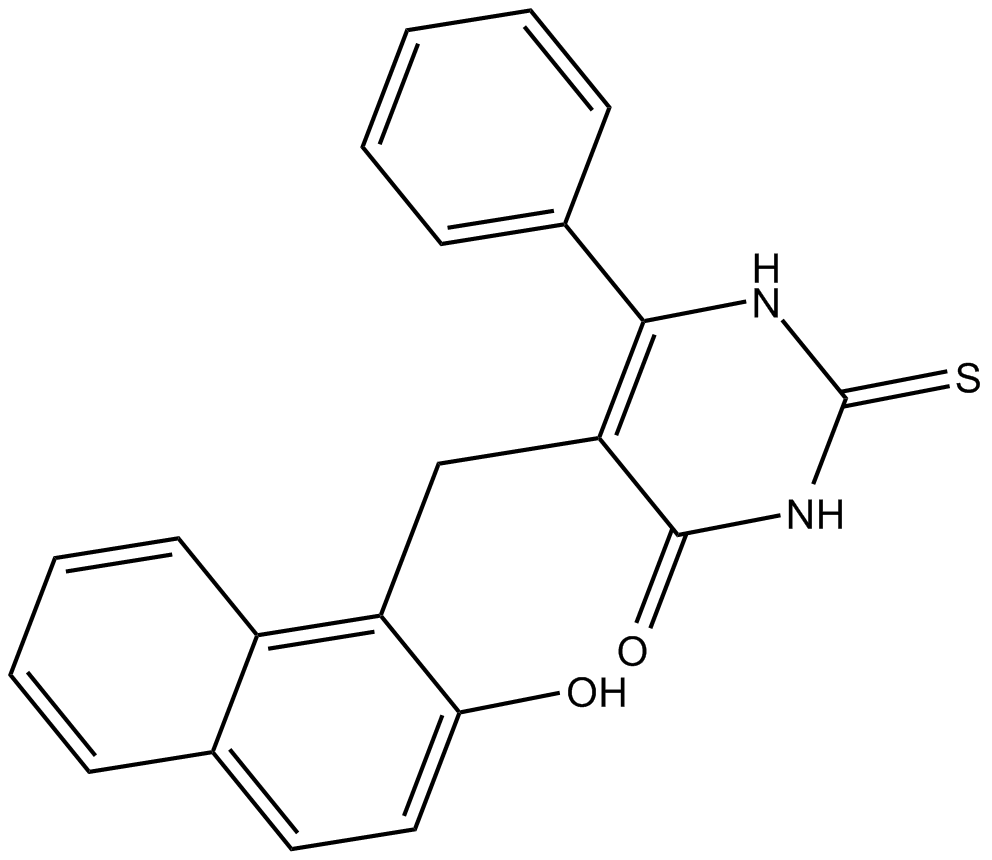
Cas No.: 14513-15-6
Sample solution is provided at 25 µL, 10mM.
_1-3.$$$39978408@51.jpg');)
_1-9.$$$38538795@65.jpg');)
_1-9.$$$39112701@51.jpg');)
_1-7.$$$37316672@70.jpg');)
_366-372.$$$36198801@70.jpg');)
.$$$38565142@65.jpg');)
_1867-1883.$$$33248023@67.jpg');)
_eads6055.$$$39977546@45.jpg');)
_eadm9805.$$$40080571@45.jpg');)
_eadj3020.$$$39666821@45.jpg');)
_1-20.$$$39757301@28.jpg');)
_1-24.$$$38898113@28.jpg');)
_273-287.$$$36806353@46.jpg');)
_1-16.$$$37156877@44.jpg');)
_1-19.$$$37460805@44.jpg');)
_1291-1307.$$$34518654@46.jpg');)
Cambinol (SIRT1/2 Inhibitor IV), a hydroxynaphthol compound, is an inhibitor of SIRT1 and SIRT2, with IC₅₀ values of 56μM and 59μM, respectively. As NAD⁺-dependent deacetylases, SIRT1 and SIRT2 deacetylate key regulatory proteins such as p53 and the BCL6 oncoprotein, playing roles in cellular stress response and tumorigenesis. Cambinol induces hyperacetylation of these stress-responsive proteins, leading to cell cycle arrest and demonstrating antitumor activity[1]. Cambinol also inhibits sphingomyelinase (SMase) as an exosome-inhibiting agent, with an EC₅₀ of 5µM[2].
In vitro, Cambinol (100µM; 16h) inhibited SIRT1 and SIRT2, leading to hyperacetylation of tubulin, p53, and other deacetylation targets of SIRT1 and SIRT2 in NCI-H460 cells[2]. Cambinol (50µM; 8h) promoted etoposide-induced p21 induction in NCI-H460 cells[2]. Cambinol (55µM; 24h) upregulated Mitogen-Activated Protein Kinase Phosphatase 3 (MKP3) expression in premalignant ganglionic cells from TH-MYCN transgenic mice, thereby inhibiting cancer cell growth[3]. Cambinol (20-320μM; 24-48h) inhibited the proliferation of RPMI-8226 and U266 cells in a time- and dose-dependent manner, with 48h IC₅₀ values of approximately 77.24μM and 79.23μM, respectively[4]. Cambinol (80μM; 48h) significantly induced apoptosis and cell cycle arrest in RPMI-8226 and U266 cells[4]. Cambinol (50μM; 5-7d) induced differentiation-like phenotypes in MCF-7, NB4, and 3T3-L1 cells, while promoting lipid droplet formation and modulating differentiation-related proteins (p16, p27, p130, RARs, and PPARγ) in 3T3-L1 cells[5].
In vivo, Cambinol (100mg/kg/day; i.p./i.v.; 10 days) significantly inhibited tumor growth in NOD/SCID mice bearing subcutaneous Daudi xenografts, without notable weight loss[2]. Cambinol (100mg/kg/day; i.p.; 10 days) significantly reduced tumor volume in TH-MYCN transgenic mice[3]. Cambinol (100mg/kg; i.p.; 2 weeks) inhibited tumor growth without affecting the proliferative capacity of normal liver parenchyma in mice harboring HCC xenografts[6].
References:
[1] Heltweg B, Gatbonton T, Schuler AD, et al. Antitumor activity of a small-molecule inhibitor of human silent information regulator 2 enzymes. Cancer Res. 2006;66(8):4368-4377.
[2] Zhang H, Lu J, Liu J, Zhang G, Lu A. Advances in the discovery of exosome inhibitors in cancer. J Enzyme Inhib Med Chem. 2020;35(1):1322-1330.
[3] Marshall GM, Liu PY, Gherardi S, et al. SIRT1 promotes N-Myc oncogenesis through a positive feedback loop involving the effects of MKP3 and ERK on N-Myc protein stability. PLoS Genet. 2011;7(6):e1002135.
[4] Lu B, Zhang D, Wang X, Lin D, Chen Y, Xu X. Targeting SIRT1 to inhibit the proliferation of multiple myeloma cells. Oncol Lett. 2021;21(4):306.
[5] Giordano D, Scafuri B, De Masi L, et al. Sirtuin Inhibitor Cambinol Induces Cell Differentiation and Differently Interferes with SIRT1 and 2 at the Substrate Binding Site. Biomedicines. 2023;11(6):1624.
[6] Portmann S, Fahrner R, Lechleiter A, et al. Antitumor effect of SIRT1 inhibition in human HCC tumor models in vitro and in vivo. Mol Cancer Ther. 2013;12(4):499-508.
| Cell experiment [1]: | |
Cell lines | NCI-H460 cells |
Preparation Method | NCI-H460 cells were grown on coverslips and treated with 100µM Cambinol for 16 hours. Acetylated α-tubulin and α-tubulin, acetylated p53 and total p53 were visualized. |
Reaction Conditions | 100µM; 16h |
Applications | Cambinol caused hyperacetylation of SIRT1 and SIRT2 targets, tubulin and p53. |
| Animal experiment [1]: | |
Animal models | NOD/SCID mouse subcutaneous Daudi xenograft model |
Preparation Method | Cambinol, prepared as 10%/10% ethanol/Cremophore solution to improve solubility, at the dose of 100mg/kg, or vehicle were administered i.v. through tail vein injection or i.p. daily from day 5 to 19 ( five injections per week). |
Dosage form | 100mg/kg/d; i.v. or i.p.; 2 weeks (five injections weekly) |
Applications | No significant weight loss occurred in Cambinol-treated animals relative to controls. Treatment with Cambinol reduced tumor growth relative to mice treated with vehicle alone. |
References: | |
| Cas No. | 14513-15-6 | SDF | |
| Synonyms | Cambinol,NSC 112546,SIRT1 Inhibitor II,SIRT2 Inhibitor VI | ||
| Chemical Name | 2,3-dihydro-5-[(2-hydroxy-1-naphthalenyl)methyl]-6-phenyl-2-thioxo-4(1H)-pyrimidinone | ||
| Canonical SMILES | S=C1NC(C(CC2=C(C=CC=C3)C3=CC=C2O)=C(C4=CC=CC=C4)N1)=O | ||
| Formula | C21H16N2O2S | M.Wt | 360.4 |
| Solubility | DMF: 16 mg/ml,DMSO: 20 mg/ml,DMSO:PBS (pH 7.2) (1:6): 0.14 mg/ml,Ethanol: 0.33 mg/ml | Storage | -20°C, protect from light |
| General tips | Please select the appropriate solvent to prepare the stock solution according to the
solubility of the product in different solvents; once the solution is prepared, please store it in
separate packages to avoid product failure caused by repeated freezing and thawing.Storage method
and period of the stock solution: When stored at -80°C, please use it within 6 months; when stored
at -20°C, please use it within 1 month. To increase solubility, heat the tube to 37°C and then oscillate in an ultrasonic bath for some time. |
||
| Shipping Condition | Evaluation sample solution: shipped with blue ice. All other sizes available: with RT, or with Blue Ice upon request. | ||
| Prepare stock solution | |||

|
1 mg | 5 mg | 10 mg |
| 1 mM | 2.7747 mL | 13.8735 mL | 27.7469 mL |
| 5 mM | 554.9 μL | 2.7747 mL | 5.5494 mL |
| 10 mM | 277.5 μL | 1.3873 mL | 2.7747 mL |
Step 1: Enter information below (Recommended: An additional animal making an allowance for loss during the experiment)
 g
μL
g
μL
Step 2: Enter the in vivo formulation (This is only the calculator, not formulation. Please contact us first if there is no in vivo formulation at the solubility Section.)
Calculation results:
Working concentration: mg/ml;
Method for preparing DMSO master liquid: mg drug pre-dissolved in μL DMSO ( Master liquid concentration mg/mL, Please contact us first if the concentration exceeds the DMSO solubility of the batch of drug. )
Method for preparing in vivo formulation: Take μL DMSO master liquid, next addμL PEG300, mix and clarify, next addμL Tween 80, mix and clarify, next add μL saline, mix and clarify.
Method for preparing in vivo formulation: Take μL DMSO master liquid, next add μL Corn oil, mix and clarify.
Note: 1. Please make sure the liquid is clear before adding the next solvent.
2. Be sure to add the solvent(s) in order. You must ensure that the solution obtained, in the previous addition, is a clear solution before proceeding to add the next solvent. Physical methods such as vortex, ultrasound or hot water bath can be used to aid dissolving.
3. All of the above co-solvents are available for purchase on the GlpBio website.
Quality Control & SDS
- View current batch:
- Purity: >99.00% Appearance: A solid
- COA (Certificate of Analysis)
- SDS (Safety Data Sheet)
- Datasheet
Average Rating: 5 (Based on Reviews and 16 reference(s) in Google Scholar.)