

SR 48692 |
Catalog No.GC13242
 One-Click Copy Product Info
|

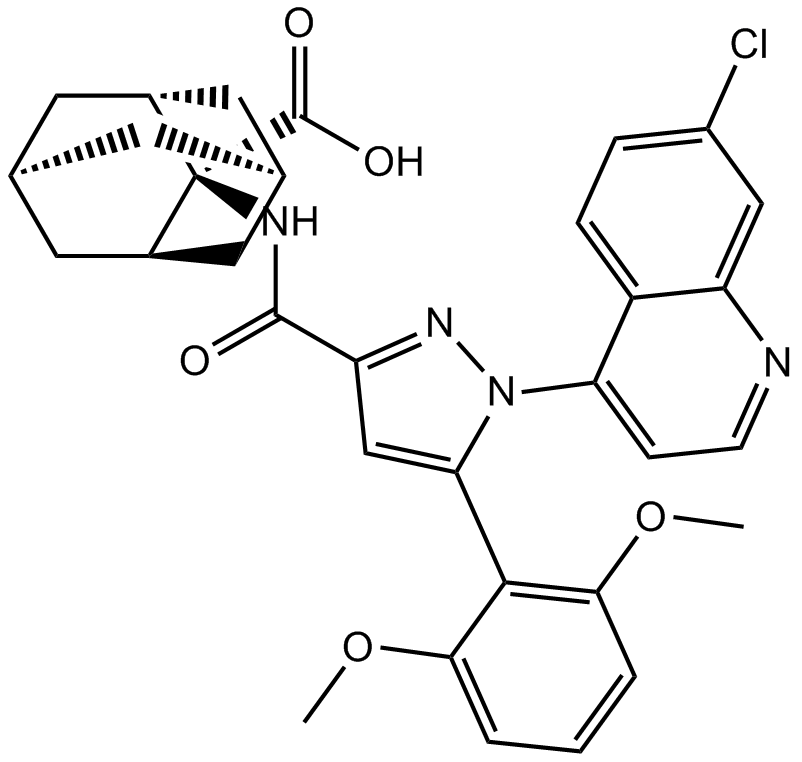
SR 48692 (Meclinertant) is an orally bioavailable, allosteric antagonist of the neuropeptide Y receptor NTS1 (Kd=3.4nM).
Products are for research use only. Not for human use. We do not sell to patients.
Cas No.: 146362-70-1
Sample solution is provided at 25 µL, 10mM.
_1-3.$$$39978408@51.jpg');)
_1-9.$$$38538795@65.jpg');)
_1-9.$$$39112701@51.jpg');)
_1-7.$$$37316672@70.jpg');)
_366-372.$$$36198801@70.jpg');)
.$$$38565142@65.jpg');)
_1867-1883.$$$33248023@67.jpg');)
_eads6055.$$$39977546@45.jpg');)
_eadm9805.$$$40080571@45.jpg');)
_eadj3020.$$$39666821@45.jpg');)
_1-20.$$$39757301@28.jpg');)
_1-24.$$$38898113@28.jpg');)
_273-287.$$$36806353@46.jpg');)
_1-16.$$$37156877@44.jpg');)
_1-19.$$$37460805@44.jpg');)
_1291-1307.$$$34518654@46.jpg');)
SR 48692 (Meclinertant) is an orally bioavailable, allosteric antagonist of the neuropeptide Y receptor NTS1 (Kd=3.4nM)[1, 2]. SR 48692 is the first non-peptide antagonist developed for NTS1, used in scientific research to explore the interactions of neuropeptide Y with other neurotransmitters in the brain[3]. SR 48692 enhances the sensitivity of ovarian cancer cells and experimental tumors to carboplatin[4]. SR 48692, when administered chronically via a central cannula to the paraventricular nucleus (PVN) of the hypothalamus, effectively attenuated the increase in central HPA axis activity caused by circadian rhythm fluctuations and stress responses[5].
In vitro, treatment of A375 melanoma cells with SR 48692 (5μM) for 1-4 days significantly inhibited neuropeptide-induced cell proliferation, inducing cell cycle arrest and apoptosis[6]. SR 48692 (5μM) also antagonized neuropeptide-induced increases in cytosolic Ca2+ in NCI-H209 cells[7].
In vivo, oral administration of SR 48692 (25mg/kg/day) for 5 days significantly inhibited tumor growth in mice bearing human prostate cancer cells (PC-3M-Luc cells) xenografts, and showed synergistic anti-tumor activity when combined with radiotherapy[8].
References:
[1] Gully D, Canton M, Boigegrain R, et al. Biochemical and pharmacological profile of a potent and selective nonpeptide antagonist of the neurotensin receptor[J]. Proceedings of the National Academy of Sciences, 1993, 90(1): 65-69.
[2] Labbe-Jullie C, Botto J M, Mas M V, et al. [3H] SR 48692, the first nonpeptide neurotensin antagonist radioligand: characterization of binding properties and evidence for distinct agonist and antagonist binding domains on the rat neurotensin receptor[J]. Molecular pharmacology, 1995, 47(5): 1050-1056.
[3] Iyer M R, Kunos G. Therapeutic approaches targeting the neurotensin receptors[J]. Expert Opinion on Therapeutic Patents, 2021, 31(5): 361-386.
[4] Liu J, Agopiantz M, Poupon J, et al. Neurotensin receptor 1 antagonist SR48692 improves response to carboplatin by enhancing apoptosis and inhibiting drug efflux in ovarian cancer[J]. Clinical Cancer Research, 2017, 23(21): 6516-6528.
[5] Rowe W B, Nicot A, Sharma S, et al. Central administration of the neurotensin receptor antagonist, SR48692, modulates diurnal and stress-related hypothalamic-pituitary-adrenal activity[J]. Neuroendocrinology, 1997, 66(2): 75-85.
[6] Zhang Y, Zhu S, Yi L, et al. Neurotensin receptor1 antagonist SR48692 reduces proliferation by inducing apoptosis and cell cycle arrest in melanoma cells[J]. Molecular and cellular biochemistry, 2014, 389(1): 1-8.
[7] Moody T W, Chiles J, Casibang M, et al. SR48692 is a neurotensin receptor antagonist which inhibits the growth of small cell lung cancer cells[J]. Peptides, 2001, 22(1): 109-115.
[8] Valerie N C K, Casarez E V, DaSilva J O, et al. Inhibition of neurotensin receptor 1 selectively sensitizes prostate cancer to ionizing radiation[J]. Cancer research, 2011, 71(21): 6817-6826.
| Cell experiment [1]: | |
|
Cell lines |
A375 melanoma cells |
|
Preparation Method |
A375 melanoma cells were treated with 0.01μM neurotensin (NTS) and 0.01μM+5μM SR 48692 seprately, DMSO was used as a control. OD570nm was measured daily from 1 to 4 days. |
|
Reaction Conditions |
5μM; 1-4 days |
|
Applications |
SR48692 can inhibit cell proliferation induced by NTS. |
| Animal experiment [2]: | |
|
Animal models |
Male athymic nude mice |
|
Preparation Method |
Human PC-3M-luc-C6 cells were used in an orthotopic xenograft model in male athymic nude mice. Surgery was conducted to expose the prostate, and 20μL of the tumor cell suspension (5×10⁵ cells) was injected into the dorsolateral lobe of the prostate gland. Following closure, mice were treated with SR 48692 (25mg/kg in PEG800) or vehicle control for 5 consecutive days. Drug was administered orally in 0.2mL volumes 4h prior to radiation treatments. Mice were then anesthetized with a ketamine/xylazine mix, and a dose of 2.5 Gy X-ray was given to the prostate area while shielding the body with lead. Animals were imaged on a weekly basis by anesthetizing with isoflurane before and during imaging and injecting intraperitoneally with luciferin. Animals were imaged at a peak time of 10 to 20min post-luciferin injection via a Xenogen IVIS instrument, using exposure times and sensitivity settings to avoid saturation. Image processing was conducted using Living Image software (Xenogen) by region-of-interest analysis of total photons/sec for each tumor, with appropriate background subtraction. |
|
Dosage form |
25mg/kg/day; 5 days; p.o. |
|
Applications |
Combined treatment of SR 48692 with radiation elicits synergistic antitumor activity against PC-3M tumor xenografts in mice. |
|
References: |
|
| Cas No. | 146362-70-1 | SDF | |
| Chemical Name | (1R,2R,3R,5S,7S)-2-(1-(7-chloroquinolin-4-yl)-5-(2,6-dimethoxyphenyl)-1H-pyrazole-3-carboxamido)adamantane-2-carboxylic acid | ||
| Canonical SMILES | ClC1=CC=C2C(N3N=C(C=C3C(C(OC)=CC=C4)=C4OC)C(N[C@]5(C(O)=O)[C@H]6C[C@H]7C[C@H]5C[C@H](C7)C6)=O)=CC=NC2=C1 | ||
| Formula | C32H31ClN4O5 | M.Wt | 587.07 |
| Solubility | DMSO: 20 mM | Storage | Store at -20°C |
| General tips | Please select the appropriate solvent to prepare the stock solution according to the
solubility of the product in different solvents; once the solution is prepared, please store it in
separate packages to avoid product failure caused by repeated freezing and thawing.Storage method
and period of the stock solution: When stored at -80°C, please use it within 6 months; when stored
at -20°C, please use it within 1 month. To increase solubility, heat the tube to 37°C and then oscillate in an ultrasonic bath for some time. |
||
| Shipping Condition | Evaluation sample solution: shipped with blue ice. All other sizes available: with RT, or with Blue Ice upon request. | ||
| Prepare stock solution | |||

|
1 mg | 5 mg | 10 mg |
| 1 mM | 1.7034 mL | 8.5169 mL | 17.0337 mL |
| 5 mM | 340.7 μL | 1.7034 mL | 3.4067 mL |
| 10 mM | 170.3 μL | 851.7 μL | 1.7034 mL |
Step 1: Enter information below (Recommended: An additional animal making an allowance for loss during the experiment)
 g
μL
g
μL
Step 2: Enter the in vivo formulation (This is only the calculator, not formulation. Please contact us first if there is no in vivo formulation at the solubility Section.)
Calculation results:
Working concentration: mg/ml;
Method for preparing DMSO master liquid: mg drug pre-dissolved in μL DMSO ( Master liquid concentration mg/mL, Please contact us first if the concentration exceeds the DMSO solubility of the batch of drug. )
Method for preparing in vivo formulation: Take μL DMSO master liquid, next addμL PEG300, mix and clarify, next addμL Tween 80, mix and clarify, next add μL saline, mix and clarify.
Method for preparing in vivo formulation: Take μL DMSO master liquid, next add μL Corn oil, mix and clarify.
Note: 1. Please make sure the liquid is clear before adding the next solvent.
2. Be sure to add the solvent(s) in order. You must ensure that the solution obtained, in the previous addition, is a clear solution before proceeding to add the next solvent. Physical methods such as vortex, ultrasound or hot water bath can be used to aid dissolving.
3. All of the above co-solvents are available for purchase on the GlpBio website.
Quality Control & SDS
- View current batch:
- Purity: >98.00% Appearance: A solid
- COA (Certificate of Analysis)
- SDS (Safety Data Sheet)
- Datasheet
Average Rating: 5 (Based on Reviews and 1 reference(s) in Google Scholar.)