

SR9011 |
Catalog No.GC17310
 One-Click Copy Product Info
|

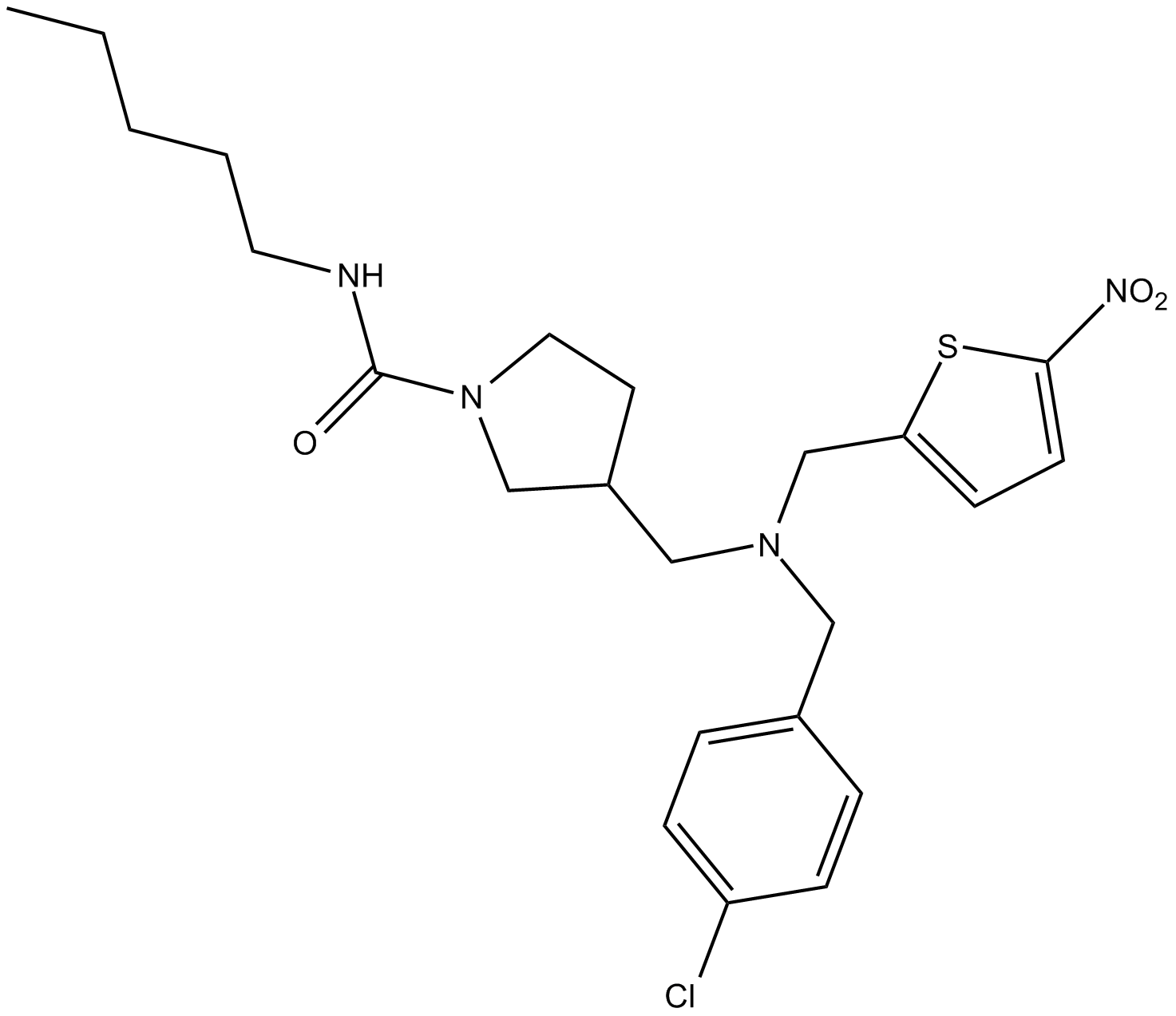
REV-ERB-α/β agonist
Products are for research use only. Not for human use. We do not sell to patients.
Cas No.: 1379686-29-9
Sample solution is provided at 25 µL, 10mM.
_1-3.$$$39978408@51.jpg');)
_1-9.$$$38538795@65.jpg');)
_1-9.$$$39112701@51.jpg');)
_1-7.$$$37316672@70.jpg');)
_366-372.$$$36198801@70.jpg');)
.$$$38565142@65.jpg');)
_1867-1883.$$$33248023@67.jpg');)
_eads6055.$$$39977546@45.jpg');)
_eadm9805.$$$40080571@45.jpg');)
_eadj3020.$$$39666821@45.jpg');)
_1-20.$$$39757301@28.jpg');)
_1-24.$$$38898113@28.jpg');)
_273-287.$$$36806353@46.jpg');)
_1-16.$$$37156877@44.jpg');)
_1-19.$$$37460805@44.jpg');)
_1291-1307.$$$34518654@46.jpg');)
IC50: 790 nM for REV-ERB-α; 560 nM for REV-ERB-β
SR9011 is a REV-ERB-α/β agonist.
REV-ERB nuclear receptors have a critical role in feedback regulation of the circadian oscillator. Both Bmal1 and Clock are direct REV-ERB target genes and loss of REV-ERB-α alters circadian behaviour.
In vitro: SR9011 dose-dependently increased the REV-ERB-dependent repressor activity assessed in HEK293 cells. In addition, SR9011 potently and efficaciously suppressed transcription in a cotransfection assay using full-length REV-ERB-a along with a luciferase reporter driven by the Bmal1 promoter. SR9011 also suppressed the expression of BMAL1 messenger RNA in HepG2 cells in a REV-ERB-a/b-dependent manner. Moreover, SR9011 inhibited the activity of the SCNclock, with reversible inhibition of circadian oscillations [1].
In vivo: In the mice under constant darkness conditions, it was observed that the SR9011-dependent decrease in wheel running behaviour was dose-dependent and that the potency (half-maximum effective dose 56 mg/kg) was similar to the potency of SR9011-mediated suppression of a REV-ERB responsive gene, Srebf1, in vivo. Moreover, Tau was not affected by treatment with SR9011, and the recovery after the drug to resume the normal rhythm was similar to the effect observed after removal of the drug from the SCN explants [1].
Clinical trial: Up to now, SR9011 is still in the preclinical development stage.
Reference:
[1] Solt LA,Wang Y,Banerjee S,Hughes T,Kojetin DJ,Lundasen T,Shin Y,Liu J,Cameron MD,Noel R,Yoo SH,Takahashi JS,Butler AA,Kamenecka TM,Burris TP. Regulation of circadian behaviour and metabolism by synthetic REV-ERB agonists. Nature.2012 Mar 29;485(7396):62-8.
|
Cell experiment: |
MCF10A, MDA-MB-231, MCF-7, MDA-MB-361, SKBR3, BT474 cells are plated in 6-well plates one day before treatment. The MTT cell proliferation assays are performed. Briefly, 3×10³ to 5 × 10³ cells per well are plated in 96-well plates. Twenty-four hours later, cells are treated with SR9011 (0, 2, 4, 6, 8 and 10 μM) or DMSO. Seventy-two hours after treatment, the cells are labeled with 1.2 mM MTT and incubated for 4 hours. DMSO is then added and readings are taken on a plate reader at 540 nm[2]. |
|
Animal experiment: |
Mice[1] For circadian gene expression experiments male C57BL6 mice (8-10 weeks of age) are either maintained on a L:D (12h:12h) cycle or on constant darkness. At circadian time (CT) 0 animals are administered a single dose of 100 mg/kg SR9011 (i.p.) and groups of animals (n=6) are sacrificed at CT0, CT6, CT12 and CT18. Gene expression is determined by real time QPCR. |
|
References: [1]. Solt LA, et al. Regulation of circadian behaviour and metabolism by synthetic REV-ERB agonists. Nature. 2012 Mar 29;485(7396):62-8. |
|
| Cas No. | 1379686-29-9 | SDF | |
| Chemical Name | 3-(((4-chlorobenzyl)((5-nitrothiophen-2-yl)methyl)amino)methyl)-N-pentylpyrrolidine-1-carboxamide | ||
| Canonical SMILES | CCCCCNC(N1CCC(C1)CN(CC(S2)=CC=C2[N+]([O-])=O)CC3=CC=C(Cl)C=C3)=O | ||
| Formula | C23H31ClN4O3S | M.Wt | 479.04 |
| Solubility | ≥ 47.9mg/mL in DMSO | Storage | Store at -20°C |
| General tips | Please select the appropriate solvent to prepare the stock solution according to the
solubility of the product in different solvents; once the solution is prepared, please store it in
separate packages to avoid product failure caused by repeated freezing and thawing.Storage method
and period of the stock solution: When stored at -80°C, please use it within 6 months; when stored
at -20°C, please use it within 1 month. To increase solubility, heat the tube to 37°C and then oscillate in an ultrasonic bath for some time. |
||
| Shipping Condition | Evaluation sample solution: shipped with blue ice. All other sizes available: with RT, or with Blue Ice upon request. | ||
| Prepare stock solution | |||

|
1 mg | 5 mg | 10 mg |
| 1 mM | 2.0875 mL | 10.4375 mL | 20.8751 mL |
| 5 mM | 417.5 μL | 2.0875 mL | 4.175 mL |
| 10 mM | 208.8 μL | 1.0438 mL | 2.0875 mL |
Step 1: Enter information below (Recommended: An additional animal making an allowance for loss during the experiment)
 g
μL
g
μL
Step 2: Enter the in vivo formulation (This is only the calculator, not formulation. Please contact us first if there is no in vivo formulation at the solubility Section.)
Calculation results:
Working concentration: mg/ml;
Method for preparing DMSO master liquid: mg drug pre-dissolved in μL DMSO ( Master liquid concentration mg/mL, Please contact us first if the concentration exceeds the DMSO solubility of the batch of drug. )
Method for preparing in vivo formulation: Take μL DMSO master liquid, next addμL PEG300, mix and clarify, next addμL Tween 80, mix and clarify, next add μL saline, mix and clarify.
Method for preparing in vivo formulation: Take μL DMSO master liquid, next add μL Corn oil, mix and clarify.
Note: 1. Please make sure the liquid is clear before adding the next solvent.
2. Be sure to add the solvent(s) in order. You must ensure that the solution obtained, in the previous addition, is a clear solution before proceeding to add the next solvent. Physical methods such as vortex, ultrasound or hot water bath can be used to aid dissolving.
3. All of the above co-solvents are available for purchase on the GlpBio website.
Quality Control & SDS
- View current batch:
- Purity: >99.50% Appearance: A solid
- COA (Certificate of Analysis)
- SDS (Safety Data Sheet)
- Datasheet
Average Rating: 5 (Based on Reviews and 7 reference(s) in Google Scholar.)