

SU 5402 |
Catalog No.GC14660
 One-Click Copy Product Info
|

SU 5402 is a multi-targeted receptor tyrosine kinase inhibitor that inhibit against vascular endothelial growth factor receptor 2 (VEGF-R2) and fibroblast growth factor receptor 1 (FGF-R1) tyrosine kinase activity with IC50 values of 20 and 30nM, respectively.
Products are for research use only. Not for human use. We do not sell to patients.
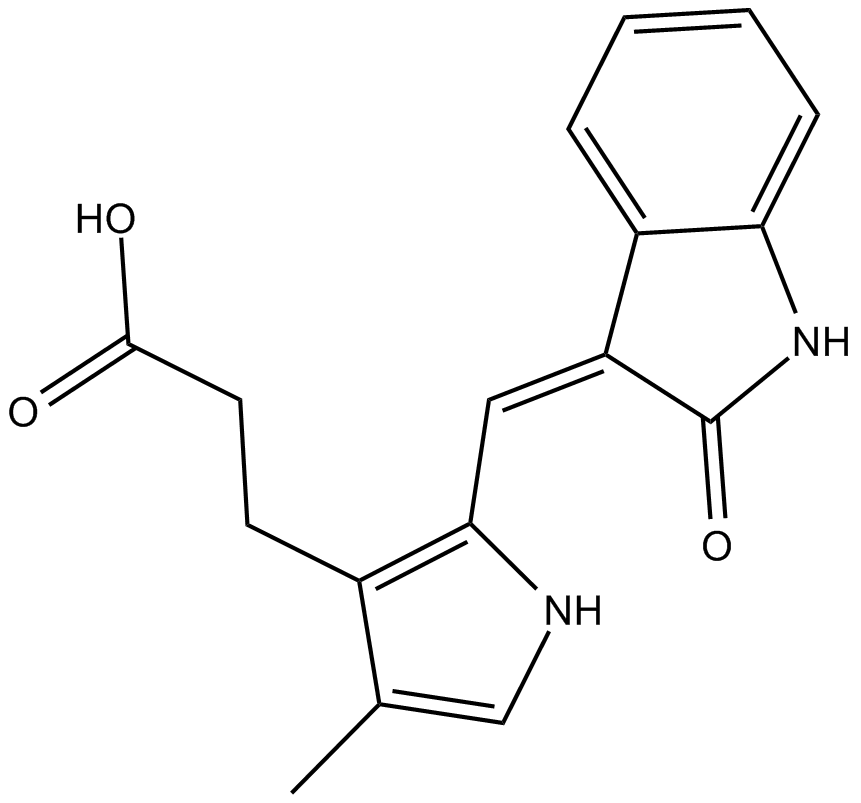
Cas No.: 215543-92-3
Sample solution is provided at 25 µL, 10mM.
_1-3.$$$39978408@51.jpg');)
_1-9.$$$38538795@65.jpg');)
_1-9.$$$39112701@51.jpg');)
_1-7.$$$37316672@70.jpg');)
_366-372.$$$36198801@70.jpg');)
.$$$38565142@65.jpg');)
_1867-1883.$$$33248023@67.jpg');)
_eads6055.$$$39977546@45.jpg');)
_eadm9805.$$$40080571@45.jpg');)
_eadj3020.$$$39666821@45.jpg');)
_1-20.$$$39757301@28.jpg');)
_1-24.$$$38898113@28.jpg');)
_273-287.$$$36806353@46.jpg');)
_1-16.$$$37156877@44.jpg');)
_1-19.$$$37460805@44.jpg');)
_1291-1307.$$$34518654@46.jpg');)
SU 5402 is a multi-targeted receptor tyrosine kinase inhibitor that inhibit against vascular endothelial growth factor receptor 2 (VEGF-R2) and fibroblast growth factor receptor 1 (FGF-R1) tyrosine kinase activity with IC50 values of 20 and 30nM, respectively[1]. SU 5402 also acts as a FGF-2 inhibitor with an IC50 value of 9µM and produces concentration-dependent reductions in FGF-2 enhancement of granule neuron survival[2].
In vitro, SU 5402 (10μM) pretreated human breast cancer T47D cells for 20min before 10ng/mL bFGF stimulation effectively blocked the binding of bFGF to its receptor FGFR, thereby inhibiting the activation of downstream signaling pathways induced by bFGF. SU 5402 indirectly affects the activation of the PI3K/Akt and MAPK signaling pathways by selectively inhibiting FGFR, thereby effectively suppressing bFGF induced hypoxia-inducible factor (HIF-1α) expression[3]. SU 5402 (20μM) applied on thyroid cancer FTC133 cells for 4h inhibited the phosphorylation of LDHA and PKM2, which was elevated in all analysed cancer subtypes[4]. SU 5402 (10μM) treatment on murine mesenchymal stem cell line C3H10T1/2 cells cultured in osteoblast medium for 2 weeks with 2,000pg/mL fibroblast growth factor 23 (FGF23) diminished the bone-derived effects of FGF23[5].
In vivo, SU 5402 (3μg; 1μL) injected into the lateral ventricle of ICR mice 1h prior to daily oral gavage of paeoniflorin (40mg/kg) for 7 days prevented the antidepressant effects of paeoniflorin and blocked the neuroinflammatory and neurogenic regulatory effects of paeoniflorin[6]. SU 5402 (25mg/kg/day) administrated into monocrotaline-induced pulmonary hypertension (PH) rat model via daily s.c. injection from day 21 to day 42 reversed established monocrotaline-induced PH in rats, decreased the values of pulmonary artery pressure, right ventricular hypertrophy, and peripheral artery muscularization to the levels observed in vehicle-treated rats[7].
References:
[1] Sun L, Liang C X, Tang F, et al. Design, synthesis, and evaluations of substituted 3-[(3- or 4-carboxyethylpyrrol-2-yl)methylidenyl]indolin-2-ones as inhibitors of VEGF, FGF, and PDGF receptor tyrosine kinases. J Med Chem. 1999 Dec 16;42(25):5120-30.
[2] Skaper S D, Kee W J, Facci L, et al. The FGFR1 inhibitor PD 173074 selectively and potently antagonizes FGF-2 neurotrophic and neurotropic effects. J Neurochem. 2000 Oct;75(4):1520-7.
[3] Zhang C C, Yu J X, Li S F, et al. Effect of basic fibroblast growth factor on hypoxia-inducible factor (HIF)-1α expression (Exp) and HIF-1 transcription in breast Cancer cell through PI-3 K Akt signaling. Cytokine. 2025 Mar:187:156859.
[4] Kachel P, Trojanowicz B, Sekulla C, et al. Phosphorylation of pyruvate kinase M2 and lactate dehydrogenase A by fibroblast growth factor receptor 1 in benign and malignant thyroid tissue. BMC Cancer. 2015 Mar 18;15:140.
[5] Li Y, He X, Olauson H, Larsson T E, Lindgren U. FGF23 affects the lineage fate determination of mesenchymal stem cells. Calcif Tissue Int. 2013 Dec;93(6):556-64.
[6] Cheng J, Chen M, Wan H Q, et al. Paeoniflorin exerts antidepressant-like effects through enhancing neuronal FGF-2 by microglial inactivation. J Ethnopharmacol. 2021 Jun 28:274:114046.
[7] Izikki M, Guignabert C, Fadel E, et al. Endothelial-derived FGF2 contributes to the progression of pulmonary hypertension in humans and rodents. J Clin Invest. 2009 Mar;119(3):512-23.
| Cell experiment [1]: | |
Cell lines | Human breast cancer T47D cells |
Preparation Method | After serum starvation for 24h, T47D cells were pretreated with SU 5402 (10μM) for 20min and 10ng/mL bFGF was applied for 18h for stimulation. |
Reaction Conditions | 10μM; 20min |
Applications | SU 5402 effectively blocked the binding of bFGF to its receptor FGFR, thereby inhibiting the activation of downstream signaling pathways induced by bFGF. SU 5402 indirectly affects the activation of the PI3K/Akt and MAPK signaling pathways by selectively inhibiting FGFR, thereby effectively suppressing bFGFinduced hypoxia-inducible factor (HIF-1α) expression. |
| Animal experiment [2]: | |
Animal models | Adult male Wistar rats |
Preparation Method | Adult male Wistar rats (200–250g) were given monocrotaline (60mg/kg; s.c.), left untreated for 21 days, then randomly divided into 2 groups, of which one was treated with SU 5402 (25mg/kg) and the other given the vehicle, from day 21 to day 42. All treatments were given once a day by s.c. injection. |
Dosage form | 25mg/kg; s.c.; daily from day 21 to day 42 |
Applications | SU 5402 reversed established monocrotaline-induced pulmonary hypertension in rats, decreasing the values of pulmonary artery pressure, right ventricular hypertrophy, and peripheral artery muscularization to the levels observed in vehicle-treated rats. |
References: | |
| Cas No. | 215543-92-3 | SDF | |
| Chemical Name | 3-[4-methyl-2-[(Z)-(2-oxo-1H-indol-3-ylidene)methyl]-1H-pyrrol-3-yl]propanoic acid | ||
| Canonical SMILES | CC1=CNC(=C1CCC(=O)O)C=C2C3=CC=CC=C3NC2=O | ||
| Formula | C17H16N2O3 | M.Wt | 296.33 |
| Solubility | ≥ 14.8 mg/mL in DMSO | Storage | Store at -20°C |
| General tips | Please select the appropriate solvent to prepare the stock solution according to the
solubility of the product in different solvents; once the solution is prepared, please store it in
separate packages to avoid product failure caused by repeated freezing and thawing.Storage method
and period of the stock solution: When stored at -80°C, please use it within 6 months; when stored
at -20°C, please use it within 1 month. To increase solubility, heat the tube to 37°C and then oscillate in an ultrasonic bath for some time. |
||
| Shipping Condition | Evaluation sample solution: shipped with blue ice. All other sizes available: with RT, or with Blue Ice upon request. | ||
| Prepare stock solution | |||

|
1 mg | 5 mg | 10 mg |
| 1 mM | 3.3746 mL | 16.8731 mL | 33.7462 mL |
| 5 mM | 674.9 μL | 3.3746 mL | 6.7492 mL |
| 10 mM | 337.5 μL | 1.6873 mL | 3.3746 mL |
Step 1: Enter information below (Recommended: An additional animal making an allowance for loss during the experiment)
 g
μL
g
μL
Step 2: Enter the in vivo formulation (This is only the calculator, not formulation. Please contact us first if there is no in vivo formulation at the solubility Section.)
Calculation results:
Working concentration: mg/ml;
Method for preparing DMSO master liquid: mg drug pre-dissolved in μL DMSO ( Master liquid concentration mg/mL, Please contact us first if the concentration exceeds the DMSO solubility of the batch of drug. )
Method for preparing in vivo formulation: Take μL DMSO master liquid, next addμL PEG300, mix and clarify, next addμL Tween 80, mix and clarify, next add μL saline, mix and clarify.
Method for preparing in vivo formulation: Take μL DMSO master liquid, next add μL Corn oil, mix and clarify.
Note: 1. Please make sure the liquid is clear before adding the next solvent.
2. Be sure to add the solvent(s) in order. You must ensure that the solution obtained, in the previous addition, is a clear solution before proceeding to add the next solvent. Physical methods such as vortex, ultrasound or hot water bath can be used to aid dissolving.
3. All of the above co-solvents are available for purchase on the GlpBio website.
Quality Control & SDS
- View current batch:
- Purity: >98.00% Appearance: A solid
- COA (Certificate of Analysis)
- SDS (Safety Data Sheet)
- Datasheet
Average Rating: 5 (Based on Reviews and 30 reference(s) in Google Scholar.)