

TAK-715 |
Catalog No.GC16543
 One-Click Copy Product Info
|

TAK-715 is a potent, selective, and orally active p38 mitogen-activated protein kinase (p38 MAPK) inhibitor, with IC50 values of 7.1nM and 200nM for p38α and p38β, respectively.
Products are for research use only. Not for human use. We do not sell to patients.
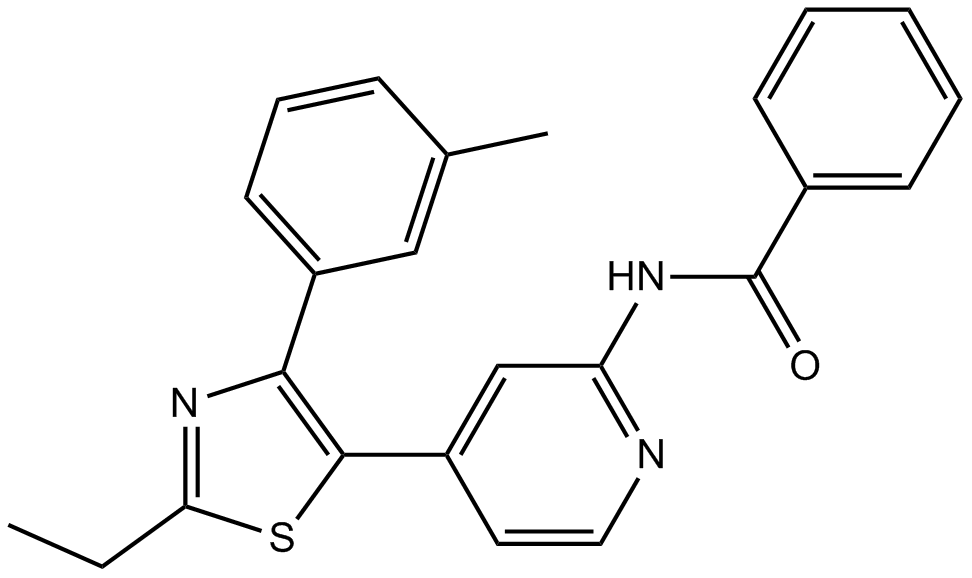
Cas No.: 303162-79-0
Sample solution is provided at 25 µL, 10mM.
TAK-715 is a potent, selective, and orally active p38 mitogen-activated protein kinase (p38 MAPK) inhibitor, with IC50 values of 7.1nM and 200nM for p38α and p38β, respectively[1]. The p38 MAPK pathway is a key regulator of pro-inflammatory cytokine biosynthesis at both transcriptional and translational levels and plays a critical role in the initiation and progression of inflammation[2]. TAK-715 is commonly used in the treatment and research of inflammatory diseases such as rheumatoid arthritis, as well as diseases related to lipid accumulation and tissue degeneration[1,3].
In vitro, pretreatment of rat nucleus pulposus cells (NPCs) with TAK-715 (0.5-1μM) for 2h followed by co-treatment with IL-1β for 48h significantly reduced the expression of pro-inflammatory factors COX-2 and HMGB1, suppressed the expression of apoptosis-related proteins Bax and cleaved-caspase 3, and up-regulated the anti-apoptotic protein Bcl-2[4]. Treatment of 3T3-L1 preadipocytes with TAK-715 (10μM) for 8 days significantly suppressed lipid droplet accumulation and intracellular triglyceride content without cytotoxicity[5]. Treatment of melanoma A375 cell line with TAK-715 (25μM) for 24h reduced cell viability in a dose-dependent manner[6].
In vivo, pretreatment of BALB/c mice in a transfusion-related acute lung injury (TRALI) model with TAK-715 (10mg/kg; i.p.) 1h before injection of an MHC-I monoclonal antibody (mAb) effectively reduced MAPK phosphorylation and TLR3 expression, and significantly inhibited the levels of multiple inflammatory cytokines and mast cell activation[7]. Intradiscal injection of TAK-715 (1μM; 5μL) into an SD rat model of disc degeneration induced by caudal vertebral puncture improved magnetic resonance imaging (MRI) signal intensity after 8 weeks and exerted beneficial effects on the tissue of the inner nucleus pulposus[4].
References:
[1] MIWATASHI S, ARIKAWA Y, KOTANI E, et al. Novel inhibitor of p38 MAP kinase as an anti-TNF-α drug: discovery of N-[4-[2-ethyl-4-(3-methylphenyl)-1, 3-thiazol-5-yl]-2-pyridyl] benzamide (TAK-715) as a potent and orally active anti-rheumatoid arthritis agent[J]. Journal of Medicinal Chemistry, 2005, 48(19): 5966-5979.
[2] SAKLATVALA J. The p38 MAP kinase pathway as a therapeutic target in inflammatory disease[J]. Current Opinion in Pharmacology, 2004, 4(4): 372-377.
[3] LI L, ZHANG G, YANG Z, et al. Stress-activated protein kinases in intervertebral disc degeneration: unraveling the impact of JNK and p38 MAPK[J]. Biomolecules, 2024, 14(4): 393.
[4] WANG K, YAO D, LI Y, et al. TAK-715 alleviated IL-1β-induced apoptosis and ECM degradation in nucleus pulposus cells and attenuated intervertebral disc degeneration ex vivo and in vivo[J]. Arthritis Research & Therapy, 2023, 25(1): 45.
[5] PERUMAL N L, MUFIDA A, YADAV A K, et al. Suppression of lipid accumulation in the differentiation of 3T3-L1 preadipocytes and human adipose stem cells into adipocytes by TAK-715, a specific inhibitor of p38 MAPK[J]. Life, 2023, 13(2): 412.
[6] XIE Y, WANG R, XU M, et al. Potential of CLSPN as a therapeutic target in melanoma: a key player in melanoma progression and tumor microenvironment[J/OL]. Journal of Translational Medicine, 2025, 23(1): 470.
[7] FANG X, SONG T, ZHENG L, et al. Targeting mast cell activation alleviates anti-MHC I antibody and LPS-induced TRALI in mice by pharmacologically blocking the TLR3 and MAPK pathway[J]. Biomedicine & Pharmacotherapy, 2024, 180: 117456.
| Cell experiment [1]: | |
Cell lines | Rat nucleus pulposus cells (NPCs) |
Preparation Method | NPCs were preincubated with TAK-715 (0.5, 1μM) for 2h, and then, IL-1β was added for 48h. Western blot analysis was used to analyze the expression of COX-2 and HMGB1 in NPCs, and the immunoblots of COX-2 and HMGB1 were quantitatively analyzed. |
Reaction Conditions | 0.5 and 1μM; 2h |
Applications | Under IL-1β stimulation, the NPCs expressed significantly higher levels of COX-2 and HMGB1. Nevertheless, TAK-715 dose-dependently inhibited this increase. TAK-715 significantly inhibited IL-1β-induced inflammatory mediator and cytokine production. |
| Animal experiment [2]: | |
Animal models | Antibody-mediated TRALI model in BALB/c mice |
Preparation Method | BALB/c mice were treated with LPS and anti-MHC-I mAb to develop the TRALI model. Mice received i.p. injection of LPS (0.1mg/kg) 24h before the experiment. After 23h, the mice were injected i.p. with TAK-715 (10mg/kg). After 1h, the mice were anesthetized and injected with anti-MHC-I mAb through the tail vein. The mice were sacrificed 2h after the anti-MHC-I mAb injection using 1% pentobarbital sodium solution at 200mg/kg, and blood samples were collected via cardiac puncture. The right lungs were harvested for qPCR, ELISA, and western blotting. |
Dosage form | 10mg/kg; i.p. |
Applications | The western blot and qPCR analyses revealed that pretreatment with TAK-715 effectively suppressed MAPK phosphorylation and TLR3 expression, and significantly inhibited mast cell activation as well as the levels of multiple inflammatory cytokines. |
References: | |
| Cas No. | 303162-79-0 | SDF | |
| Chemical Name | N-[4-[2-ethyl-4-(3-methylphenyl)-1,3-thiazol-5-yl]pyridin-2-yl]benzamide | ||
| Canonical SMILES | CCC1=NC(=C(S1)C2=CC(=NC=C2)NC(=O)C3=CC=CC=C3)C4=CC(=CC=C4)C | ||
| Formula | C24H21N3OS | M.Wt | 399.52 |
| Solubility | ≥ 40mg/mL in DMSO | Storage | Store at -20°C |
| General tips | Please select the appropriate solvent to prepare the stock solution according to the
solubility of the product in different solvents; once the solution is prepared, please store it in
separate packages to avoid product failure caused by repeated freezing and thawing.Storage method
and period of the stock solution: When stored at -80°C, please use it within 6 months; when stored
at -20°C, please use it within 1 month. To increase solubility, heat the tube to 37°C and then oscillate in an ultrasonic bath for some time. |
||
| Shipping Condition | Evaluation sample solution: shipped with blue ice. All other sizes available: with RT, or with Blue Ice upon request. | ||
| Prepare stock solution | |||

|
1 mg | 5 mg | 10 mg |
| 1 mM | 2.503 mL | 12.515 mL | 25.03 mL |
| 5 mM | 500.6 μL | 2.503 mL | 5.006 mL |
| 10 mM | 250.3 μL | 1.2515 mL | 2.503 mL |
Step 1: Enter information below (Recommended: An additional animal making an allowance for loss during the experiment)
 g
μL
g
μL
Step 2: Enter the in vivo formulation (This is only the calculator, not formulation. Please contact us first if there is no in vivo formulation at the solubility Section.)
Calculation results:
Working concentration: mg/ml;
Method for preparing DMSO master liquid: mg drug pre-dissolved in μL DMSO ( Master liquid concentration mg/mL, Please contact us first if the concentration exceeds the DMSO solubility of the batch of drug. )
Method for preparing in vivo formulation: Take μL DMSO master liquid, next addμL PEG300, mix and clarify, next addμL Tween 80, mix and clarify, next add μL saline, mix and clarify.
Method for preparing in vivo formulation: Take μL DMSO master liquid, next add μL Corn oil, mix and clarify.
Note: 1. Please make sure the liquid is clear before adding the next solvent.
2. Be sure to add the solvent(s) in order. You must ensure that the solution obtained, in the previous addition, is a clear solution before proceeding to add the next solvent. Physical methods such as vortex, ultrasound or hot water bath can be used to aid dissolving.
3. All of the above co-solvents are available for purchase on the GlpBio website.
Quality Control & SDS
- View current batch:
- Purity: >98.00% Appearance: A solid
- COA (Certificate of Analysis)
- SDS (Safety Data Sheet)
- Datasheet
Average Rating: 5 (Based on Reviews and 29 reference(s) in Google Scholar.)