

W146 |
Catalog No.GC16621
 One-Click Copy Product Info
|

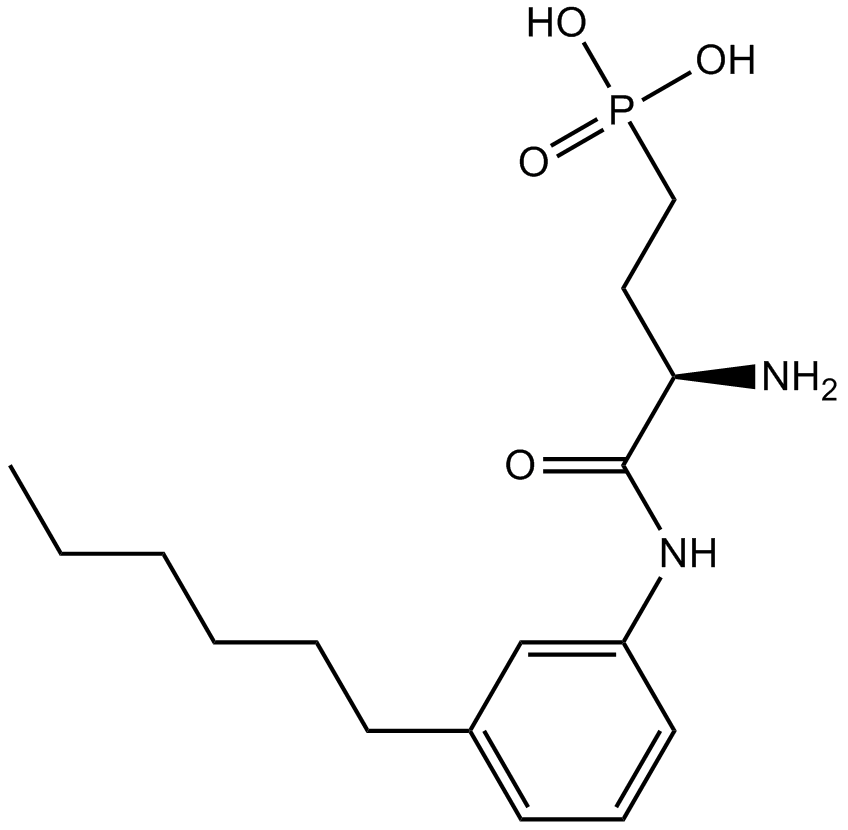
W146 is a selective antagonist of Sphingosine 1-phosphate receptors 1 (S1PR1) with an EC50 value of 398nM.
Products are for research use only. Not for human use. We do not sell to patients.
Cas No.: 909725-61-7
Sample solution is provided at 25 µL, 10mM.
W146 is a selective antagonist of Sphingosine 1-phosphate receptors 1 (S1PR1) with an EC50 value of 398nM[1].W146 is widely used to investigate S1P/S1PR1-mediated biological processes.
In vitro, W146 (10μM) was employed for 30min in HEK293 and CHO-K1 cells stably expressing S1P receptor. W146 completely abolished a water-soluble highly-selective S1PR1 agonist CYM-5442- or S1P-induced S1PR1 internalization, phosphorylation and ubiquitination, and p42/p44 MAPK activation[2]. W146 (1µM) pretreated microglia for 30min before siponimod treatment and then the cells were stimulated with 1µg/mL LPS alone (for 24h) or 1µg/mL LPS (for 3.5h) plus 10µM inflammasome activator nigericin (for the final 30min). Pretreatment with W146 and siponimod significantly suppressed the production of interleukin-1β in activated microglia stimulated with lipopolysaccharide plus nigericin[3].W146 (10μM) was applied to cultured rat fat-pad endothelial cells (RFPECs) and human coronary artery endothelial cells for 10min and then the cells were exposed to S1P or plasma protein-containing media for 2 hours. W146 abolished the protective role of S1P and plasma proteins on the glycocalyx[4].
In vivo, W146 (10mg/kg) was administered intraperitoneally into non fasted Swiss mice and induced a significant but transient blood lymphopenia in mice and a parallel increase in CD4+ and CD8+ lymphocytes in lymph nodes[5].W146 (0.1mg/kg) was administrated into C57BL/6 mice via intraperitoneal injection daily for 3 days before animals subjected to 20 minutes of renal ischemia followed by 24 hours of reperfusion. W146-treated mice exhibited significantly exacerbated renal and hepatic injury[6]. W146 (5mg/kg) injected intraperitoneally 1h before AMD3100 administration significantly enhanced the mobilization of Kit+/Sca-1+/Lin− (KSL) hematopoietic stem and progenitor cells in C57BL/6 mice by approximately 8-fold[7].
References:
[1] M Germana Sanna, et al. Enhancement of capillary leakage and restoration of lymphocyte egress by a chiral S1P1 antagonist in vivo. Nat Chem Biol. 2006 Aug;2(8):434-41. Epub 2006 Jul 9.
[2] Gonzalez-Cabrera P J, Jo E J, Sanna M G, et al. Full pharmacological efficacy of a novel S1P1 agonist that does not require S1P-like headgroup interactions. Mol Pharmacol. 2008 Nov;74(5):1308-18.
[3] Tarrasón G, Aulí M, Mustafa S, et al.The sphingosine-1-phosphate receptor-1 antagonist, W146, causes early and short-lasting peripheral blood lymphopenia in mice. Int Immunopharmacol. 2011 Nov;11(11):1773-9.
[4] Zeng Y, Adamson R H, Curry F R E, Tarbell J M.Sphingosine-1-phosphate protects endothelial glycocalyx by inhibiting syndecan-1 shedding. Am J Physiol Heart Circ Physiol. 2014 Feb;306(3):H363-72.
[5] Tarrasón G, Aulí M, Mustafa S,et al. The sphingosine-1-phosphate receptor-1 antagonist, W146, causes early and short-lasting peripheral blood lymphopenia in mice. Int Immunopharmacol. 2011 Nov;11(11):1773-9.
[6] Ham A, Kim M, Kim J Y, et al. Selective deletion of the endothelial sphingosine-1-phosphate 1 receptor exacerbates kidney ischemia-reperfusion injury. Kidney Int. 2014 Apr;85(4):807-23.
[7] Liu J J, Zhao J W, Lee J F, et al. 3-amino-4-(3-hexylphenylamino)-4-oxobutyl phosphonic acid (W146), a Selective Antagonist of Sphingosine-1-phospahte Receptor Subtype 1, Enhances AMD3100-stimulated Mobilization of Hematopoietic Stem Progenitor Cells in Animals. J Biochem Pharmacol Res. 2013 Dec;1(4):197-203.
| Cell experiment [1]: | |
|
Cell lines |
HEK293 and CHO-K1 cells stably expressing human S1P receptor 1 |
|
Preparation Method |
The cells were incubated for 4h in serum-free DMEM. In the antagonist experiments, W146 were incubated with W146 for 30min at 10μM prior to agonist treatment. |
|
Reaction Conditions |
10μM; 30min |
|
Applications |
W146 completely abolished a water-soluble highly-selective S1PR1 agonist CYM-5442- or S1P-induced S1PR1 internalization, phosphorylation and ubiquitination, and p42/p44 MAPK activation. |
| Animal experiment [2]: | |
|
Animal models |
C57BL/6 mice |
|
Preparation Method |
C57BL/6 mice (6–8 weeks old, 5 mice per group) were subcutaneously (s.c.) injected with AMD3100. To induce mobilization of hematopoietic stem progenitor cells, animals received AMD3100 at a dose of 5mg/kg of body weight. For combined treatments, W146 were injected intraperitoneally (i.p.; 5mg/kg) 1 hour prior to AMD3100 administration. |
|
Dosage form |
5mg/kg; i.p.; 1 hour prior to AMD3100 administration |
|
Applications |
W146 significantly augmented AMD3100-induced KSL-HSPC mobilization into peripheral blood. |
|
References: |
|
| Cas No. | 909725-61-7 | SDF | |
| Chemical Name | (R)-(3-amino-4-((3-hexylphenyl)amino)-4-oxobutyl)phosphonic acid | ||
| Canonical SMILES | OP(O)(CC[C@H](C(NC1=CC(CCCCCC)=CC=C1)=O)N)=O | ||
| Formula | C16H27N2O4P | M.Wt | 342.37 |
| Solubility | 3eq. NaOH: 6.85mg/mL (20mM) | Storage | Store at -20°C |
| General tips | Please select the appropriate solvent to prepare the stock solution according to the
solubility of the product in different solvents; once the solution is prepared, please store it in
separate packages to avoid product failure caused by repeated freezing and thawing.Storage method
and period of the stock solution: When stored at -80°C, please use it within 6 months; when stored
at -20°C, please use it within 1 month. To increase solubility, heat the tube to 37°C and then oscillate in an ultrasonic bath for some time. |
||
| Shipping Condition | Evaluation sample solution: shipped with blue ice. All other sizes available: with RT, or with Blue Ice upon request. | ||
| Prepare stock solution | |||

|
1 mg | 5 mg | 10 mg |
| 1 mM | 2.9208 mL | 14.6041 mL | 29.2082 mL |
| 5 mM | 584.2 μL | 2.9208 mL | 5.8416 mL |
| 10 mM | 292.1 μL | 1.4604 mL | 2.9208 mL |
Step 1: Enter information below (Recommended: An additional animal making an allowance for loss during the experiment)
 g
μL
g
μL
Step 2: Enter the in vivo formulation (This is only the calculator, not formulation. Please contact us first if there is no in vivo formulation at the solubility Section.)
Calculation results:
Working concentration: mg/ml;
Method for preparing DMSO master liquid: mg drug pre-dissolved in μL DMSO ( Master liquid concentration mg/mL, Please contact us first if the concentration exceeds the DMSO solubility of the batch of drug. )
Method for preparing in vivo formulation: Take μL DMSO master liquid, next addμL PEG300, mix and clarify, next addμL Tween 80, mix and clarify, next add μL saline, mix and clarify.
Method for preparing in vivo formulation: Take μL DMSO master liquid, next add μL Corn oil, mix and clarify.
Note: 1. Please make sure the liquid is clear before adding the next solvent.
2. Be sure to add the solvent(s) in order. You must ensure that the solution obtained, in the previous addition, is a clear solution before proceeding to add the next solvent. Physical methods such as vortex, ultrasound or hot water bath can be used to aid dissolving.
3. All of the above co-solvents are available for purchase on the GlpBio website.
Quality Control & SDS
- View current batch:
- Purity: >98.00% Appearance: A solid
- COA (Certificate of Analysis)
- SDS (Safety Data Sheet)
- Datasheet
Average Rating: 5 (Based on Reviews and 24 reference(s) in Google Scholar.)