

Zoledronic Acid |
Catalog No.GC14701
 One-Click Copy Product Info
|

Zoledronic Acid is a third-generation nitrogen-containing bisphosphonate bone resorption inhibitor.
Products are for research use only. Not for human use. We do not sell to patients.
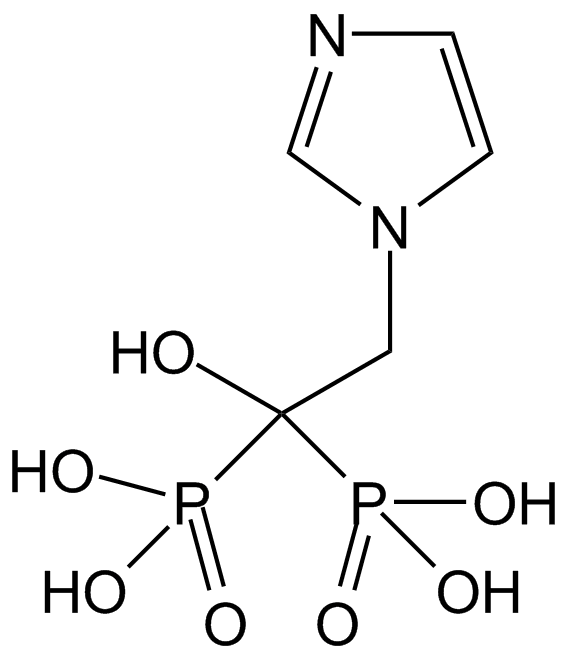
Cas No.: 118072-93-8
Sample solution is provided at 25 µL, 10mM.
_1-3.$$$39978408@51.jpg');)
_1-9.$$$38538795@65.jpg');)
_1-9.$$$39112701@51.jpg');)
_1-7.$$$37316672@70.jpg');)
_366-372.$$$36198801@70.jpg');)
.$$$38565142@65.jpg');)
_1867-1883.$$$33248023@67.jpg');)
_eads6055.$$$39977546@45.jpg');)
_eadm9805.$$$40080571@45.jpg');)
_eadj3020.$$$39666821@45.jpg');)
_1-20.$$$39757301@28.jpg');)
_1-24.$$$38898113@28.jpg');)
_273-287.$$$36806353@46.jpg');)
_1-16.$$$37156877@44.jpg');)
_1-19.$$$37460805@44.jpg');)
_1291-1307.$$$34518654@46.jpg');)
Zoledronic Acid is a third-generation nitrogen-containing bisphosphonate bone resorption inhibitor. Zoledronic Acid reduces bone calcium release and lowers blood calcium levels by inhibiting osteoclast activity and inducing osteoclast apoptosis. Zoledronic Acid blocks the mevalonate pathway by inhibiting farnesyl pyrophosphate synthase activity. Zoledronic Acid can be used in research related to osteoporosis, Paget's disease, bone metastases of malignant tumors, and hypercalcemia caused by malignant tumors[1-4].
In vitro, CT26 colon cancer cells were treated with Zoledronic Acid (0-300μM) for 24-48 hours. Zoledronic Acid inhibited cell proliferation, induced apoptosis, and regulated autophagy[5]. Under high glucose conditions, MC3T3-E1 cells were treated with Zoledronic Acid (1mM) for 7 days. Zoledronic Acid significantly upregulated the expression of RUNX2, miR-133, and miR-204, while downregulating the expression of MALAT1 and miR-20a[6].
In vivo, female Balb/c mice were subcutaneously injected with Zoledronic Acid (5μg/kg) every other day for 10 days. Zoledronic Acid prevented carboplatin-induced bone loss and muscle weakness[7]. Male C57BL/6J mice received a single subcutaneous injection of Zoledronic Acid (100μg/kg). Zoledronic Acid increased body weight and muscle mass, improved muscle structural damage, increased the proportion of type I muscle fibers, and upregulated the protein expression of β-catenin and AKT, as well as the mRNA expression of Wnt3a, Wnt16, Myf5, and PI3K[8].
References:
[1] Cheer SM, Noble S. Zoledronic acid. Drugs. 2001;61(6):799-805; discussion 806.
[2] Finianos A, Aragon-Ching JB. Zoledronic acid for the treatment of prostate cancer. Expert Opin Pharmacother. 2019 Apr;20(6):657-666.
[3] Karpuz S. Zoledronic acid-induced severe lymphopenia. Osteoporos Int. 2023 Sep;34(9):1653-1655.
[4] Ishikawa T. Differences between zoledronic acid and denosumab for breast cancer treatment. J Bone Miner Metab. 2023 May;41(3):301-306.
[5] Zhu J, Liu M, Liu Y, et al. Zoledronic Acid Regulates Autophagy and Induces Apoptosis in Colon Cancer Cell Line CT26. Biomed Res Int. 2017;2017:7203584.
[6] Chen HL, Hu JP, Li JF, et al. Zoledronic acid epigenetically alleviates high-glucose-suppressed osteogenic differentiation of MC3T3-E1 cells. Eur Rev Med Pharmacol Sci. 2023 Aug;27(16):7576-7581.
[7] Hain BA, Jude B, Xu H, et al. Zoledronic Acid Improves Muscle Function in Healthy Mice Treated with Chemotherapy. J Bone Miner Res. 2020 Feb;35(2):368-381.
[8] Li W, Xu M, Shi X, et al. Effect of zoledronic acid on muscle metabolism in mice with osteoporosis combined with sarcopenia. BMC Musculoskelet Disord. 2024 Nov 21;25(1):937.
| Cell experiment [1]: | |
Cell lines | CT26 colon cancer cells |
Preparation Method | CT26 cells were cultured in DMEM medium supplemented with 10% fetal bovine serum in 5% CO₂ at 37°C. CT26 cells were treated with various concentrations of Zoledronic Acid (0-300μM) for 24 hours for viability and apoptosis assays. For Western blot analysis, cells were treated with 200μM Zoledronic Acid for 12h, 24h, 36h, and 48h. |
Reaction Conditions | 0-300μM; 12-48h |
Applications | Zoledronic Acid inhibited CT26 cell proliferation and induced apoptosis in a dose-dependent manner. Treatment with 200μM Zoledronic Acid for 36h and 48h significantly increased the expression of cleaved caspase-3 and p-p53. Treatment with 200μM Zoledronic Acid for 24h, 36h, and 48h significantly increased the expression of p62 and regulated the expression of beclin-1. |
| Animal experiment [2]: | |
Animal models | Female Balb/c mice |
Preparation Method | Mice were administered carboplatin (100mg/kg; i.p.) once, with or without Zoledronic Acid (5μg/kg; s.c.) every other day for 10 days. Mice were euthanized 10 days after injection. |
Dosage form | 5μg/kg; s.c.; every other day for 10 days |
Applications | Zoledronic Acid prevented carboplatin-induced bone loss in the distal femur and proximal tibia. Zoledronic Acid prevented carboplatin-induced muscle weakness (improved forelimb grip strength and EDL specific force to control levels), but did not prevent loss of body weight or muscle mass. |
References: | |
| Cas No. | 118072-93-8 | SDF | |
| Chemical Name | (1-hydroxy-2-imidazol-1-yl-1-phosphonoethyl)phosphonic acid | ||
| Canonical SMILES | C1=CN(C=N1)CC(O)(P(=O)(O)O)P(=O)(O)O | ||
| Formula | C5H10N2O7P2 | M.Wt | 272.09 |
| Solubility | ≥ 6.8mg/mL in Water with gentle warming | Storage | Store at -20°C |
| General tips | Please select the appropriate solvent to prepare the stock solution according to the
solubility of the product in different solvents; once the solution is prepared, please store it in
separate packages to avoid product failure caused by repeated freezing and thawing.Storage method
and period of the stock solution: When stored at -80°C, please use it within 6 months; when stored
at -20°C, please use it within 1 month. To increase solubility, heat the tube to 37°C and then oscillate in an ultrasonic bath for some time. |
||
| Shipping Condition | Evaluation sample solution: shipped with blue ice. All other sizes available: with RT, or with Blue Ice upon request. | ||
| Prepare stock solution | |||

|
1 mg | 5 mg | 10 mg |
| 1 mM | 3.6753 mL | 18.3763 mL | 36.7525 mL |
| 5 mM | 735.1 μL | 3.6753 mL | 7.3505 mL |
| 10 mM | 367.5 μL | 1.8376 mL | 3.6753 mL |
Step 1: Enter information below (Recommended: An additional animal making an allowance for loss during the experiment)
 g
μL
g
μL
Step 2: Enter the in vivo formulation (This is only the calculator, not formulation. Please contact us first if there is no in vivo formulation at the solubility Section.)
Calculation results:
Working concentration: mg/ml;
Method for preparing DMSO master liquid: mg drug pre-dissolved in μL DMSO ( Master liquid concentration mg/mL, Please contact us first if the concentration exceeds the DMSO solubility of the batch of drug. )
Method for preparing in vivo formulation: Take μL DMSO master liquid, next addμL PEG300, mix and clarify, next addμL Tween 80, mix and clarify, next add μL saline, mix and clarify.
Method for preparing in vivo formulation: Take μL DMSO master liquid, next add μL Corn oil, mix and clarify.
Note: 1. Please make sure the liquid is clear before adding the next solvent.
2. Be sure to add the solvent(s) in order. You must ensure that the solution obtained, in the previous addition, is a clear solution before proceeding to add the next solvent. Physical methods such as vortex, ultrasound or hot water bath can be used to aid dissolving.
3. All of the above co-solvents are available for purchase on the GlpBio website.
Quality Control & SDS
- View current batch:
- Purity: >99.00% Appearance: A solid
- COA (Certificate of Analysis)
- SDS (Safety Data Sheet)
- Datasheet
Average Rating: 5 (Based on Reviews and 23 reference(s) in Google Scholar.)