

AMP PNP |
Catalog No.GC50334
 One-Click Copy Product Info
|

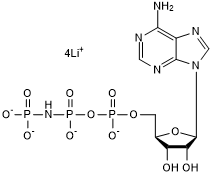
AMP PNP (adenylyl-imidodiphosphate) is a non-hydrolyzable analog of ATP.
Products are for research use only. Not for human use. We do not sell to patients.
Cas No.: 72957-42-7
Sample solution is provided at 25 µL, 10mM.
_1-3.$$$39978408@51.jpg');)
_1-9.$$$38538795@65.jpg');)
_1-9.$$$39112701@51.jpg');)
_1-7.$$$37316672@70.jpg');)
_366-372.$$$36198801@70.jpg');)
.$$$38565142@65.jpg');)
_1867-1883.$$$33248023@67.jpg');)
_eads6055.$$$39977546@45.jpg');)
_eadm9805.$$$40080571@45.jpg');)
_eadj3020.$$$39666821@45.jpg');)
_1-20.$$$39757301@28.jpg');)
_1-24.$$$38898113@28.jpg');)
_273-287.$$$36806353@46.jpg');)
_1-16.$$$37156877@44.jpg');)
_1-19.$$$37460805@44.jpg');)
_1291-1307.$$$34518654@46.jpg');)
AMP PNP (adenylyl-imidodiphosphate) is a non-hydrolyzable analog of ATP. AMP PNP can inhibit fast axonal transport and promote interactions between membranous organelles and microtubules [1]. AMP-PNP acts as a competitive inhibitor for most ATP-dependent systems, inhibiting a variety of ATP-hydrolyzing enzymes such as DNA topoisomerase II, SV40 large T antigen helicase, and several kinases. AMP PNP also blocks ATP-sensitive, calcium-dependent potassium channels [2-4]. AMP-PNP can be used for the preparation of nucleotide solutions [5], dual-polarization fluorescence detection, actin cytoskeleton preparation for flow cells [6], and cascade binding reactions [7]. However, AMP-PNP is highly unstable under acidic conditions and rapidly hydrolyzes into phosphamide and inorganic phosphate.
References:
[1]. Brady ST. A novel brain ATPase with properties expected for the fast axonal transport motor. Nature. 1985 Sep 5-11;317(6032):73-5. doi: 10.1038/317073a0. PMID: 2412134.
[2]. Hehl S, Neumcke B. KATP channels of mouse skeletal muscle: mechanism of channel blockage by AMP-PNP. Eur Biophys J. 1994;23(4):231-7. doi: 10.1007/BF00213573. PMID: 7805625.
[3]. Subramanian R, Gelles J. Two distinct modes of processive kinesin movement in mixtures of ATP and AMP-PNP. J Gen Physiol. 2007 Nov;130(5):445-55. doi: 10.1085/jgp.200709866. PMID: 17968024; PMCID: PMC2151671.
[4]. Lasek RJ, Brady ST. Attachment of transported vesicles to microtubules in axoplasm is facilitated by AMP-PNP. Nature. 1985 Aug 15-21;316(6029):645-7. doi: 10.1038/316645a0. PMID: 4033761.
[5]. Fendley GA, Urbatsch IL, et,al. Nucleotide dependence of the dimerization of ATP binding cassette nucleotide binding domains. Biochem Biophys Res Commun. 2016 Nov 11;480(2):268-272. doi: 10.1016/j.bbrc.2016.10.046. Epub 2016 Oct 17. PMID: 27765627.
[6]. DeBerg HA, Blehm BH, et,al. Motor domain phosphorylation modulates kinesin-1 transport. J Biol Chem. 2013 Nov 8;288(45):32612-32621. doi: 10.1074/jbc.M113.515510. Epub 2013 Sep 26. PMID: 24072715; PMCID: PMC3820893.
[7]. Jung C, Hawkins JA, et,al. Massively Parallel Biophysical Analysis of CRISPR-Cas Complexes on Next Generation Sequencing Chips. Cell. 2017 Jun 29;170(1):35-47.e13. doi: 10.1016/j.cell.2017.05.044. PMID: 28666121; PMCID: PMC5552236.
| Cas No. | 72957-42-7 | SDF | |
| Canonical SMILES | NC1=C2C(N([C@@H]3O[C@H](COP(OP(NP([O-])([O-])=O)([O-])=O)([O-])=O)[C@@H](O)[C@H]3O)C=N2)=NC=N1.[Li+].[Li+].[Li+].[Li+] | ||
| Formula | C10H13Li4N6O12P3 | M.Wt | 529.93 |
| Solubility | 26.5mg/ml in water | Storage | Store at -20°C |
| General tips | Please select the appropriate solvent to prepare the stock solution according to the
solubility of the product in different solvents; once the solution is prepared, please store it in
separate packages to avoid product failure caused by repeated freezing and thawing.Storage method
and period of the stock solution: When stored at -80°C, please use it within 6 months; when stored
at -20°C, please use it within 1 month. To increase solubility, heat the tube to 37°C and then oscillate in an ultrasonic bath for some time. |
||
| Shipping Condition | Evaluation sample solution: shipped with blue ice. All other sizes available: with RT, or with Blue Ice upon request. | ||
| Prepare stock solution | |||

|
1 mg | 5 mg | 10 mg |
| 1 mM | 1.887 mL | 9.4352 mL | 18.8704 mL |
| 5 mM | 377.4 μL | 1.887 mL | 3.7741 mL |
| 10 mM | 188.7 μL | 943.5 μL | 1.887 mL |
Step 1: Enter information below (Recommended: An additional animal making an allowance for loss during the experiment)
 g
μL
g
μL
Step 2: Enter the in vivo formulation (This is only the calculator, not formulation. Please contact us first if there is no in vivo formulation at the solubility Section.)
Calculation results:
Working concentration: mg/ml;
Method for preparing DMSO master liquid: mg drug pre-dissolved in μL DMSO ( Master liquid concentration mg/mL, Please contact us first if the concentration exceeds the DMSO solubility of the batch of drug. )
Method for preparing in vivo formulation: Take μL DMSO master liquid, next addμL PEG300, mix and clarify, next addμL Tween 80, mix and clarify, next add μL saline, mix and clarify.
Method for preparing in vivo formulation: Take μL DMSO master liquid, next add μL Corn oil, mix and clarify.
Note: 1. Please make sure the liquid is clear before adding the next solvent.
2. Be sure to add the solvent(s) in order. You must ensure that the solution obtained, in the previous addition, is a clear solution before proceeding to add the next solvent. Physical methods such as vortex, ultrasound or hot water bath can be used to aid dissolving.
3. All of the above co-solvents are available for purchase on the GlpBio website.
Quality Control & SDS
- View current batch:
- Purity: >90.00% Appearance: A solid
- COA (Certificate of Analysis)
- SDS (Safety Data Sheet)
- Datasheet
Average Rating: 5 (Based on Reviews and 34 reference(s) in Google Scholar.)