

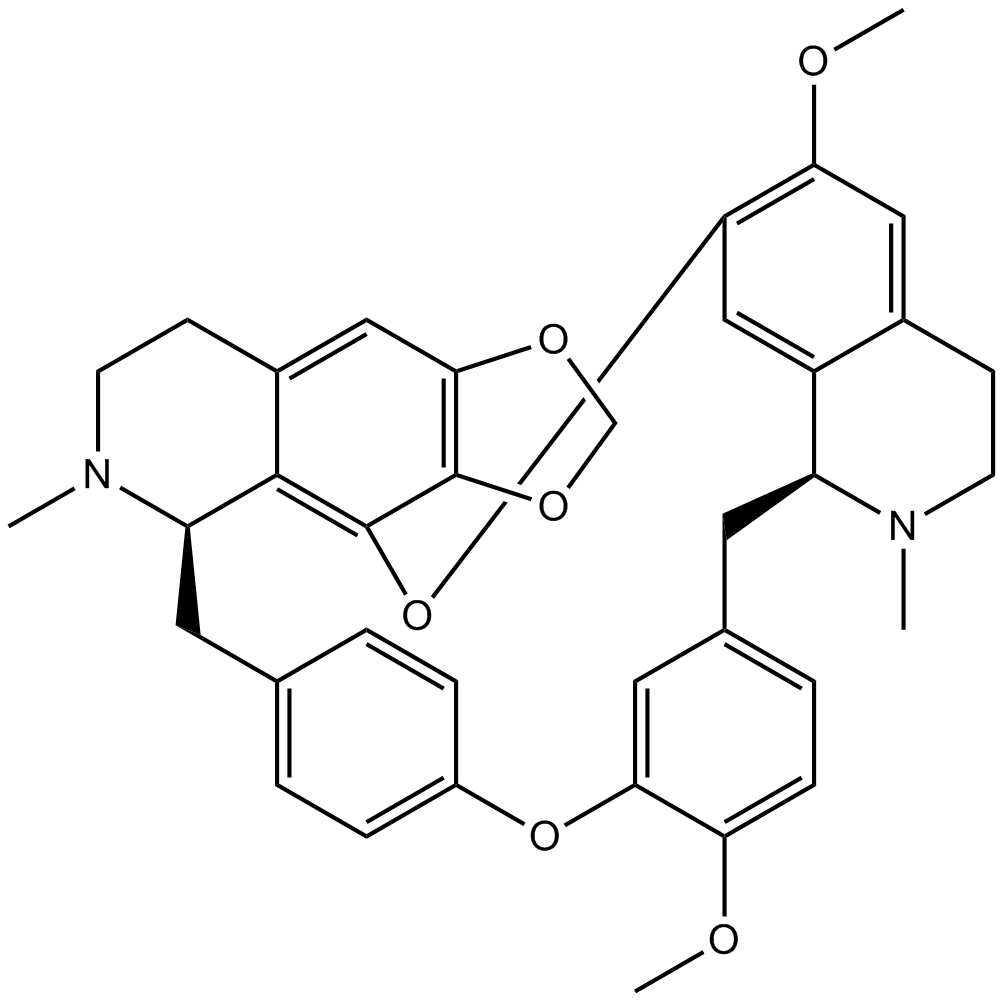
Cepharanthine (Synonyms: O-Methylcepharanoline, NSC 623442) |
Catalog No.GN10113
 One-Click Copy Product Info
|

Cepharanthine, a bisbenzylisoquinoline alkaloid, has potent antiviral activity with the EC50 values of 0.15µM and 0.026µM for SARS-CoV-2 and HIV-1, respectively.
Products are for research use only. Not for human use. We do not sell to patients.
Cas No.: 481-49-2
Sample solution is provided at 25 µL, 10mM.
_1-3.$$$39978408@51.jpg');)
_1-9.$$$38538795@65.jpg');)
_1-9.$$$39112701@51.jpg');)
_1-7.$$$37316672@70.jpg');)
_366-372.$$$36198801@70.jpg');)
.$$$38565142@65.jpg');)
_1867-1883.$$$33248023@67.jpg');)
_eads6055.$$$39977546@45.jpg');)
_eadm9805.$$$40080571@45.jpg');)
_eadj3020.$$$39666821@45.jpg');)
_1-20.$$$39757301@28.jpg');)
_1-24.$$$38898113@28.jpg');)
_273-287.$$$36806353@46.jpg');)
_1-16.$$$37156877@44.jpg');)
_1-19.$$$37460805@44.jpg');)
_1291-1307.$$$34518654@46.jpg');)
Cepharanthine, a bisbenzylisoquinoline alkaloid, has potent antiviral activity with the EC50 values of 0.15µM and 0.026µM for SARS-CoV-2 and HIV-1, respectively[1]. Cepharanthine effectively reversed most of the dysregulated genes and pathways in virus-infected cells, including endoplasmic reticulum (ER) stress/unfolded protein response and heat shock factor 1 (HSF1)-mediated heat shock response[2]. Cepharanthine has been widely used as an anti-inflammatory agent to reduce the levels of TNF-α, IL-1β and IL-6 in cellular and animal models[3].
In vitro, Cepharanthine treatment for 48 hours significantly inhibited the proliferation of Eca109 cells with an IC50 value of 6.20 ± 0.17μM[4]. Treatment with 20μM Cepharanthine for 24 hours significantly inhibited the viability of HT1376 cells, reduced the migration and invasion of cells, and activated the Rap1 signaling pathway in the cells[5]. Pretreatment with 10μM Cepharanthine for 1h significantly inhibited lipopolysaccharide-induced NO production and iNOS and COX-2 expression in RAW264.7 cells[6].
In vivo, Cepharanthine (20mg/kg) administered intraperitoneally once every two days for 24 days significantly suppressed tumor weight and volume in a mouse model of hepatocellular carcinoma and reduced Ki67 expression in tumor tissues[7]. Cepharanthine treatment at a dose of 15mg/kg once weekly via intraperitoneal injection for 12 weeks significantly ameliorated cartilage degeneration and prevented osteoarthritis (OA) in a mouse OA model[8].
References:
[1] Liu K, Hong B, Wang S, et al. Pharmacological activity of cepharanthine[J]. Molecules, 2023, 28(13): 5019.
[2] Shi L, Wang S, Zhang S, et al. Research progress on pharmacological effects and mechanisms of cepharanthine and its derivatives[J]. Naunyn-Schmiedeberg's Archives of Pharmacology, 2023, 396(11): 2843-2860.
[3] Liang D, Li Q, Du L, et al. Pharmacological effects and clinical prospects of cepharanthine[J]. Molecules, 2022, 27(24): 8933.
[4] Zhou P, Zhang R, Wang Y, et al. Cepharanthine hydrochloride reverses the mdr1 (P-glycoprotein)-mediated esophageal squamous cell carcinoma cell cisplatin resistance through JNK and p53 signals[J]. Oncotarget, 2017, 8(67): 111144.
[5] Chen B, Chen L, Yang J, et al. Cepharanthine inhibits migration, invasion, and EMT of bladder cancer cells by activating the Rap1 signaling pathway in vitro[J]. American journal of translational research, 2024, 16(5): 1602.
[6] Paudel K R, Karki R, Kim D W. Cepharanthine inhibits in vitro VSMC proliferation and migration and vascular inflammatory responses mediated by RAW264. 7[J]. Toxicology in vitro, 2016, 34: 16-25.
[7] Feng F, Pan L, Wu J, et al. Cepharanthine inhibits hepatocellular carcinoma cell growth and proliferation by regulating amino acid metabolism and suppresses tumorigenesis in vivo[J]. International journal of biological sciences, 2021, 17(15): 4340.
[8] Yao M, Zhang C, Ni L, et al. Cepharanthine ameliorates chondrocytic inflammation and osteoarthritis via regulating the MAPK/NF-κB-Autophagy pathway[J]. Frontiers in Pharmacology, 2022, 13: 854239.
| Cell experiment [1]: | |
|
Cell lines |
HT1376 cells |
|
Preparation Method |
HT1376 cells were cultured in Roswell Park Memorial Institute-1640 medium supplemented with 10% fetal bovine serum (FBS) from a Chinese company and 1% antibiotics containing 100U/mL penicillin G and 100μg/mL streptomycin. Subsequently, cells were cultured under specific conditions maintained at 37°C, 5% CO2, and 70% to 80% humidity. HT1376 cells were seeded in 96-well plates at a density of 5000 cells per well. After cell attachment, cells were treated with different concentrations (0, 5, 10, 15, 20, 25, and 30μM) of Cepharanthine (dissolved in dimethyl sulfoxide) for 24h. After washing with PBS, the cells were treated with CCK-8 reagent and incubated with complete medium for 2h at 37°C to determine the absorbance at 450nm. |
|
Reaction Conditions |
0, 5, 10, 15, 20, 25, and 30μM; 24h |
|
Applications |
Cepharanthine treatment reduced the cell viability of HT1376 cells in a concentration-dependent manner. |
| Animal experiment [2]: | |
|
Animal models |
Female nude mice |
|
Preparation Method |
Twenty female nude mice were maintained under standard conditions, and each nude mouse was subcutaneously injected with 2×10⁶ Hep3B cells in the right axilla. When the tumor diameter was between 5-8mm, the mice were randomly divided into control group, a positive control group (cisplatin; 5mg/kg), and treatment group (Cepharanthine; 20mg/kg), with 5 mice in each group. The drug was injected intraperitoneally every 2 days, and the longest (L) and longitudinal (R) axes of the tumor were recorded. The tumor volume (V) was calculated according to the following formula: V=0.5×L×R2. After 24 days of treatment, the nude mice were sacrificed, and tumor tissues were collected and fixed overnight in 4% paraformaldehyde for subsequent immunohistochemical experiments. |
|
Dosage form |
20mg/kg every two days for 24 days; i.p. |
|
Applications |
Cepharanthine treatment significantly inhibited tumor weight and volume in mice, and decreased Ki67 expression in tumor tissues. |
|
References: |
|
| Cas No. | 481-49-2 | SDF | |
| Synonyms | O-Methylcepharanoline, NSC 623442 | ||
| Canonical SMILES | CN1CCC2=CC3=C(C4=C2C1CC5=CC=C(C=C5)OC6=C(C=CC(=C6)CC7C8=CC(=C(C=C8CCN7C)OC)O4)OC)OCO3 | ||
| Formula | C37H38N2O6 | M.Wt | 606.71 |
| Solubility | ≥ 21.9mg/mL in DMSO | Storage | Store at -20°C |
| General tips | Please select the appropriate solvent to prepare the stock solution according to the
solubility of the product in different solvents; once the solution is prepared, please store it in
separate packages to avoid product failure caused by repeated freezing and thawing.Storage method
and period of the stock solution: When stored at -80°C, please use it within 6 months; when stored
at -20°C, please use it within 1 month. To increase solubility, heat the tube to 37°C and then oscillate in an ultrasonic bath for some time. |
||
| Shipping Condition | Evaluation sample solution: shipped with blue ice. All other sizes available: with RT, or with Blue Ice upon request. | ||
| Prepare stock solution | |||

|
1 mg | 5 mg | 10 mg |
| 1 mM | 1.6482 mL | 8.2412 mL | 16.4823 mL |
| 5 mM | 329.6 μL | 1.6482 mL | 3.2965 mL |
| 10 mM | 164.8 μL | 824.1 μL | 1.6482 mL |
Step 1: Enter information below (Recommended: An additional animal making an allowance for loss during the experiment)
 g
μL
g
μL
Step 2: Enter the in vivo formulation (This is only the calculator, not formulation. Please contact us first if there is no in vivo formulation at the solubility Section.)
Calculation results:
Working concentration: mg/ml;
Method for preparing DMSO master liquid: mg drug pre-dissolved in μL DMSO ( Master liquid concentration mg/mL, Please contact us first if the concentration exceeds the DMSO solubility of the batch of drug. )
Method for preparing in vivo formulation: Take μL DMSO master liquid, next addμL PEG300, mix and clarify, next addμL Tween 80, mix and clarify, next add μL saline, mix and clarify.
Method for preparing in vivo formulation: Take μL DMSO master liquid, next add μL Corn oil, mix and clarify.
Note: 1. Please make sure the liquid is clear before adding the next solvent.
2. Be sure to add the solvent(s) in order. You must ensure that the solution obtained, in the previous addition, is a clear solution before proceeding to add the next solvent. Physical methods such as vortex, ultrasound or hot water bath can be used to aid dissolving.
3. All of the above co-solvents are available for purchase on the GlpBio website.
Quality Control & SDS
- View current batch:
- Purity: >98.00% Appearance: A solid
- COA (Certificate of Analysis)
- SDS (Safety Data Sheet)
- Datasheet
Average Rating: 5 (Based on Reviews and 30 reference(s) in Google Scholar.)