

Cortagine |
Catalog No.GC50455
 One-Click Copy Product Info
|

Cortagine is a kind of corticotropin-releasing factor receptor subtype 1 (CRF1) peptidic agonist, with an IC50 of 2.6nM and an EC50 of 0.47nM for rCRF1.
Products are for research use only. Not for human use. We do not sell to patients.
Sample solution is provided at 25 µL, 10mM.
_1-3.$$$39978408@51.jpg');)
_1-9.$$$38538795@65.jpg');)
_1-9.$$$39112701@51.jpg');)
_1-7.$$$37316672@70.jpg');)
_366-372.$$$36198801@70.jpg');)
.$$$38565142@65.jpg');)
_1867-1883.$$$33248023@67.jpg');)
_eads6055.$$$39977546@45.jpg');)
_eadm9805.$$$40080571@45.jpg');)
_eadj3020.$$$39666821@45.jpg');)
_1-20.$$$39757301@28.jpg');)
_1-24.$$$38898113@28.jpg');)
_273-287.$$$36806353@46.jpg');)
_1-16.$$$37156877@44.jpg');)
_1-19.$$$37460805@44.jpg');)
_1291-1307.$$$34518654@46.jpg');)
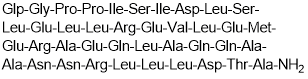
Cortagine is a kind of corticotropin-releasing factor receptor subtype 1 (CRF1) peptidic agonist, with an IC50 of 2.6nM and an EC50 of 0.47nM for rCRF1 [1]. Cortagine has a high selectivity with strong affinity for CRF1 and a very low binding preference for CRF2 [2]. The preclinical models of behavior shows that Cortagine elicits anxiogenic and antidepressant-like effects [2].
Cortagine (0.1nM~1μM; 30min) induced a concentration-dependent cAMP increase in BON-1N cells [3].
Cortagine (30, 100, 300ng; i.c.v.) increased anxiety-like behavior and reduced locomotor activity in C57BL/6J mice [1]. Cortagine (3, 6, and 10μg/kg; i.p.) induced a dose-related increase in fecal pellet output in conscious Sprague-Dawley rats [4].
References:
[1] Tezval H, Jahn O, Todorovic C, et al. Cortagine, a specific agonist of corticotropin-releasing factor receptor subtype 1, is anxiogenic and antidepressive in the mouse model [J]. Proceedings of the National Academy of Sciences of the United States of America, 2004, 101(25): 9468-9473.
[2] Farrokhi C B, Tovote P, Blanchard R J, et al. Cortagine: behavioral and autonomic function of the selective CRF receptor subtype 1 agonist [J]. CNS drug reviews, 2007, 13(4): 423-443.
[3] Wu S V, Yuan P Q, Lai J, et al. Activation of Type 1 CRH receptor isoforms induces serotonin release from human carcinoid BON-1N cells: an enterochromaffin cell model [J]. Endocrinology, 2011, 152(1): 126-137.
[4] Larauche M, Gourcerol G, Wang L, et al. Cortagine, a CRF1 agonist, induces stresslike alterations of colonic function and visceral hypersensitivity in rodents primarily through peripheral pathways [J]. American journal of physiology Gastrointestinal and liver physiology, 2009, 297(1): 215-227.
| Cell experiment [1]: | |
Cell lines | BON-1N cells |
Preparation Method | BON-1N cells (5×10⁵) grown in 12-well plates were treated with increasing concentrations of Cortagine (0.1nM~1μM ) for 30min in the presence of 3-isobutyl-1-methyl-xanthine (1mM). Intracellular cAMP content of cell extracts was measured using a calibrated standard in an EIA kit. |
Reaction Conditions | 0.1nM~1μM; 30min |
Applications | Cortagine induced a concentration-dependent cAMP increase. |
| Animal experiment [2]: | |
Animal models | Sprague-Dawley rats |
Preparation Method | The conscious rats were injected with vehicle or Cortagine at 3, 6, 10μg/kg. Fecal pellet output (FPO) was monitored every 15min for 1h after the treatments. |
Dosage form | 3, 6, and 10μg/kg; i.p. |
Applications | Cortagine induced a dose-related increase in pellet output per hour. |
References: | |
| Cas No. | SDF | ||
| Formula | C192H323N55O63S | M.Wt | 4442.06 |
| Solubility | Soluble in DMSO | Storage | Store at -20°C |
| General tips | Please select the appropriate solvent to prepare the stock solution according to the
solubility of the product in different solvents; once the solution is prepared, please store it in
separate packages to avoid product failure caused by repeated freezing and thawing.Storage method
and period of the stock solution: When stored at -80°C, please use it within 6 months; when stored
at -20°C, please use it within 1 month. To increase solubility, heat the tube to 37°C and then oscillate in an ultrasonic bath for some time. |
||
| Shipping Condition | Evaluation sample solution: shipped with blue ice. All other sizes available: with RT, or with Blue Ice upon request. | ||
| Prepare stock solution | |||

|
1 mg | 5 mg | 10 mg |
| 1 mM | 225.1 μL | 1.1256 mL | 2.2512 mL |
| 5 mM | 45 μL | 225.1 μL | 450.2 μL |
| 10 mM | 22.5 μL | 112.6 μL | 225.1 μL |
Step 1: Enter information below (Recommended: An additional animal making an allowance for loss during the experiment)
 g
μL
g
μL
Step 2: Enter the in vivo formulation (This is only the calculator, not formulation. Please contact us first if there is no in vivo formulation at the solubility Section.)
Calculation results:
Working concentration: mg/ml;
Method for preparing DMSO master liquid: mg drug pre-dissolved in μL DMSO ( Master liquid concentration mg/mL, Please contact us first if the concentration exceeds the DMSO solubility of the batch of drug. )
Method for preparing in vivo formulation: Take μL DMSO master liquid, next addμL PEG300, mix and clarify, next addμL Tween 80, mix and clarify, next add μL saline, mix and clarify.
Method for preparing in vivo formulation: Take μL DMSO master liquid, next add μL Corn oil, mix and clarify.
Note: 1. Please make sure the liquid is clear before adding the next solvent.
2. Be sure to add the solvent(s) in order. You must ensure that the solution obtained, in the previous addition, is a clear solution before proceeding to add the next solvent. Physical methods such as vortex, ultrasound or hot water bath can be used to aid dissolving.
3. All of the above co-solvents are available for purchase on the GlpBio website.
Quality Control & SDS
- View current batch:
- Purity: >98.00% Appearance: A solid
- COA (Certificate of Analysis)
- SDS (Safety Data Sheet)
- Datasheet
Average Rating: 5 (Based on Reviews and 28 reference(s) in Google Scholar.)